
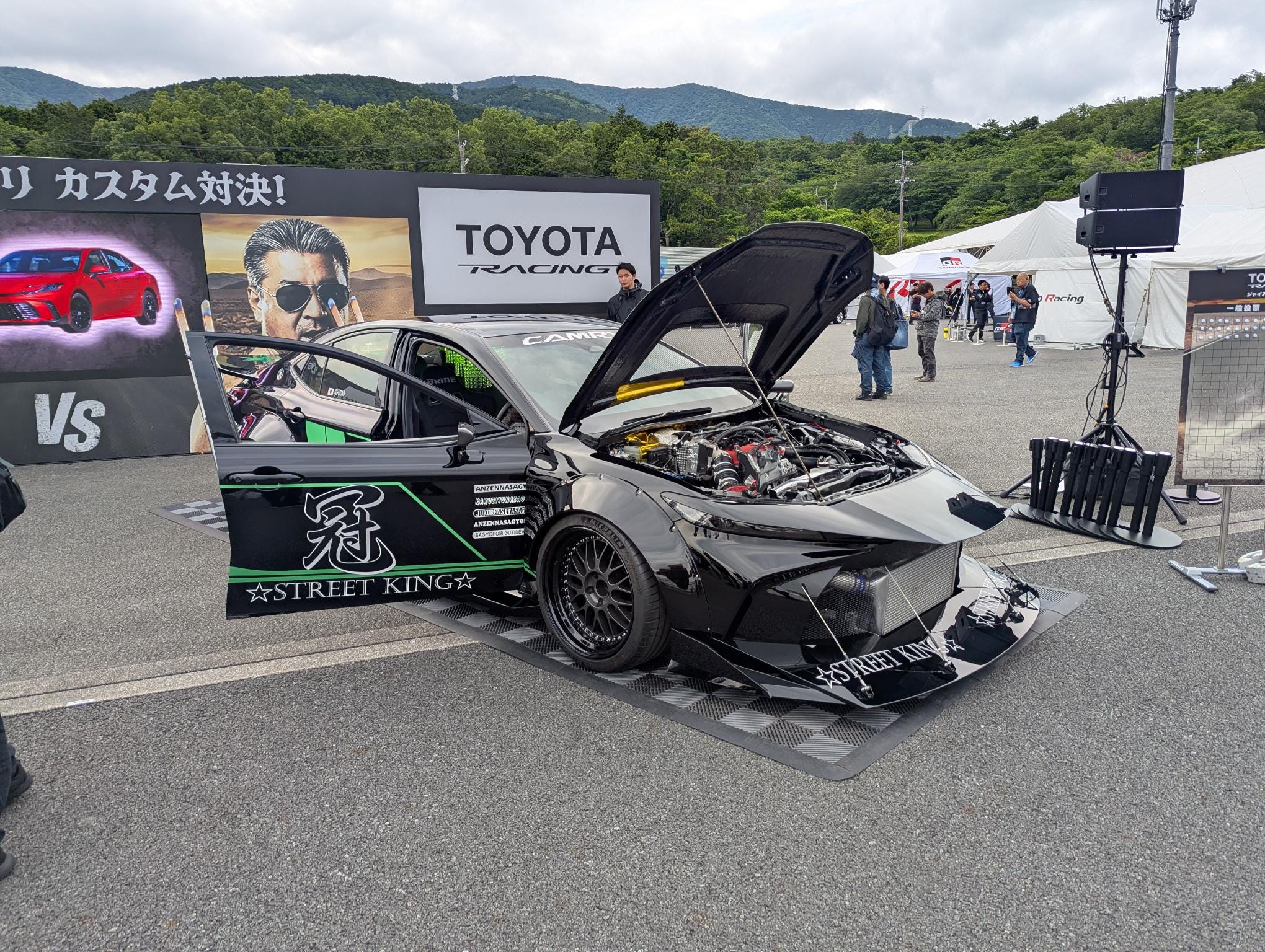


A second engine in the trunk. A chandelier in the back seat. Exhaust pipes reaching for the sky like smokestacks on a river barge. This is what happens when Akio Toyoda tells two of his racing divisions to have a project-car showdown using the most vanilla sedan on the planet.
Toyota unveiled two radically modified Camrys at Fuji Speedway ahead of the 24-hour Super Taikyu Race, each built by rival internal teams — Gazoo Racing and Toyota Racing — as the finale of a three-part build competition. The occasion: drumming up excitement for the American-built Camry’s eventual entry into the Japanese domestic market. The method: pure, unapologetic absurdity.
Gazoo Racing brought a white Camry with overfenders, a massive rear wing, a side-exit exhaust borrowed from NASCAR thinking, and the headliner — a second engine stuffed into the trunk to create an improvised all-wheel-drive system. The team reportedly pulled an all-nighter just to get it running in time for the engine-rev competition. Car and Driver’s Austin Irwin got behind the wheel and pinned the tachometer, producing enough noise to overpower a J-Pop group performing just feet away.
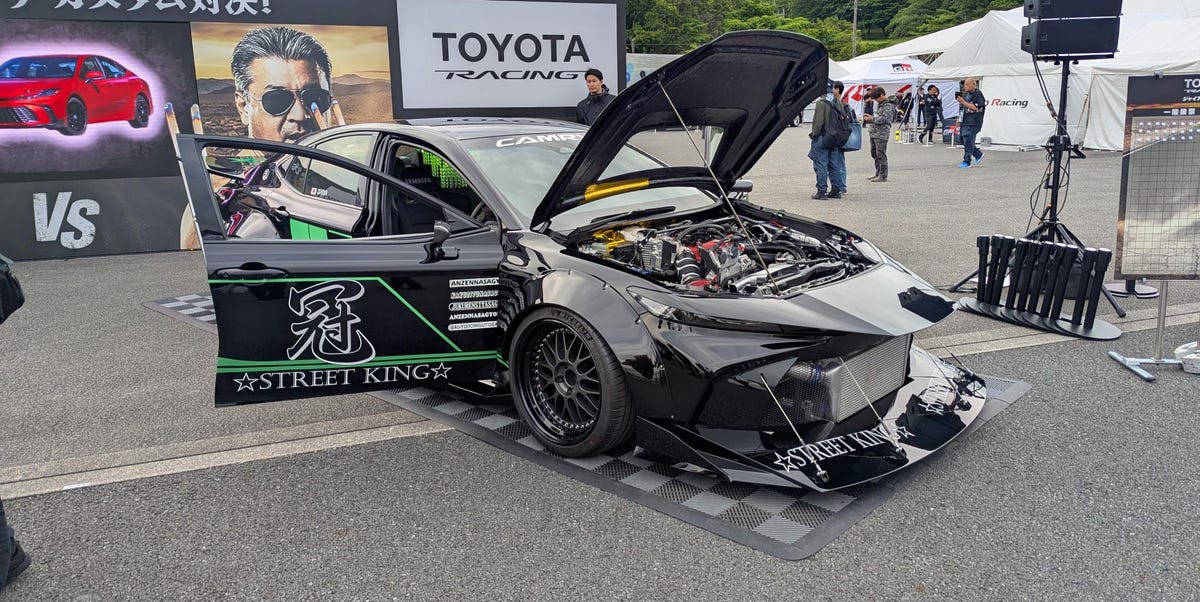
Toyota Racing took a different route entirely. Their black Camry channels bōsōzoku style, the aesthetic born from Japan’s outlaw motorcycle gangs of the 1950s, but with a Kentucky whiskey twist — a nod to the Camry’s Georgetown, Kentucky assembly plant. Stretched tires, a sharknose front bumper that looks like it wants to eat you, and exhaust tips angled upward toward Mount Fuji.
Inside, a retro 1980s digital gauge cluster, a glass shift knob with a fake ice cube trapped inside like a highball garnish, and yes, a chandelier mounted in the front seat area. They also swapped the steering to right-hand drive and dropped in the turbocharged three-cylinder from the GR Yaris. The speedometer read 158 km/h while the car sat in park, which tells you everything about the build’s priorities.
Toyota was emphatic that neither car represents a future trim level, a dealership accessory package, or any kind of mid-cycle refresh. These are one-off builds, nothing more. The company practically begged journalists to make that clear, which is both understandable and a little disappointing.
Fans at Fuji Speedway voted on a winner, but the real story is what these builds say about Toyota’s relationship with its own most boring product. The Camry has sold more than 400,000 units annually in the U.S. for years precisely because it asks nothing of its driver. It is appliance-grade transportation, reliable as gravity, exciting as drywall.
And yet here is Toyoda — the man who drove his own company’s Le Mans car, who created the entire GR performance sub-brand because he thought Toyota had lost its soul — using the Camry as a canvas for two teams to prove they still know how to have fun. The competition format, the overnight wrenching, the ridiculous details like a whiskey-themed interior — none of it will ever reach a showroom floor. That’s the point.
These cars exist to remind people that the engineers building your commuter sedan are capable of far more than they’re allowed to deliver. Whether this translates into any real enthusiasm for the Camry in Japan remains to be seen. The JDM market hasn’t had the Camry for years, and Japanese buyers tend to favor kei cars and minivans over midsize sedans.
A chandelier and a second engine won’t change purchasing habits, but they make for a hell of a story at Fuji Speedway. Sometimes the best thing a car company can do is remind everyone it hasn’t forgotten how to play.
Share this Story