
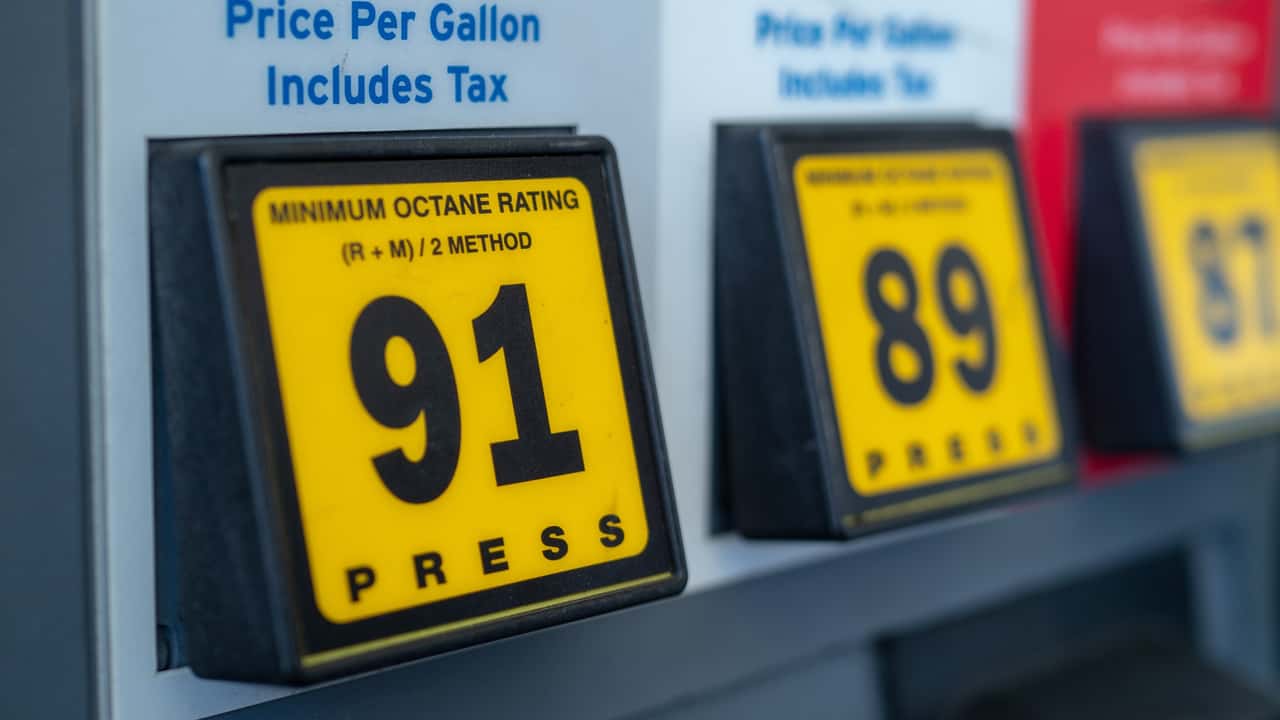


Three buttons. Two tanks. One trick that’s been hiding in plain sight at every gas station in America for decades.
Most drivers assume each octane grade on the pump corresponds to its own underground storage tank. Regular in one, midgrade in another, premium in a third. It’s a logical assumption, and it’s wrong.
The vast majority of gas stations store only two types of gasoline underground: regular and premium. That middle option, 89 octane, doesn’t sit in a tank at all. It’s mixed on the spot inside the dispenser the instant you press the button, and it didn’t exist as a product until a few seconds before it hit your fuel tank.
The mechanics are straightforward. Press 87, and the pump draws from the regular tank. Press 91 or 93, and it pulls from the premium tank.
Press 89, and a computerized blending system draws from both tanks at once, metering precise amounts of each fuel before combining them into a single stream flowing through the nozzle. Service technicians who crack open a fuel dispenser typically find two fuel lines inside, not three.
The reason is economics, not deception. Installing an underground fuel tank is a six-figure headache involving excavation, environmental compliance, leak monitoring equipment, and ongoing maintenance. Midgrade gasoline accounts for a sliver of total fuel sales, so dedicating an entire tank to it would be like building a third garage bay for a car you drive twice a month.
Blending solves the problem cleanly. Stations stock the two products customers actually buy in volume, and the pump creates the third on demand. Operators monitor two tank levels instead of three, manage two fuel deliveries instead of three, and still offer customers the full menu.
The natural question is whether blended midgrade is somehow inferior to fuel that arrives at the station pre-mixed. It isn’t. Dispensers use metering systems accurate enough to satisfy state Weights and Measures inspectors, who routinely test pumps for both volume accuracy and octane compliance.
Any unit outside acceptable tolerances gets pulled from service until it’s recalibrated. So no, you’re not getting ripped off.
Octane itself is widely misunderstood. It’s not a quality score or an energy measurement. It’s a rating of gasoline’s resistance to pre-ignition, the uncontrolled combustion that causes engine knock.
A properly blended 89 octane performs identically to a pre-mixed 89 octane because the chemistry is the same regardless of when the mixing happened. The molecules don’t care whether they met in a tanker truck or inside a pump housing.
This setup has been standard practice across the fuel industry for years. It’s not a shortcut employed by budget brands or a corner being cut by independent operators. Major fuel companies, branded stations, and independents alike use blending dispensers, and finding a station with a dedicated midgrade tank is the exception.
There’s a quiet lesson buried in this bit of infrastructure trivia. The fuel industry figured out decades ago that the most efficient solution isn’t always the most obvious one. Three tanks for three products seems intuitive, but two tanks and a computer doing math in real time delivers the same result at lower cost with less environmental risk.
Next time you stand at the pump staring at those three buttons, know that two of them are telling you the truth about where your gas comes from. The third is telling you what it becomes on its way out.



Share this Story