
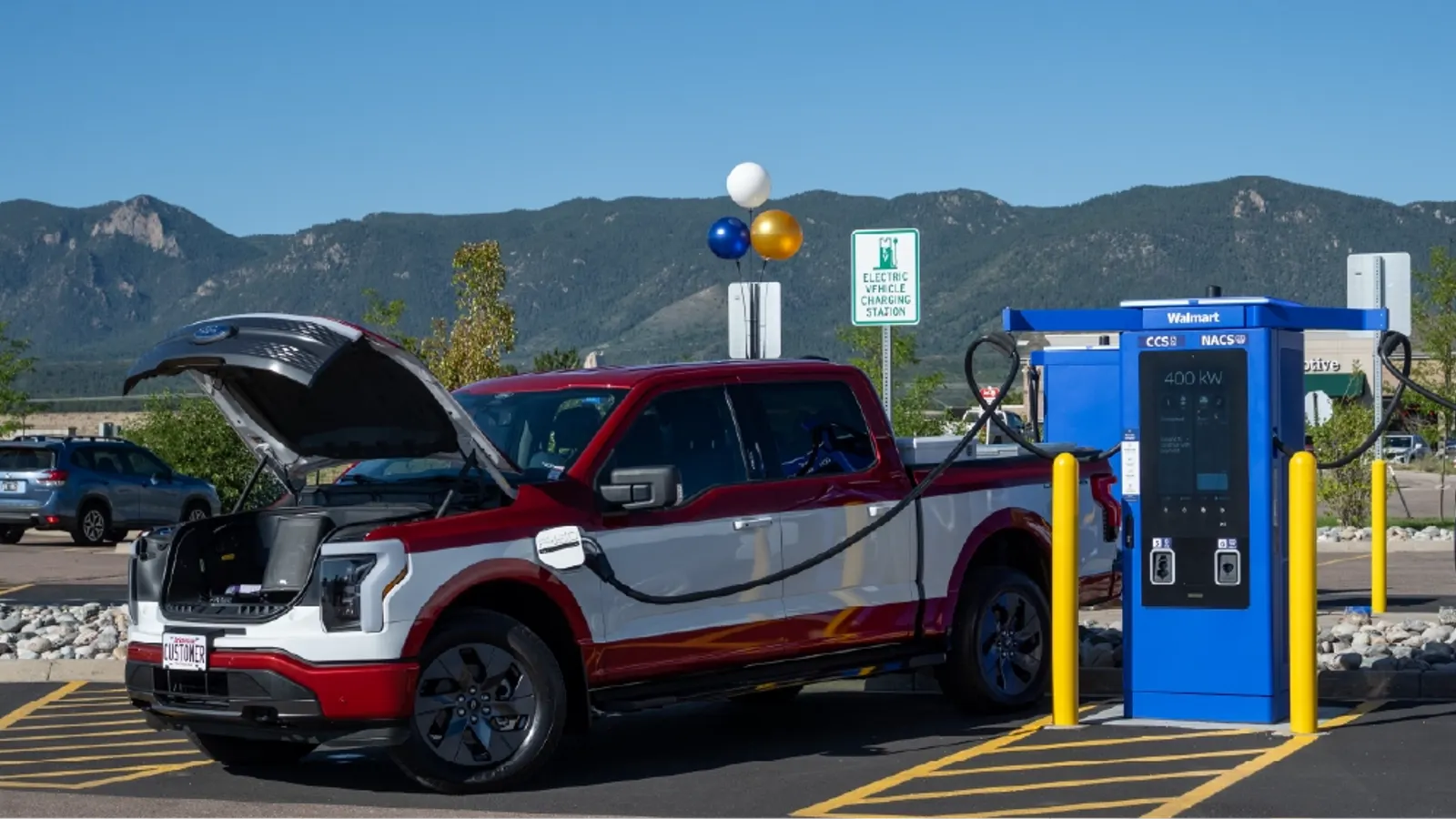


Walmart planted its 100th company-owned EV fast-charging station at a Supercenter in Monument, Colorado, stretching its self-branded network across 20 states. The milestone sounds impressive until you realize there are already more Walmart parking lots hosting Electrify America chargers than Walmart’s own. That awkward math tells the real story of the retail giant’s charging ambitions: big plans, deliberate pace.
The company confirmed its charging network goals back in 2023, targeting thousands of Walmart and Sam’s Club locations by 2030. The first branded station didn’t go live until April 2025. Sixteen months later, 100 sites is progress, but it’s not exactly a land grab.
Each location typically features 8 to 16 stalls equipped with both CCS and NACS connectors capable of delivering up to 400 kW. The specs are competitive with anything Tesla or Ionna is deploying. Walmart says the stations are designed to feel “as reliable and effortless as the rest of their shopping trip,” according to Adam Happel, General Manager of Walmart Retail EV Charging.
Reliability claims are easy to make, and the charging industry is littered with them. What Walmart does have going for it is foot traffic. The company likes to remind people that roughly 90% of Americans live within 10 miles of a Walmart or Sam’s Club, an infrastructure advantage no charging startup can match if the retailer ever decides to move faster.
For now, though, it’s being outrun by Ionna, the automaker-backed network that barely existed in 2024. Ionna topped 120 locations by July and recently beat Tesla’s Supercharger network in a customer satisfaction study. Backed by BMW, GM, Honda, Hyundai, Kia, Mercedes-Benz, Stellantis, and Toyota, Ionna has both the capital and the motivation to build quickly.
The payment structure reinforces just how tightly Walmart is tying charging to its core retail business. Charging sessions are initiated through the Walmart app, and Walmart+ members get discounted rates. Other payment options are coming, the company says, but the initial approach is clearly designed to keep existing customers in the ecosystem rather than attract the broader EV driving public.
That’s a fundamentally different play than what Ionna or Tesla is running. Those networks want every EV driver, period. Walmart wants the ones already buying groceries.
Costco is thinking along similar lines, having started rolling out its own branded charging in 2024 through partnerships with providers like Electric Era. The two biggest box retailers in America are betting that the weekly shopping trip is the natural moment for a fast charge. They might be right, but neither is building at the scale needed to become a true national network anytime soon.
Walmart says it will keep expanding into markets where customers need greater access to convenient, dependable fast charging, working closely with local utilities. The language is careful, almost cautious. No hard numbers, no timeline updates against that 2030 goal, no indication of how many stations might open in the next twelve months.
At 100 locations across a country with more than 4,600 Supercenters, the parking lots are still mostly empty of Walmart-branded chargers. The question is whether the company treats this as a slow strategic rollout or whether it simply hasn’t figured out how fast it needs to move.
Share this Story