
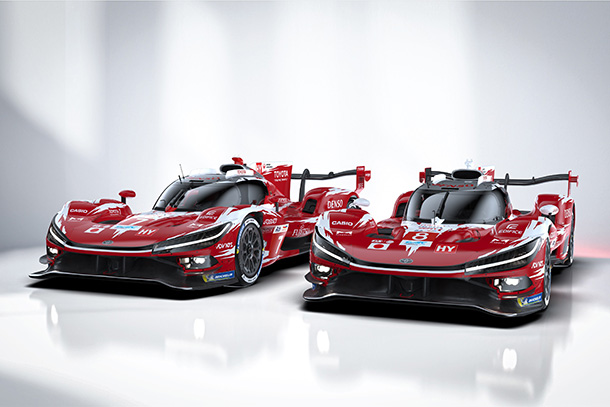


Toyota is calling its 2026 Le Mans campaign “For the Engineering Race,” a slogan so polished it practically squeaks. But strip away the branding exercise and what you find is a team that has won this race five times, fallen short in recent editions, and built an entirely new car to close the gap.
The TR010 Hybrid will see the Circuit de la Sarthe for the very first time when it rolls out for the test day on June 7. That alone is noteworthy. Toyota is bringing a machine with exactly one race win and one middling result to the most punishing endurance event on the calendar, a 13.626-kilometer circuit that eats reliability for breakfast.
The numbers frame the challenge. Eighteen Hypercars from eight manufacturers will line up on a 62-car grid in front of more than 300,000 spectators. This is the deepest, most competitive Hypercar field Le Mans has ever assembled.
Five-time winners or not, Toyota is one of many serious contenders, not the dominant force it once was.
The car itself is built around a 3.5-liter twin-turbo V6 hybrid powertrain producing north of 700 PS, running on 100% renewable racing fuel, and developed at Toyota’s Higashi-Fuji technical center. Aerodynamic updates distinguish the TR010 from its predecessor. At Imola in April, the #8 car of Sébastien Buemi, Brendon Hartley, and Ryō Hirakawa won on its debut.
Spa in May was a reality check — both cars scrapped for points without reaching the podium. That two-race sample size is all Toyota has before the biggest event of the year.
Brendon Hartley put it plainly: “We have been close in the last few years but have fallen short.” There is no spin in that sentence. Toyota’s Le Mans record since its dominant 2018-2022 run has been a story of near-misses against an increasingly stacked field.
Ferrari, Porsche, and others have made the Hypercar class a genuine knife fight. The margins at La Sarthe are measured in seconds spread across 24 hours.
The #7 car carries Mike Conway, team principal Kamui Kobayashi, and Nyck de Vries, who is still chasing his first Le Mans victory. De Vries acknowledged the compressed calendar — only two races before Le Mans this season — which means less data, less seat time in the new chassis, and more unknowns heading into a race that punishes unknowns ruthlessly.
Kobayashi, wearing both the team principal and driver hats, said the target is unambiguous: “We are going to Le Mans to win.” Teams always say that. The difference is whether they have the car underneath them to back it up.
The TR010 showed raw pace at Imola. It showed vulnerability at Spa. Le Mans will demand both speed and the kind of bulletproof reliability that only emerges from thousands of development hours.
Race week opens Wednesday, June 10, with free practice and qualifying funneling the Hypercar field into 15 Hyperpole slots. Thursday evening’s Hyperpole sessions set the grid. The race drops the green flag at 4 p.m. local time Saturday, June 13.
Toyota holds the outright lap record at La Sarthe. It has 28 entries in the race’s history and a trophy cabinet that commands respect. But this is a new car, a new identity, and a field deeper than any Le Mans grid in memory.
Engineering excellence is the stated mission. The circuit will determine whether the engineering is actually excellent or merely expensive. Twenty-four hours has a way of sorting that out with brutal clarity.
Share this Story