


Automated license plate readers have quietly colonized American roads for years, bolted to utility poles, perched at intersections, tucked near strip malls. Most drivers never notice them. A free website called DeFlock now makes them impossible to ignore.
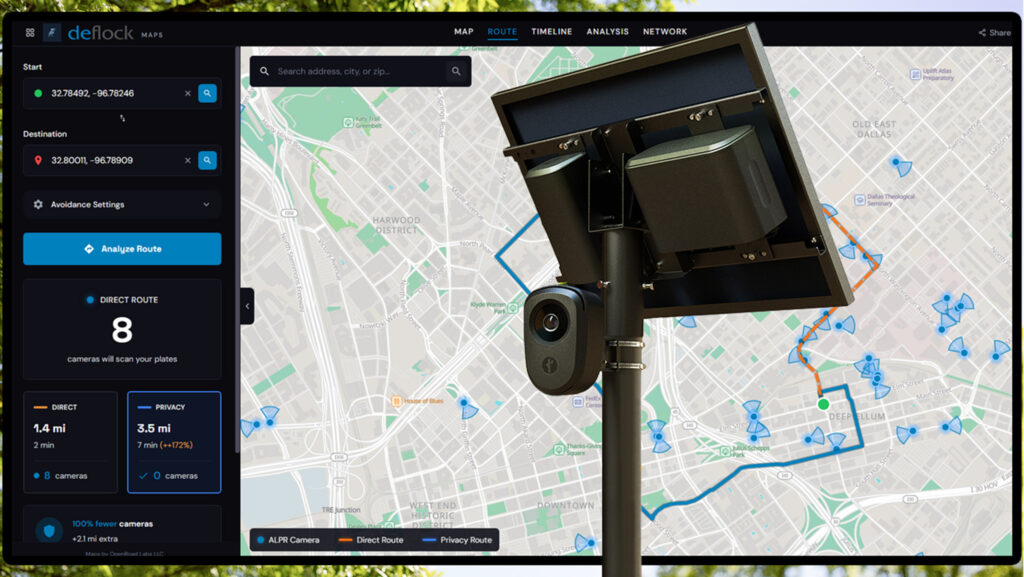
The tool works like any standard mapping service. Plug in a start point and destination, get directions. The difference is DeFlock overlays known ALPR camera locations and generates an alternative route designed to dodge them entirely.
A slider lets users set a buffer zone between 50 and 500 feet from any mapped camera. The site then lays both routes side by side so drivers can see exactly what avoidance costs them.
In one sample trip, the direct route covered 1.4 miles and passed eight cameras. The privacy route stretched to 3.5 miles, added roughly five minutes, and encountered zero. Five minutes to disappear from eight databases.
DeFlock works best on local trips. Highways tend to have fewer fixed ALPR installations than city streets, where cameras cluster around intersections and commercial corridors. Around town, the density can be startling. Most drivers have never had a way to visualize just how thick the surveillance web has become on their daily commute.
Modern ALPR systems don’t just snap plate numbers. They catalog vehicle make, model, color, bumper stickers, aftermarket parts, damage, and precise timestamps. Stitched together, that data builds a detailed travel history for every car that passes through, whether or not the driver has ever committed a crime.
Law enforcement argues the technology works. Stolen cars get recovered. Missing persons get found. Suspects get linked to investigations.
The friction is about everyone else. Every trip to work, every doctor’s visit, every school pickup, every political rally attended feeds into a searchable database. And the assumption that only authorized personnel access that data responsibly has already been shattered.
Earlier this year, a Wisconsin police officer caught felony misconduct charges for allegedly using Flock Safety’s system to track vehicles connected to a personal relationship. Similar abuse cases surfaced in Georgia and Missouri. In several instances, it wasn’t internal oversight that caught the misuse. Victims did.
Security is another open wound. Last year, researcher Benn Jordan demonstrated alongside 404 Media that numerous public safety camera systems could be accessed online without meaningful authentication. The footage, combined with publicly available information, could identify individuals, map daily routines, and expose deeply personal details including medical information.
Data collected for one purpose rarely stays in its lane. Privacy advocates have hammered that point for years. The ALPR expansion is proving them right in real time.
Some communities are pushing back. Staunton, Virginia, terminated its Flock Safety contract earlier this year despite police reporting investigative wins with the technology. Officials decided citizen concerns about privacy, data retention, and oversight outweighed the company’s promises. Other cities have paused or limited deployments after similar public pressure.
None of that has slowed the broader rollout. A newer technology called Leonardo reportedly links phones, fitness trackers, even pet microchips to GPS locations. The surveillance net isn’t shrinking.
DeFlock doesn’t disable cameras or interfere with anything. It doesn’t make a vehicle invisible. It simply tells drivers what’s watching them and where, then lets them decide whether a slightly longer route is worth the trade.
Most people have never had that choice because they never had the information. The cameras aren’t going anywhere. But for the first time, drivers can see exactly how many of them line the roads they travel every single day, exposing a surveillance infrastructure that was built to operate in silence.





Share this Story