
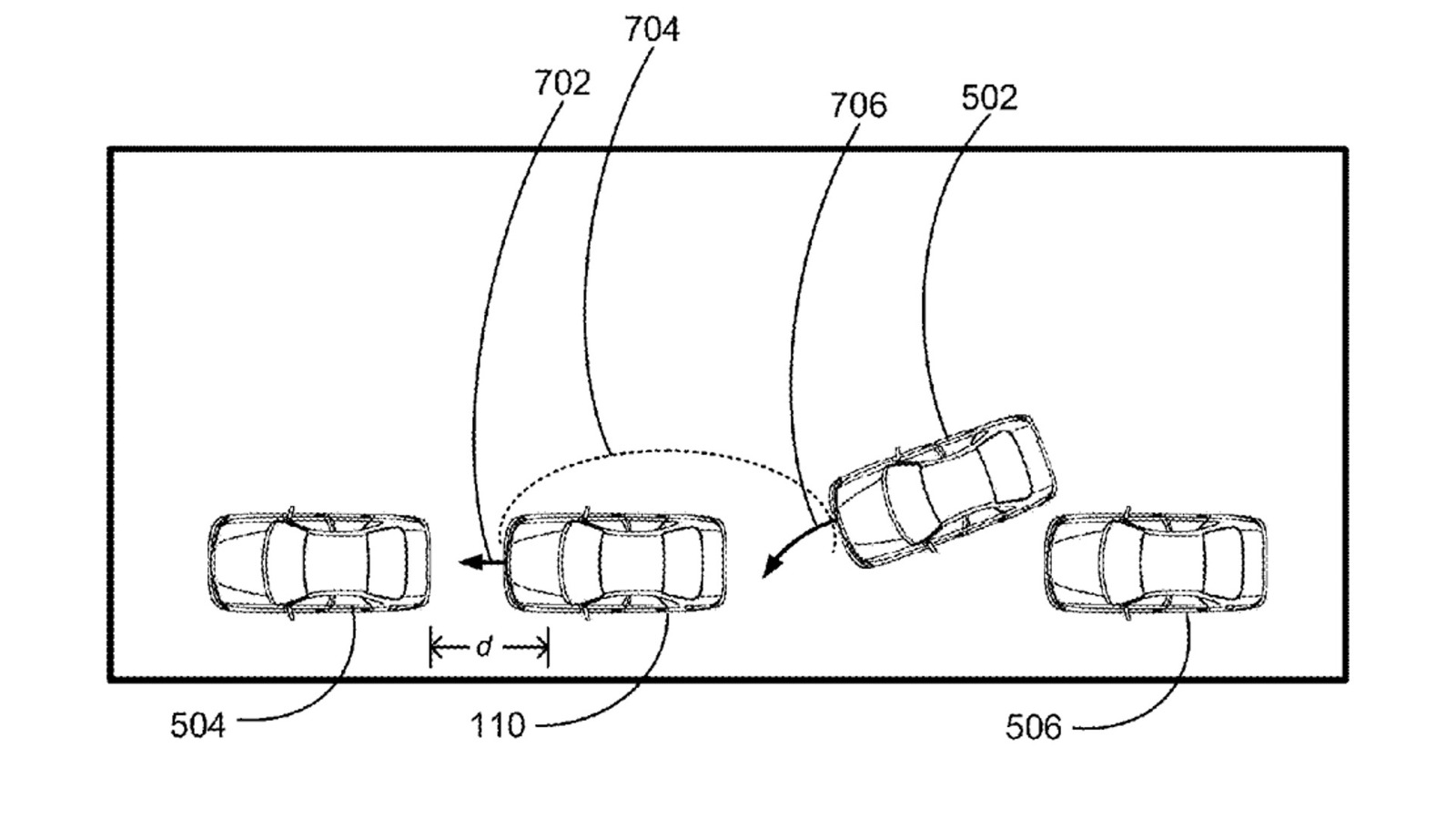


Ford has been granted a patent for a system that would let a parked car move itself out of the way of an incoming object — no driver required. Patent number US-12617393-B2, originally filed in 2023 and recently published by the U.S. Patent and Trademark Office, describes a “System for detecting moving objects” designed to reduce or avoid impacts on stationary vehicles.
The concept is straightforward, even if the engineering underneath isn’t. Sensors already common on Ford vehicles — the same ones powering its Blue Cruise hands-free driving system — would continuously monitor the area around a parked car. If the system detects an object on a collision course, it escalates through a response chain: flash the lights, hit the horn, and if the threat doesn’t change trajectory, move the car.
That last step is the one that matters. Autonomous repositioning of an unoccupied vehicle in a public space is not a software problem. It’s a regulatory minefield.
Ford’s patent describes a system that would also track stationary objects nearby — other parked cars, pillars, barriers, curbs — to determine whether the vehicle actually has room to maneuver. It’s a surprisingly complete picture for a patent filing, suggesting Ford has done more than just sketch an idea on a napkin. The hardware already exists across much of the Ford lineup. The cameras, radar, and ultrasonic sensors baked into modern vehicles for parking assist, collision warning, and highway autonomy could theoretically be repurposed for exactly this kind of low-speed defensive movement.
But automakers patent things they never build. That’s standard operating procedure, a way to stake out intellectual property territory without committing a dime to production. Ford files hundreds of patents a year, and many of them die quietly in filing cabinets. The difference here is plausibility. This doesn’t require lidar towers or purpose-built robotaxi platforms. It requires software layered onto sensors Ford already installs.
The real obstacle sits in Washington and in state capitals. Current autonomous vehicle regulations in the United States were not written with this scenario in mind. Most frameworks governing self-driving technology assume a vehicle is in active transit, not parked at a Costco. Allowing an unoccupied car to steer itself — even a few feet — in a crowded parking lot raises liability questions no regulator has meaningfully addressed. Who is responsible if the car dodges a shopping cart and clips a toddler? The owner? Ford? The software?
There’s also the practical absurdity factor. A system this sensitive, deployed in a real-world parking lot, would need to distinguish between a runaway cart and a pedestrian walking past at a normal pace. Between a car backing out of a space and a car that has lost control. The margin for error in a dense parking environment is razor thin, and a false positive — a car lurching sideways because someone walked too close with a bicycle — could create exactly the kind of collision it was designed to prevent.
Ford clearly sees value in the idea. Filing in 2023 and securing the patent in 2026 shows sustained interest, not a throwaway concept. And the consumer appeal is obvious. Nobody wants to come back to a door ding or a crumpled fender from a hit-and-run in a parking garage.
Whether this ever reaches a production vehicle depends less on Ford’s engineering capability and more on whether regulators can wrap their heads around a car that thinks for itself while its owner is inside buying spring rolls. The technology is ready. The legal framework is not even close.
Share this Story