
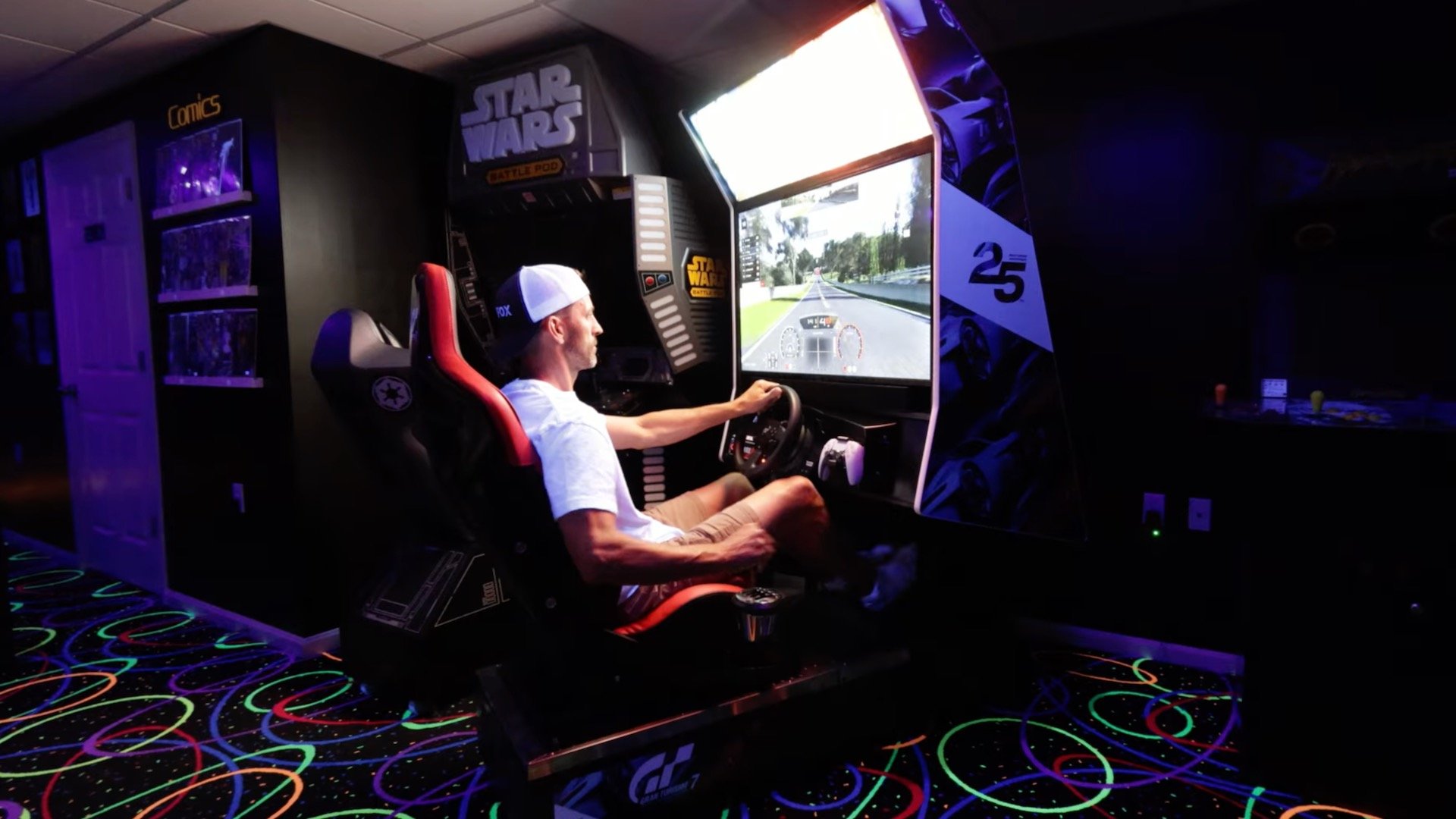


A junked Sega Jambo Safari cabinet. A copy of Gran Turismo 7. Eight YouTube videos documenting every cut, weld, and modification. The result is one of the most satisfying racing game setups you’ll see this year, and it didn’t come from a catalog.
Builder 19kfox turned that trashed Sega cabinet into a fully functional GT7 arcade machine, and the process reveals something the sim racing community keeps overlooking. Sometimes the best way to play a driving game isn’t strapping a headset to your face or spending five figures on a direct-drive rig with hydraulic motion. Sometimes it’s standing in a dark room in front of a glowing cabinet that smells faintly of nostalgia.
The Jambo Safari shell was chosen deliberately. A previous scratch-built attempt came out too bulky to sit alongside standard arcade machines. Starting with a production cabinet guaranteed proper dimensions, even if nearly everything inside had to change.
The body was widened to fit a larger monitor and a proper seat. The shifter migrated from the dashboard to the right side of the seat, closer to where it would sit in a real car. Reproduction stickers replicate the look of original arcade graphics, and a small but clever touch lets players kill the marquee light above the screen when the room goes dark.
That last detail matters more than it sounds. In a blacked-out room, the effect is total immersion without the isolation of VR goggles.
Gran Turismo 7 turns out to be a near-perfect match for this kind of setup. Polyphony Digital’s franchise has always leaned hard into car fidelity over environmental detail. The tracks look clean, the cars look extraordinary, and the format stays conservative enough to feel like it belongs in an arcade context.
It’s not trying to simulate every blade of grass beyond the guardrail the way Forza Motorsport does. That restraint works here.
The game itself keeps getting fed, too. Four years after launch, monthly updates continue adding cars that range from the mundane to the absurd. The current roster includes the Renault Twingo alongside the Yangwang U9, a 1,300-horsepower quad-motor Chinese electric hypercar with active suspension capable of driving on three wheels.
That kind of spread captures the spirit of what made arcade racing games so appealing in the first place. Pick your fantasy, drop in a metaphorical quarter, and go.
Purpose-built sim rigs serve a different audience. They’re training tools for aspiring racers, optimized for lap time improvement and muscle memory. But they don’t make you grin the way a proper arcade cabinet does. There’s a reason people who grew up feeding coins into OutRun and Daytona USA still talk about those machines with a warmth that no Fanatec wheel base inspires.
The sim racing market has exploded into a serious hardware arms race, with motion platforms, ultra-wide curved monitors, and haptic feedback systems pushing well past $10,000. That arms race produces diminishing returns for anyone who isn’t chasing tenths on iRacing.
19kfox’s build cost a fraction of those rigs and delivers something none of them can. The feeling of walking up to a machine, sitting down, and disappearing into a race without a single settings menu or calibration routine standing in the way.





Share this Story