
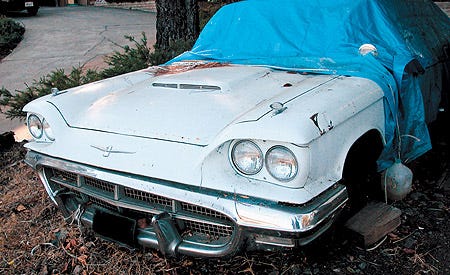


A powder-blue Thunderbird pinned to a hillside under a plastic tarp and weighted milk jugs. A big-block 1967 Corvette with its ragtop rotting off the crossmembers, leaves filling the cockpit like a shallow grave. A 1966 Shelby GT350 converted to a drag racer called “The Christian,” now home to a feral cat curled up inside the roll cage.
Jim Shane saw them all. Every day, six days a week.
Shane was a mailman in Novato, California, a working-class town of 50,000 north of San Francisco. He was also a car guy, the kind who grew up in a Ford family during the late 1950s when brand loyalty was tribal and deeply personal. When he walked his routes, he couldn’t help but catalog the automotive carcasses parked in driveways, stuffed behind fences, and buried under overgrowth across his delivery territory.
His account, first published in Car and Driver’s June 2003 issue, reads less like an article and more like an autopsy of American aspiration.
The dead cars Shane found weren’t random. They were pattern. Datsun Zs. BMW 2002s. Triumphs and MGs. Mach I Mustangs with engines that hadn’t turned over since gas was a dollar a gallon.
Old Beetles by the dozen. But almost no Toyotas. No Mazdas. No Rabbits or Sciroccos. The cars people kept weren’t the sensible ones. They were the fun ones.
A Mopar 440 Magnum had been converted into a family recycling bin, Evian bottles and McDonald’s wrappers crammed where the grille and radiator once lived. Other hulks served as locking outdoor storage for yard-sale junk. Some had new gasket sets sitting on the back seat, tools scattered around the body, square yards of primer on the fenders. Evidence of a rebuild that started with enthusiasm and stalled somewhere around Tuesday.
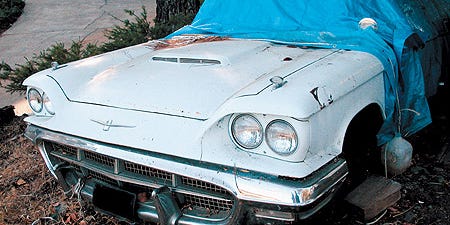
Shane understood the psychology. He’d owned a 1960 Thunderbird, drove it cross-country, took it to his first Indy 500. He got converted to Corvettes in 1965 when a Navy buddy in El Paso let him drive a red ’65.
Women chased him down in that car. Once they learned it wasn’t his, they vanished. Only the police had bothered chasing the T-Bird.
One Saturday he delivered a Mustang magazine to a guy standing in his driveway. Asked the obvious question. The man led him behind the house to show off a Forest Green 1968 Mustang GT fastback.
Then he opened the garage doors. No car inside. Skateboards, baby strollers, a pink bicycle, lawn tools, fertilizer. The debris of fatherhood.
The Mustang sat outside while the garage served the family. The man offered to move everything so Shane could see the car properly. Shane declined. It was the owner’s dream, and it wouldn’t look the same to anyone else.
That line carries more truth about car culture than a thousand concours programs.
Shane ended up delivering mail because bad internet investments married a need to pay bills. He didn’t dwell on it. What he dwelled on was why a Shelby GT350 sat rusting behind a fence while a stray cat accumulated more seat time in it than he ever would.
Why two Mach I Mustangs occupied a single driveway with engines that hadn’t rumbled in decades. Why a Triumph Spitfire sat unwashed for years with a Haynes manual still on the driver’s seat, ready, as if someone might crack it open any minute.
The manual was the tell. These cars weren’t abandoned. Their owners still believed in a future with them. The spouse might see scrap metal. The owner saw a plan. As long as the car sat there, no matter how far gone, the dream held.
Shane figured if Novato had this many dead cars, every town in America probably did. Two decades later, the inventory has only grown. The cars are older now, the parts harder to find, the owners closer to running out of tomorrows. But the Haynes manuals are probably still on the seats.


Share this Story