
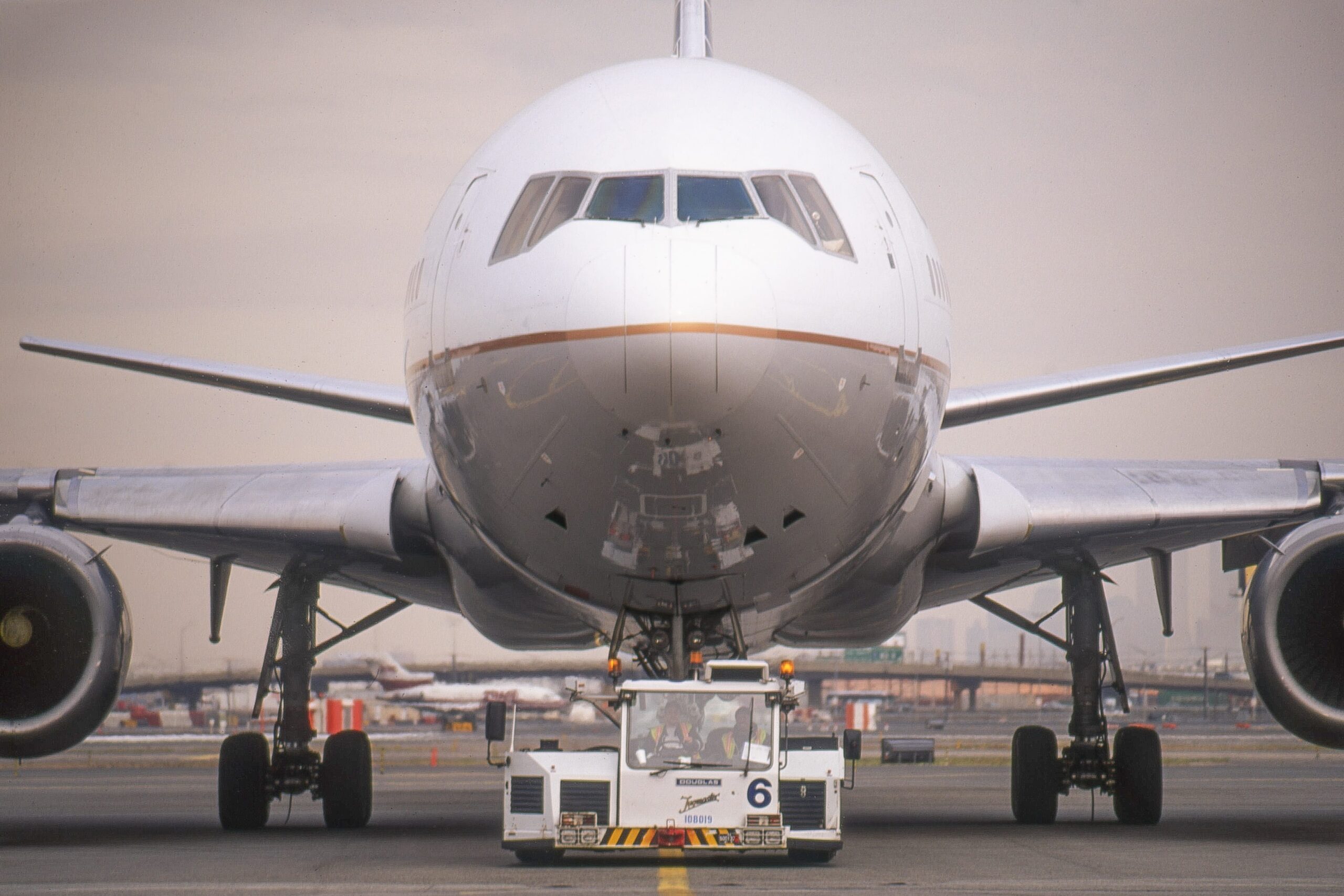


A 35,000-pound British-built tractor that clasps a Boeing 757 by its nose tires, lifts the entire front gear off the tarmac, and hauls the whole aircraft across the airport at 22 mph. That was the Douglas-Kalmar TBL-280 Tugmaster, a machine Continental Airlines bought for $481,898 a copy and deployed in a fleet worth $5 million at Newark International Airport around the year 2000.
Most airport tugs are glorified golf carts. They push planes back from gates with a steel tow bar, cover a few hundred yards, and call it a day. The TBL-280 was a different species entirely.
It didn’t attach to aircraft. It grabbed their front tires with hydraulic arms, then clean-and-jerked the nose gear seven to ten inches off the ground. With a 77,162-pound lifting capacity, it could hoist the nose of a DC-10 and carry it forward, backward, through turns, across taxiways and runways, for miles at a stretch.
Its bigger sibling, the 540-hp TBL-400, could lift 99,209 pounds, or roughly two dozen Cadillac DeVilles stacked on its cradle.
The economics were brutal and simple. Every minute a jumbo jet spent taxiing under its own power burned through engine life that cost a fortune to replace. Donald Thomas, Continental’s 30-year-old manager of supertug operations and a former Navy jet-fighter mechanic, laid it out plainly: a 747 moving itself just 50 yards to an adjacent gate burned enough fuel to cover his salary for a week. Warm-up, taxi, and shutdown could eat 45 minutes off an engine’s air life.
The TBL-280’s cabin was enclosed, heated, air-conditioned, and electrically demisted. Its seat and instrument panel swiveled 180 degrees so the driver could operate it backward as easily as forward. Three radios squawked constantly on 25 frequencies.
A Sony video screen showed the cradle alignment. Four steering modes, including a crab function that let the 27-foot-long tug slide sideways into position under a nose gear, gave operators surgical precision with a machine twice as wide as a Jeep Wrangler.
Under the hood sat a Deutz turbocharged inline-six diesel making 255 horsepower and 698 pound-feet of torque, the twist of two Corvettes combined. Top speed unladen was 22 mph. Towing a 140-ton aircraft, 15 mph.
Seven days a week, Continental’s supertugs moved between 70 and 130 aircraft at Newark. In 16 months, the airline’s first unit logged 22,000 miles scurrying across ramps and runways. Formal training took three weeks.
Car and Driver’s John Phillips attempted it in six hours, navigating a chaos of catering trucks, luggage trains, fuel tankers, hovering helicopters, jet blast from passing 737s, and puddles of spilled hydraulic fluid.
Unladen, the ride was pure dump truck. Loaded with a DC-10’s nose, it smoothed right out, until you hit the crowned surface of a runway and felt a 437-ton 747 pushing the tug like a rag doll from behind.
The unspoken rule on the ramp was absolute: an aircraft in motion always had the right of way. “People are real courteous when I’ve got a wide-body on my back,” Thomas said, “right until I meet another wide-body.”
Fender benders among ground vehicles were common at Newark. But dinging an aircraft while it sat on your cradle? William Jones, the supertug driver who walked Phillips through the procedure, had a phrase for that outcome.
“You ding a plane, just pick up your lunch pail and go grab the classifieds.”
At the time, Continental was the only domestic carrier running supertugs. Thomas and his 50-man crew expected that to change. A machine that saved engine cycles, cut fuel burn, and moved broken aircraft off active runways faster than any alternative was not a curiosity. It was an inevitability other airlines simply hadn’t written the check for yet.

Share this Story