
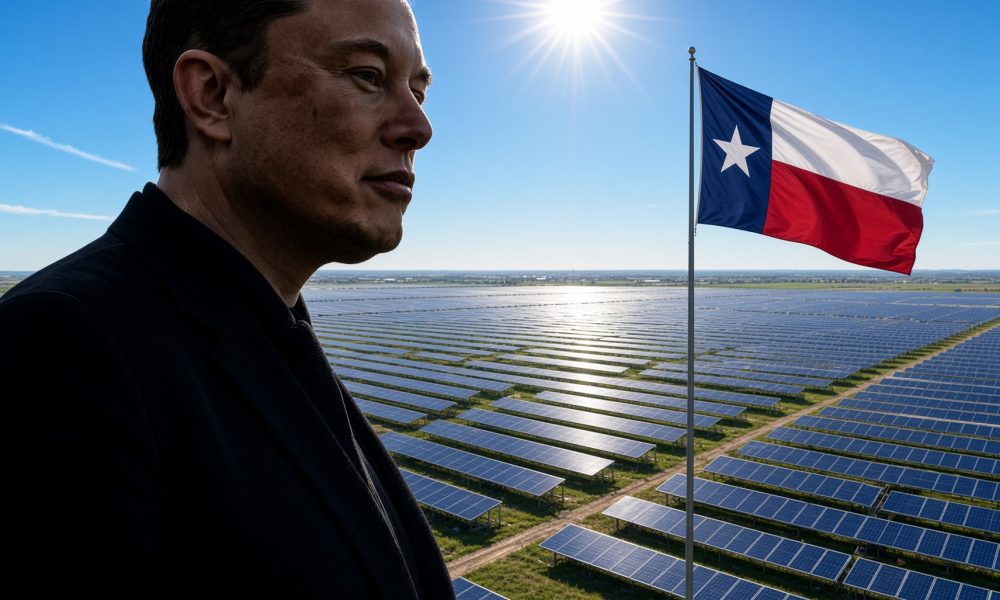


Fort Bend County commissioners voted 4-0 Thursday to approve four separate incentive agreements for Tesla’s proposed $10.1 billion solar cell factory near Needville, Texas. The project, filed under the codename “Project Crystal Sun,” would be the largest single manufacturing investment Tesla has ever made outside of vehicles.
The votes covered a property tax abatement, a Chapter 381 economic development deal, a foreign trade zone non-objection with payments in lieu of taxes, and a true-up agreement. Commissioners moved quickly and unanimously on all four.
The plant would sit on roughly 3,000 acres south of the Brazos River, producing solar cells and finished modules across the entire chain, from ingot and wafer production through cell testing. Tesla’s state filing splits the investment into $1.5 billion in real property and $8.6 billion in equipment. The company projects 9,712 permanent jobs by 2033 and commercial operations by Q1 2029.
But none of this means the factory is actually coming to Fort Bend County. Tesla has told the Texas Comptroller it is still evaluating other locations. Site selection adviser David Dennison told Lamar Consolidated ISD trustees in September that the competition had narrowed to Fort Bend and one out-of-state rival offering a “very compelling package,” per the Houston Chronicle.
Tesla hopes to make a final decision before the end of 2026. The incentives still require sign-off from both the Comptroller and the Governor’s office.
Local officials have been moving at unusual speed. Commissioners created the reinvestment zone during a special meeting on August 24, with Interim County Judge Daniel Wong withdrawing himself because his engineering firm had previous ties to Tesla. Lamar CISD trustees voted 7-0 on September 15 to advance a JETI agreement that would tax Tesla’s qualifying property at 50 percent of its value for maintenance and operations from 2029 through 2038.
The project traces directly to Elon Musk’s stated ambition. On Tesla’s Q4 2025 earnings call in January, he said the company would “work toward getting 100 GW a year of solar cell production, integrating across the entire supply chain from raw materials all the way to finished solar panels.” In March, Tesla was reportedly negotiating a $2.9 billion purchase of Chinese solar manufacturing equipment destined for Texas.
The Houston region already anchors Tesla’s energy storage ambitions. Its Megafactory in Brookshire is building Megapack 3 units, and Tesla said on its Q3 call that Megapack supply for 2027 is nearly sold out. Musk wrote on X Thursday that the company is “increasing production of Megapacks as much as possible” as data center demand surges.
The timing of Thursday’s vote lands against a broader backdrop. Tesla just reported Q3 2026 earnings showing $28 billion in revenue, a slight EPS beat, and an FSD attach rate hitting 75 percent of new North American deliveries. The company’s energy business is growing fast enough that a $10 billion solar factory no longer reads as aspirational. It reads as operational planning.
Still, the unnamed rival location has leverage. Tesla has a long history of playing jurisdictions against each other to extract maximum concessions. Austin, Nevada, and New York all went through versions of this dance.
Fort Bend has done nearly everything within its power. Whether that is enough depends on what the other side is offering, and how much of Musk’s 100 GW vision requires Texas soil versus simply the best deal on the table.
The Comptroller’s office has not publicly indicated when it expects to act.
Share this Story