
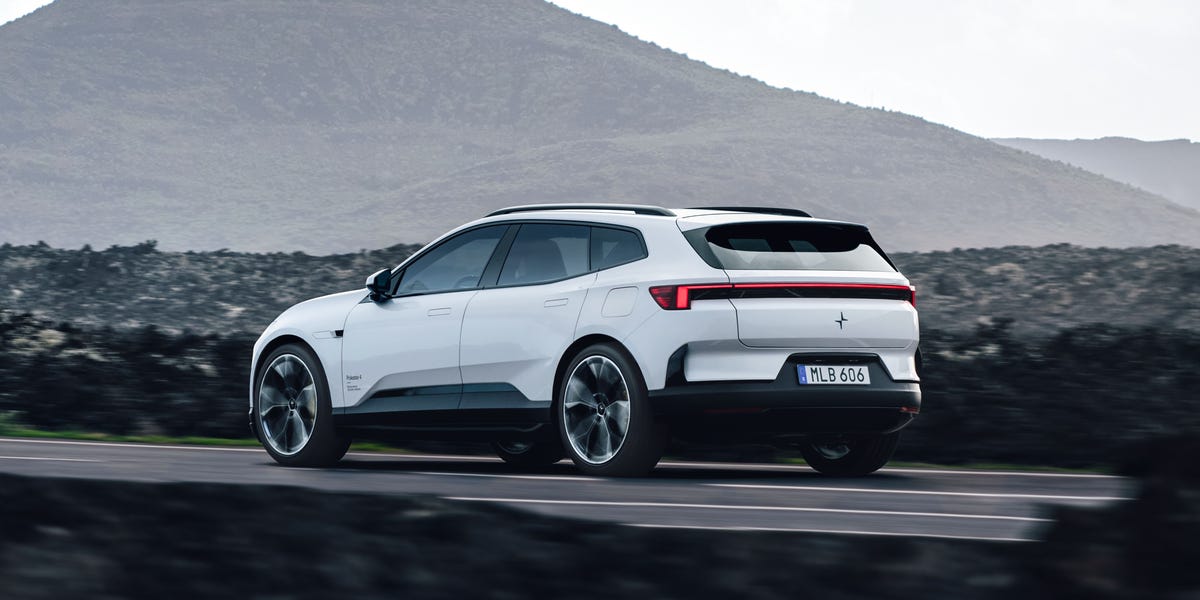


Polestar just revealed the 4 SUV, a stretched-roof, wagon-shaped variant of its controversial rear-windowless fastback. It has a real rear window, 23 cubic feet of cargo space, and up to 391 miles of WLTP range. It goes on sale globally before year’s end, and none of it matters if you live in the United States.
The original Polestar 4 made headlines in 2023 by eliminating the rear window entirely, forcing drivers to rely on a digital rearview mirror and side mirrors alone. That decision gave it a dramatic fastback silhouette but also made it deeply polarizing. The 4 SUV is Polestar’s concession that maybe people actually want to see out the back of their car.
The elongated roofline transforms the profile into something that reads far more like a traditional estate than any SUV. From the front, it’s identical to the coupe, with the same sharp headlights and trapezoidal grille opening. But behind the B-pillar, the roof stretches rearward to meet a proper tailgate with an actual glass window above the full-width taillight. Polestar even fits a conventional rearview mirror as standard, with the digital unit now relegated to an option rather than a necessity.
That extra roof length buys roughly an inch of additional rear headroom. Cargo volume jumps from 19 to 23 cubic feet behind the rear seats, and from 54 to 59 cubic feet with them folded. Roof rails handle 220 pounds of dynamic load.
A new electrochromic panoramic glass roof can switch between transparent, tinted, or selectively shaded sections. It is, by every measure, the version of the Polestar 4 that should have come first.
Underneath sits the same hardware. A 94.0-kWh battery feeds either a 268-hp single-motor rear-drive setup or a 536-hp dual-motor all-wheel-drive configuration. The rear-drive model claims 391 miles of range on Europe’s generous WLTP cycle, which typically shrinks by 20 to 25 percent when translated to EPA numbers. Two new paint colors called Aurora and Ozone join the palette, though Polestar chose to photograph the car exclusively in white, which tells you something about their marketing instincts.
Inside, the cabin carries over the coupe’s minimalist layout centered on a large touchscreen. Sustainable materials remain a priority, with recycled-plastic synthetic fabric standard and Bridge of Weir nappa leather available for those who want it. A new Camping mode keeps climate controls, entertainment, and ambient lighting active while parked and enables vehicle-to-load functionality for powering external accessories.
Production will happen in Busan, South Korea, not China. That detail matters because it’s the U.S. government’s Connected-Car Rule, targeting Chinese software and hardware in vehicles, that forced Polestar out of the American market after the 2026 model year. The Korean assembly doesn’t save it. Polestar’s underlying tech still runs afoul of the regulation.
So here is the paradox. Polestar spent years building credibility in the U.S. as a Swedish-designed alternative to Tesla. The Polestar 2 earned genuine loyalty. The Polestar 4, despite its quirks, tested well against the Model Y.
Prices had dropped below Chevy Bolt territory. And now, just as the brand delivers the practical, sensible variant that American families might actually want, it cannot sell a single unit here.
The 4 SUV goes on sale in Europe and other markets in Q4 2026. Whether Polestar can ever untangle its Chinese supply chain enough to return stateside remains an open question with no timeline attached.


Share this Story