


A group of Russian mechanics known as Garage 54 just bolted a homemade turbine to a car’s tailpipe and used exhaust gases to generate electricity. It worked. Barely.
The concept is elegantly simple: instead of using a belt to spin an alternator off the engine’s crankshaft, which saps horsepower and hurts fuel economy, why not harness the wasted energy in exhaust gases to do the same job? It’s the same principle behind every coal, gas, and nuclear power plant on earth. Spinning a turbine to make electricity is literally how civilization keeps the lights on.
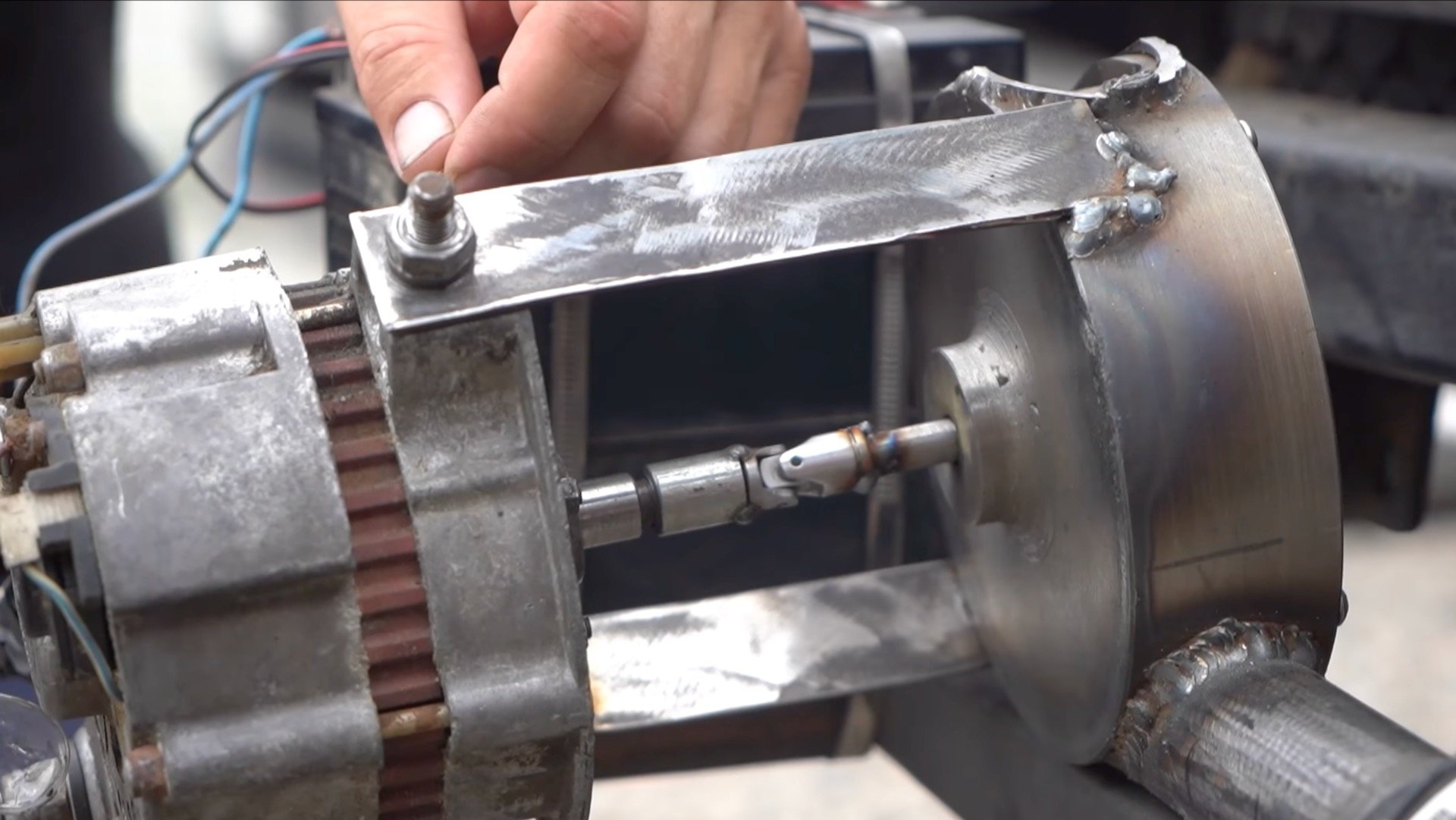
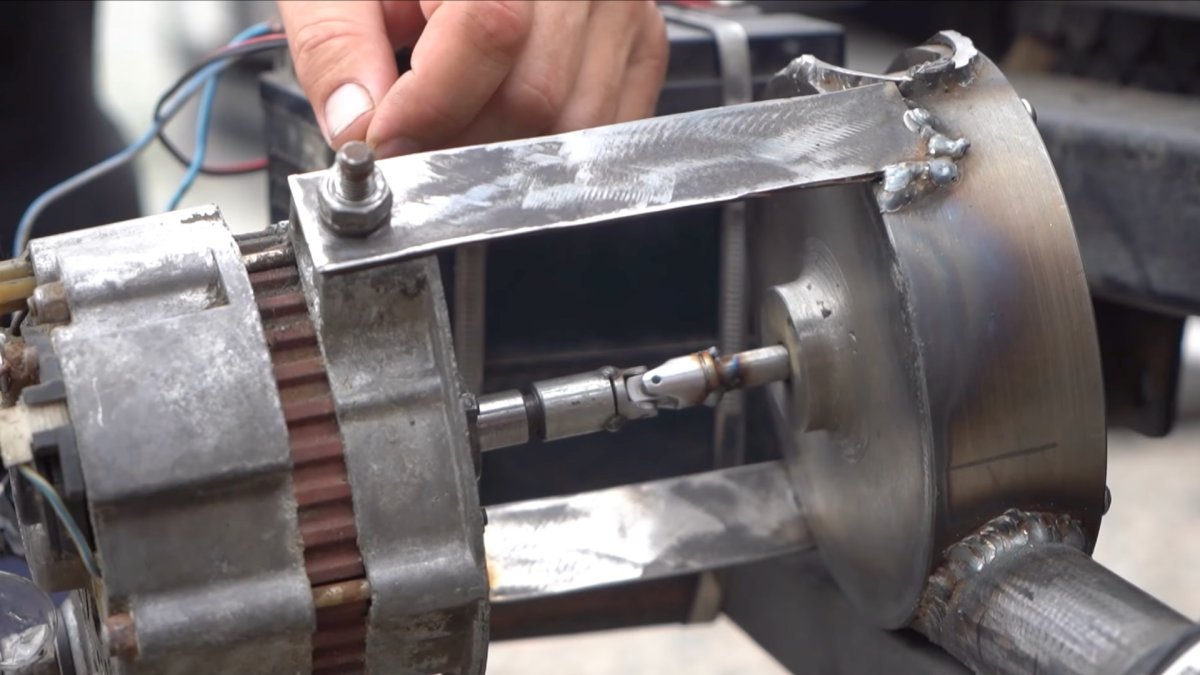
Garage 54, the same YouTube crew that once converted a Subaru boxer into an inline-four and frankensteined a V16 from chainsaw engines, built the device from scratch. A round steel housing contains a fan wheel made of flat blades. Exhaust gases enter through a precisely located port, spin the wheel, and exit through another.
The clearances had to be razor-tight, the ports carefully positioned so gas actually traveled around the wheel rather than blowing straight through. Getting the geometry right took trial and error. Port placement, chamber volume, blade count, housing diameter — all of it affects how much energy the turbine extracts from the exhaust stream.
Too loose and pressure drops. Too big and the gases lose velocity. The finished unit is surprisingly compact, though the installation is pure backyard engineering: the turbine drives a conventional alternator through a small driveshaft, and the whole assembly hangs off the rear bumper on a modified trailer hitch, plumbed directly to the tailpipe.
The goal wasn’t to power a car’s full electrical system. It was to keep three light bulbs lit. At around 2,500 engine rpm, the turbo-alternator managed that, producing a sound the hosts described as diabolical.
More throttle risked blowing the thing apart. Less throttle dimmed the bulbs. And there’s the fundamental problem.
Turbines want to spin at a consistent, high speed. Car engines don’t. They lug through traffic, idle at stoplights, surge on highway on-ramps.
Every driver knows turbo lag — the delay before a turbocharger spools up. Modern engine management has largely tamed that for boost, but taming it for steady electrical generation is a different animal entirely.
Jaguar learned this the hard way. The company originally planned a gas turbine range extender for its stunning C-X75 supercar concept, then abandoned the turbine, then abandoned the entire car. The physics of matching turbine speed to real-world driving demands proved too stubborn even for a company with billions in resources.
A belt-driven alternator works because it’s mechanically linked to an engine that’s already spinning. It generates usable power from idle to redline. It’s simple, proven, and cheap.
Some automakers have moved toward 48-volt mild-hybrid systems with larger batteries to reduce alternator load, but even those still rely on belt-driven motor-generators. None of that diminishes what Garage 54 accomplished. They identified a real inefficiency — the parasitic drag of a belt-driven alternator — and attacked it with a turbine built in a shop, not a research lab.
The fact that it lit three bulbs at moderate rpm, without fragmenting, counts as a win in the world of garage engineering. Whether this concept could ever scale to production relevance is another question. The answer, based on decades of turbine development and Jaguar’s expensive lesson, is almost certainly no.
But the instinct behind it — that there’s usable energy going out the tailpipe — is absolutely correct. Turbochargers prove it every day. Capturing that energy as electricity rather than boost just demands a level of engineering precision that doesn’t pair well with a trailer hitch and three light bulbs.





Share this Story