
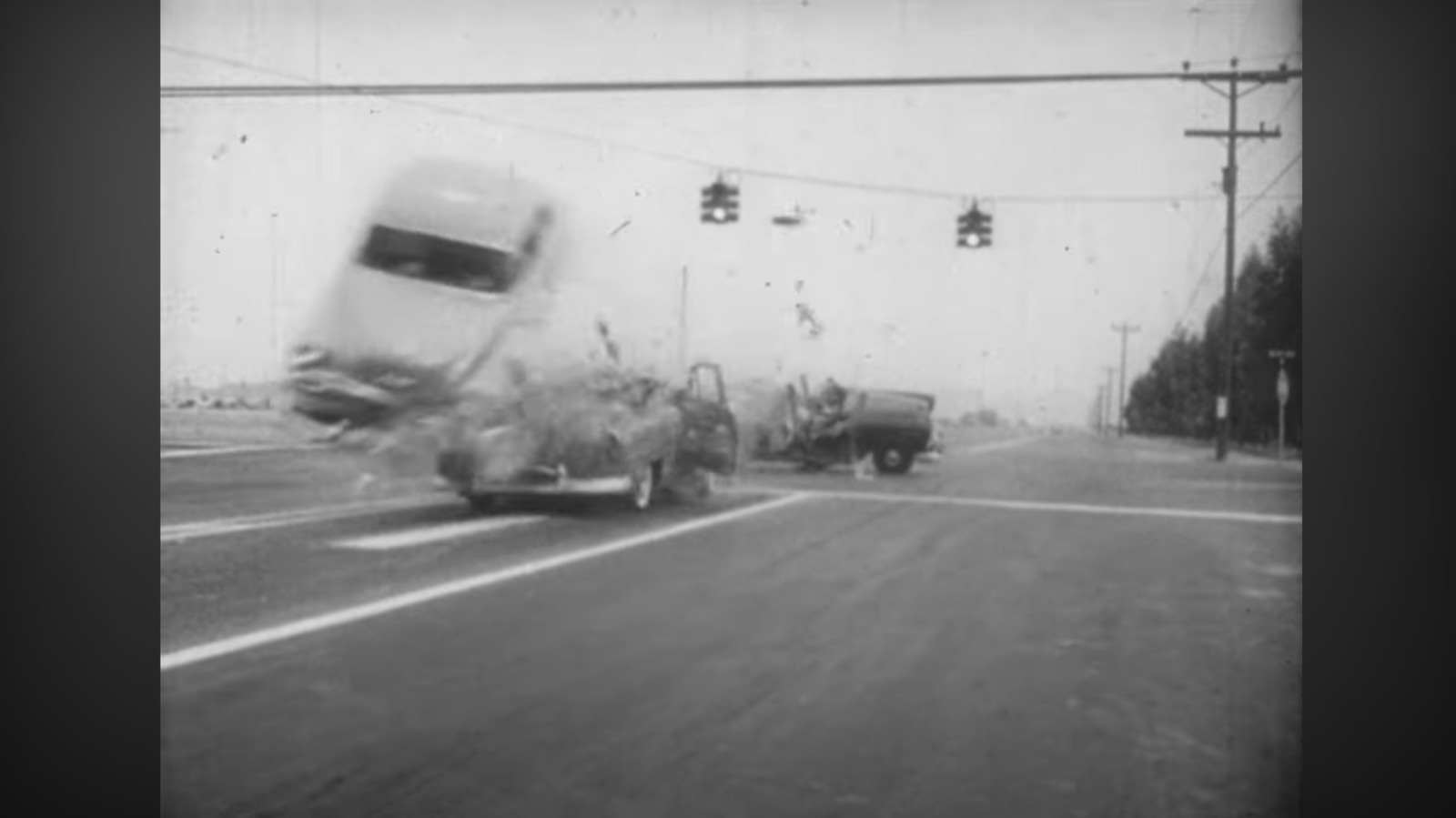


Joie Chitwood rolled Chevrolets down hillsides, plowed into parked cars, and staged head-on near-misses on film in 1963, all to show Americans what careless driving looked like. Sixty-two years later, the footage could pass for a Tuesday afternoon dashcam compilation on Reddit.
The film is called “Hellbent for Safety,” a collaboration between Chitwood, a renowned Hollywood stunt driver, and Liberty Mutual Insurance. Recently restored and shared by the YouTube channel 16mm Time Machine, the 28-minute production walks viewers through a catalog of reckless driving scenarios. Each one ends in a meticulously staged crash performed by Chitwood himself.
One segment recreates a driver blinded by oncoming high beams on a dark residential street, swerving into a row of parked cars. Another shows a reckless pass on a blind hill that forces Chitwood off the road, through a sign, and into a violent roll down an embankment. His son appears on camera to note that the only thing keeping them alive during these stunts is a simple lap belt and a helmet.
Every scenario was pulled from real-world incidents. No invention required. Just pattern recognition from an insurance company that had been paying claims on the same stupid mistakes for decades.
The kicker is that nothing in the film feels dated except the cars. Swap the ’63 Chevys for Hyundai Tucsons and Teslas, and every single scenario Chitwood demonstrated plays out daily on American roads. The distracted merge. The aggressive pass with zero visibility. The driver who treats high beams like a personal entitlement.
We have spent six decades layering technology onto the problem. Antilock brakes, stability control, blind-spot monitoring, automatic emergency braking, lane-keeping assist, forward collision warning. The federal government now mandates rear cameras and is pushing for even more automated intervention.
Automakers market their safety suites like they’re selling body armor. And yet the root cause Chitwood identified in 1963 remains perfectly intact: the person behind the wheel who simply isn’t paying attention. Or worse, doesn’t care.
The technology has arguably made things worse in one respect. Drivers who know their car will brake for them drive with the confidence of someone who has never seen a consequence. The safety net becomes permission to check a phone, drift across a lane, or tailgate at 80 mph.
Chitwood didn’t have to compete with smartphones for a driver’s attention. Today’s safety engineers do, and they’re losing.
What makes the film genuinely compelling isn’t the crashes. It’s how little the script would need to change if you remade it today. “What about you?” a voiceover asks over footage of an ambulance attending to a wreck. “Do you have to learn the hard way too?”
The answer, across 62 years of evidence, appears to be yes.
Liberty Mutual knew it then. They know it now. They’re still paying the claims. The cars got safer, the steel got stronger, and the airbags multiplied. But the person turning the key, or pushing the start button, is the same variable no engineer has been able to fix.
Chitwood proved it with rolled Chevrolets and a lap belt. Dashcam footage proves it every single day. The only difference is that in 1963, someone had to stage the crashes. Now they just happen on their own, and we watch them for entertainment on our lunch breaks.
Share this Story