
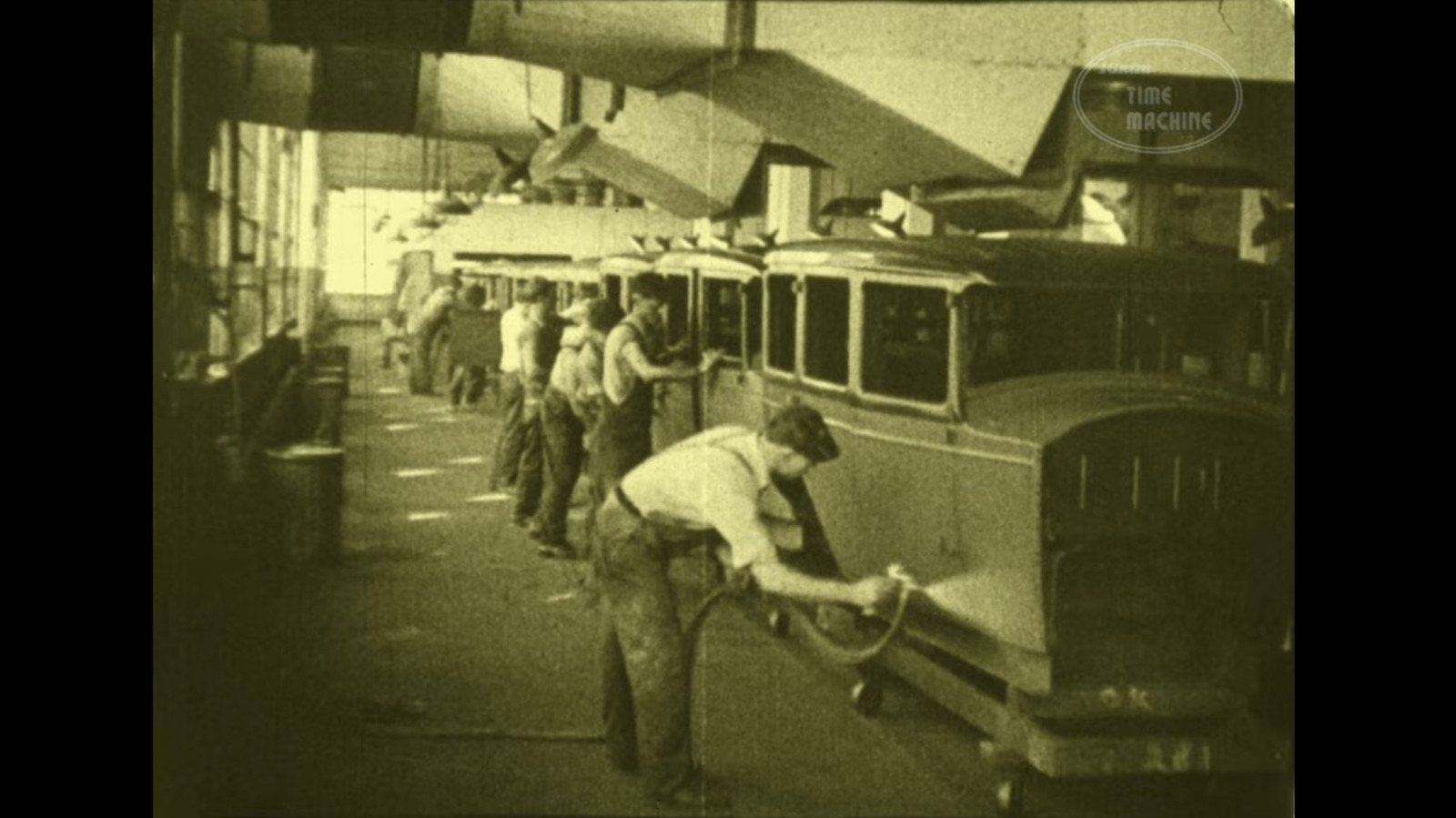


A sepia-toned industrial film from 1929 has resurfaced on YouTube, and it’s more riveting than anything Detroit’s marketing departments have produced in years. “Making the Automobile” traces car production from rubber tree plantations to final assembly. Every frame is a reminder of how violently physical the job once was.
The film, scanned and uploaded by the 16mmFilmScan channel, walks through four raw materials — steel, rubber, glass, and gas — and follows each from extraction to finished component. Steel gets melted and beaten into crankshafts. Rubber is hand-formed into tires after spending 10 days in a smokehouse.
Bodies are lowered from the ceiling onto engine-clad chassis while a group of men stands directly underneath to guide them into place. No hard hats. No safety cages. No lawyers.
Jalopnik’s Lalita Chemello flagged the film as part of a new weekly streaming column, and she’s right that the footage carries a magnetic pull. There’s a playful piano score laid over scenes of brutal manual labor, a contrast that feels almost absurd. The men in this film aren’t operating robotic welding arms or monitoring screens.
They’re standing in foundry heat, handling molten metal, breathing whatever the air happened to contain that day.
The car featured prominently appears to be a 1929 Packard, confirmed both by the video’s description and cross-referenced against Tad Burness’ “American Car Spotter’s Guide 1920-1939.” That alone makes the film a time capsule worth preserving.
But the real tension in watching this footage in 2026 isn’t nostalgia. It’s scale. In 1929, automobile production was already remarkably complex, requiring coordinated supply chains spanning forests, oil fields, glass furnaces, and steel mills.
A modern EV battery alone sources materials from mines on multiple continents, processed through chemical plants most consumers will never see or think about. Nearly a century later, that complexity has multiplied beyond recognition.
The film strips away that comfortable distance. You watch a man’s bare hands shape rubber. You see sparks fly inches from unprotected faces.
You understand, in your gut, that the object sitting in your driveway represents an enormous chain of human effort and extracted resources.
Chemello makes a pointed observation about today’s global supply chains having spread that net even wider, with a nod toward Washington’s ongoing efforts to reshape trade policy through tariffs. She doesn’t belabor the point, and she doesn’t need to. The 1929 footage makes the argument on its own.
Back then, most of the materials and labor were domestic. The car was an American product built with American hands from largely American raw goods. That world is gone.
What remains is the work itself, preserved in flickering film stock and uploaded for free. No subscription required. No algorithm necessary. Just 96-year-old proof that the automobile has always demanded more from people and the planet than most drivers ever bother to consider.
The film runs under 15 minutes. It’s worth every second, if only to watch men catch a car body falling from the ceiling and think about how far we’ve come — and how much we’ve chosen to forget.





Share this Story