
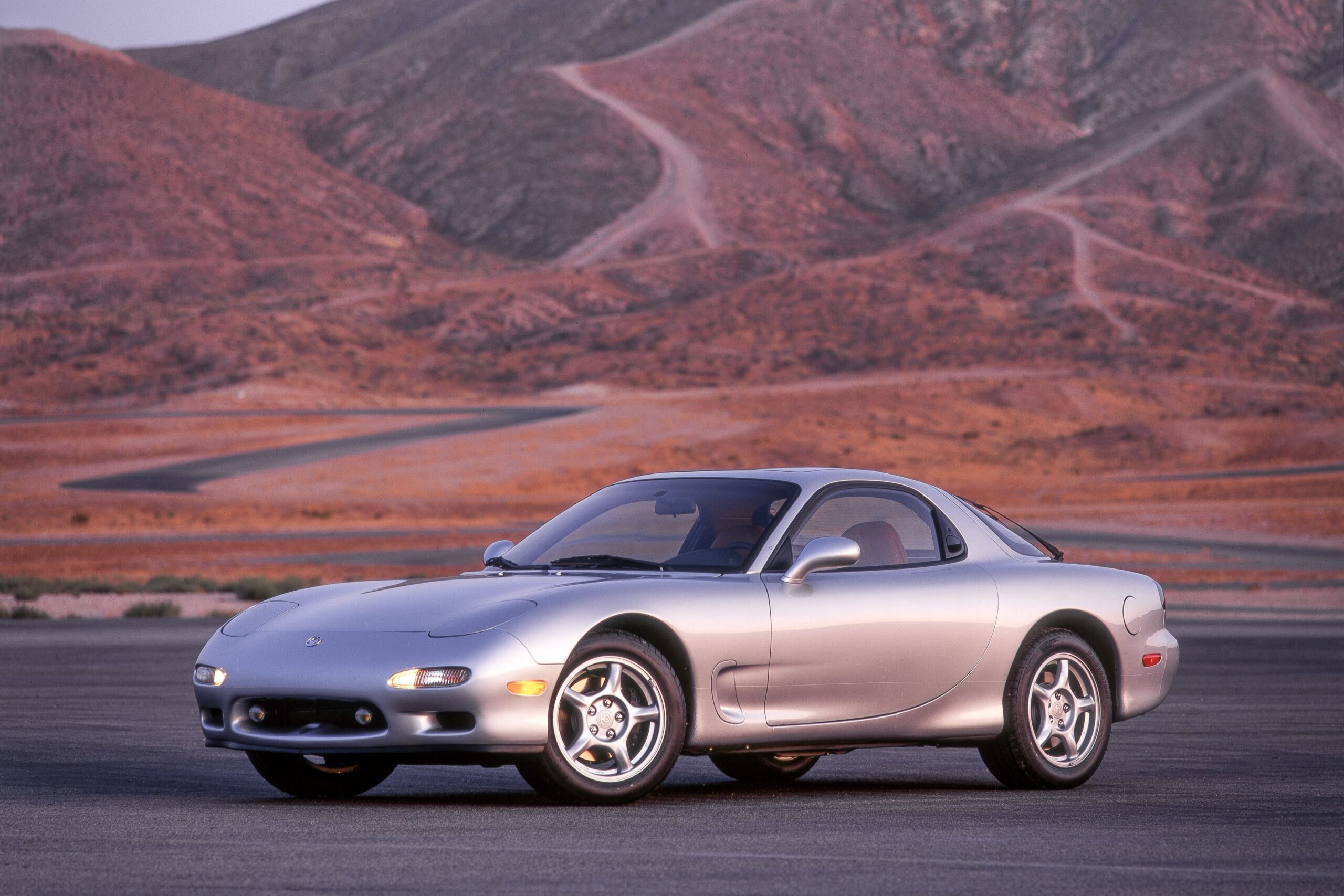


Mazda priced the original RX-7 at $6,995 in 1978. Dealers gouged buyers for thousands more because they could. One enterprising soul bought one in Idaho at sticker, drove it to Los Angeles, and flipped it for a fat profit.
Then he dated the new owner just to keep driving the car. That story, buried in the December 1991 issue of Car and Driver, tells you everything about what Mazda had in the RX-7. Three generations of a car that people would scheme, overpay, and rearrange their personal lives to get behind the wheel of.
The first-generation car made just 100 horsepower from its twin-rotor Wankel, weighed 2,390 pounds, and needed 8.5 seconds to hit 60. None of that mattered. The engine was a tiny beer keg of a motor, barely a foot in any dimension, tucked behind the front axle for near-perfect weight distribution.
Mazda had tuned the chassis specifically for tossability. The rear end could swing wide, and drivers loved it. Over seven and a half years, 372,000 found homes in the U.S. alone.
The second generation arrived in late 1985 with independent rear suspension, rack-and-pinion steering, and a refined 146-hp rotary. It was more sophisticated, more expensive, and aimed more at touring than raw sport. The wheelbase grew by less than half an inch.
The interior got roomier. Drag dropped to 0.29. It was still good, but the edge had softened.
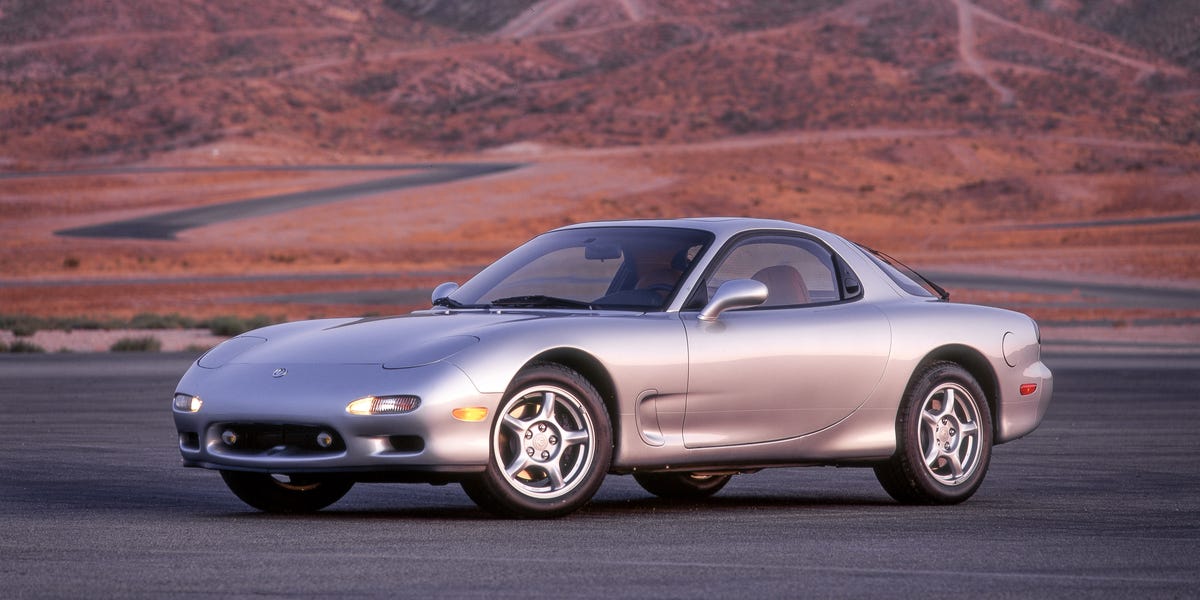
Then came the third generation, previewed as a 1993 model, and Mazda stopped hedging. Clark Vitulli, the company’s chief operating officer in the U.S., called it an “absolutely pure, two-seat sports car.” The numbers backed him up.
The twin-sequential-turbo 13B made 255 horsepower, a 55-hp jump over the previous turbo model. Curb weight dropped to 2,800 pounds. The car was shorter, lower, and wider, riding on 225/50-16 tires wrapped around eight-inch wheels.
Weight distribution sat at 50/50. The center of gravity fell a full inch. Mazda claimed 4.9 seconds to 60 and a 156-mph top speed.
The twin-turbo setup delivered thrust from 3,000 rpm, then hit a second surge around 6,000 that launched the car past the 7,500-rpm redline. The over-rev buzzer became a constant companion.
The handling, even in unfinished prototypes with undetermined spring rates and missing rocker-panel stiffeners, inspired immediate confidence. Drivers could lean on the fat tires and apply heavy throttle early in corners without needing heroic opposite-lock corrections. When the photographer wanted dramatic power oversteer for the camera, the car obliged on command.
Car and Driver was honest about the limitations of the preview. These were prototypes, not production cars. The magazine qualified its assessment when others likely would not.
Mazda had orchestrated the debut carefully, parceling out access to guarantee multiple rounds of coverage. The writers knew they were being managed. They said so plainly.
The biggest gripe was Mazda’s rigid two-package system. Package A offered performance bits: Z-rated tires, stiffer anti-roll bars, front and rear spoilers. Package B went luxury: leather, cruise control, sunroof, Bose stereo.
No mixing allowed. The ideal car probably lived somewhere between the two, with sport suspension but without the overdone aero kit, with cruise control but without the Bose system whose speaker ducting ate into the already minimal cargo space.
If that was the worst complaint anyone could muster, Mazda had pulled off something rare. The company that built the Miata, already selling over 100,000 two-seat sports cars annually worldwide, had reclaimed the RX-7’s original purpose while making it faster, lighter, and more focused than any version before.
The production cars were still months away. The final verdict would have to wait. But the trajectory from that $6,995 coupe in 1978 to this 255-hp, 156-mph machine traced a line that almost no other sports car nameplate could match for consistency of intent.
Share this Story