
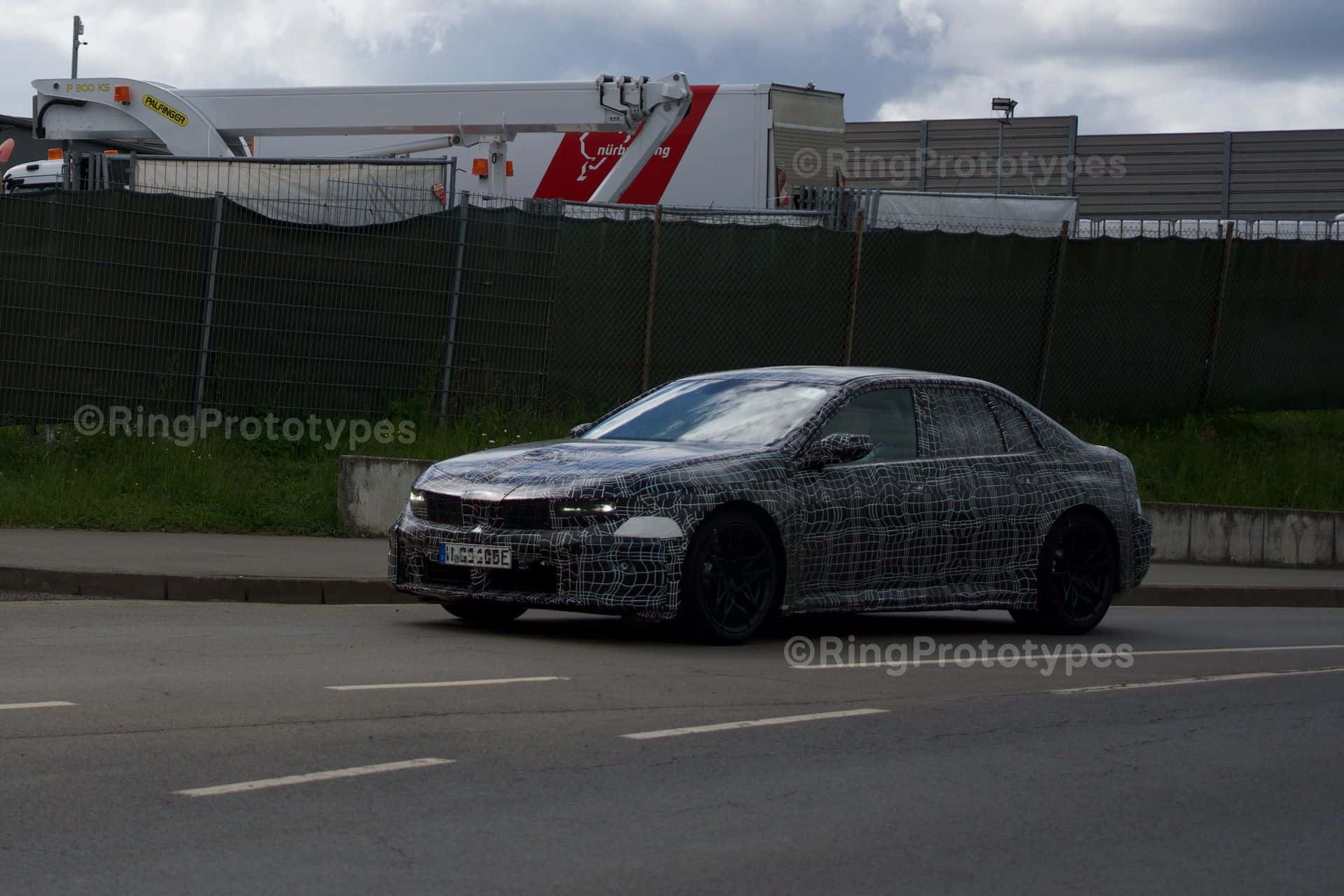


A prototype of the 2028 BMW M5 was spotted lapping the Nürburgring with its brake rotors glowing cherry red, a visceral sign of just how hard Munich is flogging its updated super sedan before next year’s launch. The car remains heavily camouflaged, but the brakes told their own story about the punishment being delivered at the Green Hell.
This is the facelifted G90, not a new generation. But the mid-cycle refresh carries more weight than usual because BMW is using it to graft Neue Klasse DNA onto a car that debuted as a polarizing plug-in hybrid heavyweight.
Early prototypes wore a radical front end inspired by the electric i3, with slimmer headlights and a horizontal kidney grille that broke sharply from the current M5’s face. BMW apparently built multiple design directions and tested them in parallel. According to sources close to the project, customer feedback killed the aggressive version, and the production car will take an evolutionary path instead.
That retreat says a lot about where BMW’s confidence sits right now. The Neue Klasse design language works on dedicated EVs where buyers expect something futuristic. Bolting it onto a $120,000 V8 sedan aimed at established M loyalists is a different calculation entirely.
Outside, expect revised headlights, new taillight graphics, and minor bumper changes. Doors, roof, and body panels stay the same. Standard LCI procedure.
The cabin is where the real surgery happens. BMW is bringing the iDrive X interface, which means a 17.9-inch central touchscreen paired with the Panoramic Vision windshield projection system already seen in Neue Klasse models. The physical instrument cluster disappears, replaced by a next-generation 3D head-up display.
The rotary iDrive controller, a hallmark of BMW interiors for over two decades, is almost certainly gone. An optional passenger-side screen rounds out the tech overhaul, a feature trickling down from the 7 Series.
Under the skin, the powertrain stays put. The M5 keeps its twin-turbo V8 mated to an electric motor and a battery pack that helps push the car’s curb weight well past 5,000 pounds. A charging port visible on the prototype confirms electrification isn’t going anywhere.
The license plate ending in “E” is Germany’s designation for plug-in hybrids, removing any doubt. One open question is power output. The current European-spec M5 lost horsepower to meet Euro 7 emissions standards, and BMW’s engineers are reportedly working to claw some of that back.
Whether they succeed will matter to buyers who already feel shortchanged compared to the U.S.-spec car.
Those glowing brakes in the spy footage underscore the fundamental tension baked into this M5. It is a car asked to be both a high-performance track weapon and a plug-in hybrid carrying hundreds of extra pounds of electrification hardware. Every hot lap punishes the braking system in ways that a lighter, purely combustion M5 never would have.
Production of the facelifted M5 sedan is expected to begin next July. The M5 Touring wagon will receive the same treatment on a similar timeline. The standard 5 Series sedan and wagon facelifts should arrive just ahead of the M variants, following BMW’s usual sequencing.
It is shaping up to be a packed 2027 for BMW M, with the electric M3 also expected to break cover. But the facelifted M5 sits at a peculiar crossroads, a car caught between the brand’s combustion past and its electric future, wearing a design that nearly went radical before someone decided to play it safe.
The brakes, at least, are not playing it safe at all.
Share this Story