
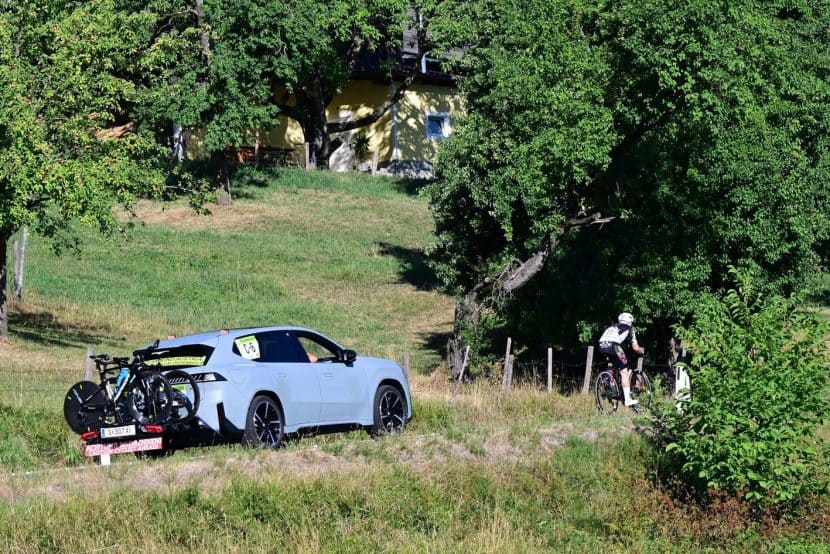


A cyclist pedaled 560 kilometers around the borders of Upper Austria. His support vehicle, a BMW iX3 50 xDrive loaded with five passengers and roughly 400 kilograms of gear, followed him the entire way without stopping to charge. When the finish line came, the battery still had juice for another 100 kilometers.
Mario Grünberger, a BMW employee at the Steyr plant, entered the Race Around Austria Challenge for the fourth time. The route traced the perimeter of Upper Austria across 6,500 meters of elevation gain, which means the iX3 wasn’t cruising flat highway the whole way. It was climbing, descending, crawling behind a cyclist, then accelerating to leap ahead and set up the next supply point.
That is brutal duty for any powertrain. Grünberger and his crew finished in 19 hours and 47 minutes. The iX3 provided food, water, navigation, and headlights after dark.
Five friends rode inside the entire time. The SUV was working, not posing.
BMW says the remaining range at the finish suggested the iX3 could have covered close to 700 kilometers under those same conditions. That figure sits well short of the 805-kilometer WLTP lab number, but lab numbers have never survived contact with passengers, cargo, and alpine roads. The gap between 700 real-world kilometers fully loaded and 805 on paper is actually one of the smaller discrepancies the industry has produced lately.
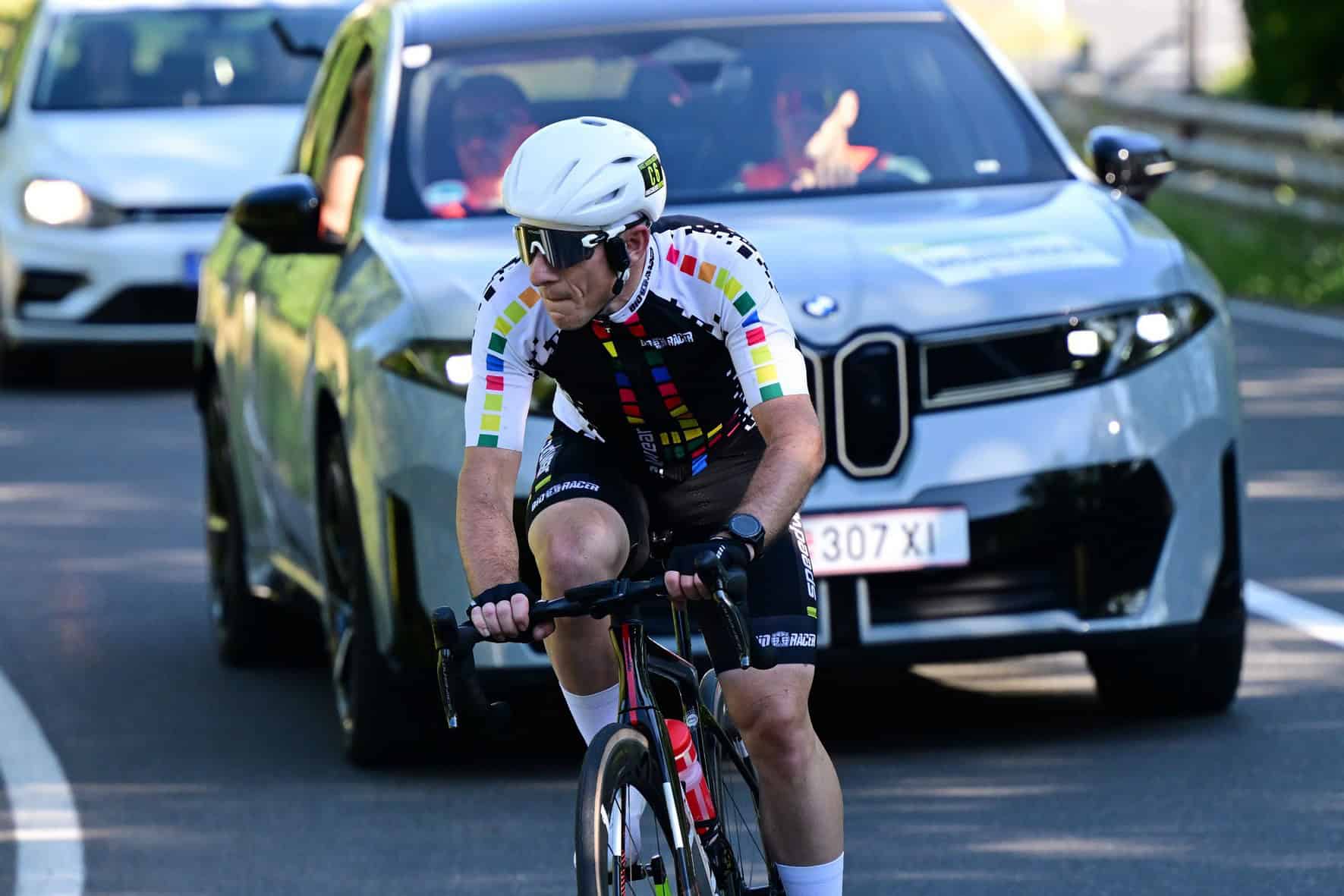
Strip the 882 pounds of payload out and the number climbs further. BMW is clearly keen to make that point, and the math supports it. Weight kills efficiency in any vehicle, and the iX3 was essentially running as a packed shuttle bus on mountain roads.
This is not the first long-range stunt BMW has staged with the Neue Klasse crossover. Earlier in 2026, the long-wheelbase Chinese-market iX3 covered 1,030 kilometers from BMW’s Shenyang factory to its Beijing R&D center on a single charge, exceeding the official CLTC rating by more than 100 kilometers. That was a controlled highway pull with optimal conditions.
Austria was the opposite: real terrain, real load, and a pace dictated by a man on a bicycle. The two tests together sketch a picture of an EV with a genuinely usable battery. The 805-kilometer WLTP claim looked aggressive when BMW announced it.
Watching the car survive a day-long endurance event in the Alps while hauling nearly half a ton of humans and supplies makes the number feel less like marketing and more like engineering.
Grünberger also raised money during the ride, with one euro donated per kilometer to BMW Steyr’s employee association supporting workers and families in difficult circumstances. That detail got buried in the press release, which tells you where BMW’s priorities were. The charity was real, but the headline was the battery.
Range anxiety remains the single biggest barrier to EV adoption in markets where charging infrastructure is thin. BMW knows this. Every one of these endurance demonstrations is designed to chip away at that hesitation, and the Austrian test may be the most convincing yet because it was the least controlled.
No hypermiling. No empty cabin. No flat roads. What BMW proved in Austria is that even when everything stacks against the car, the iX3 still finishes the job.
Whether competitors can match that cushion with their own next-generation platforms is a question nobody has answered yet.

Share this Story