
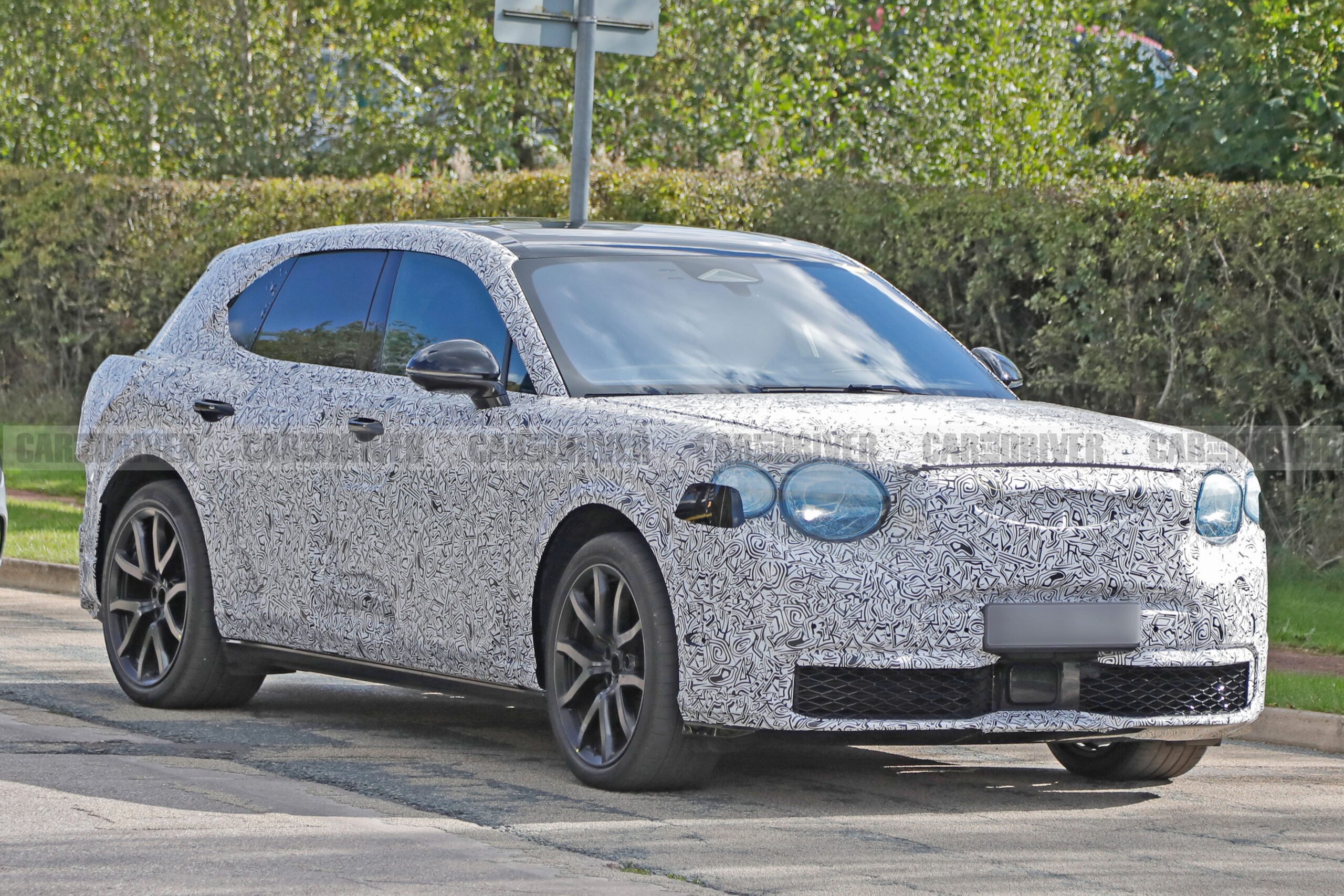


Bentley has decided that the soundtrack for its first electric vehicle won’t be a synthesized engine note. It’ll be drums.
The British marque revealed this week that the Torcal, its all-electric SUV slated for a September debut, will greet heavy throttle inputs with a percussion-driven composition inspired by, but deliberately not imitating, the combustion engines that made Crewe famous.
Engineers disassembled the acoustic signatures of Bentley’s inline-sixes from the 1930s, the legendary six-and-three-quarter-liter V-8, and the W-12 that powered two decades of Continental GTs. What they found, stripped to its mechanical essence, was rhythm. The four-stroke combustion cycle’s exhaust pulse, they concluded, shares its fundamental character with a drumstick striking a bass drum head.
It’s not a crazy observation. A big-bore American V-8 loping at idle has always been percussion. A Top Fuel dragster shakes your ribcage like a kick drum tuned to destroy furniture.
But Bentley isn’t building a muscle car. The Torcal’s sound design layers stringed instruments over the percussive foundation, aiming for something more orchestral than arena rock. And there’s one detail that reveals just how deep the obsession goes: engineers programmed a barely perceptible rhythmic imperfection into the output, mimicking the way a human drummer drifts microscopically off the beat. A machine pretending to be imperfect so it can feel more alive.
This is where the EV sound wars have landed. Hyundai’s Ioniq 5 N synthesizes turbo four-cylinder pops and bangs, cosplaying as a hot hatchback. Rolls-Royce went the opposite direction with the Spectre, making near-silence the product. Bentley is carving a third path, acknowledging that its customers expect something visceral but refusing to fake an engine note that no longer exists.
Every luxury EV maker faces the same void. Electric motors produce torque in abundance but drama in none. For brands whose identities were built on mechanical sensation, silence isn’t serenity. It’s an identity crisis.
There are only so many ways to solve it. You can fake the old sounds, which always rings hollow. You can embrace the silence, which works for Rolls-Royce because Rolls-Royce was never about driving thrills. Or you can invent something new and hope it carries enough emotional weight to justify a six-figure price tag.
Bentley is betting on invention. Whether a drum track can replace the W-12’s complex harmonic bellow when you flatten the accelerator on a Continental GT is an open question. The company says the system can be switched off entirely for customers who prefer their Bach uninterrupted by synthetic percussion.
That opt-out tells you something. Bentley isn’t fully confident this will land with everyone. It’s offering an experience, not imposing one.
The Torcal itself remains mostly under wraps. Bentley has confirmed the 2028 model year SUV will arrive as the brand’s first series-production EV. The platform, pricing, and performance specs are still months away.
But the sound question matters more than specs for a company like Bentley. Horsepower and torque figures are table stakes in the EV era. Any well-funded startup can deliver face-melting acceleration. The differentiator for legacy luxury brands is everything that surrounds the numbers, the craft, the sensation, the theater.
Bentley just decided its theater needs a drummer. Not a machine, not a loop, but a drummer who isn’t quite perfect, playing along to the ghost of engines that no longer exist. It’s either brilliantly creative or deeply strange. Probably both.
Share this Story