
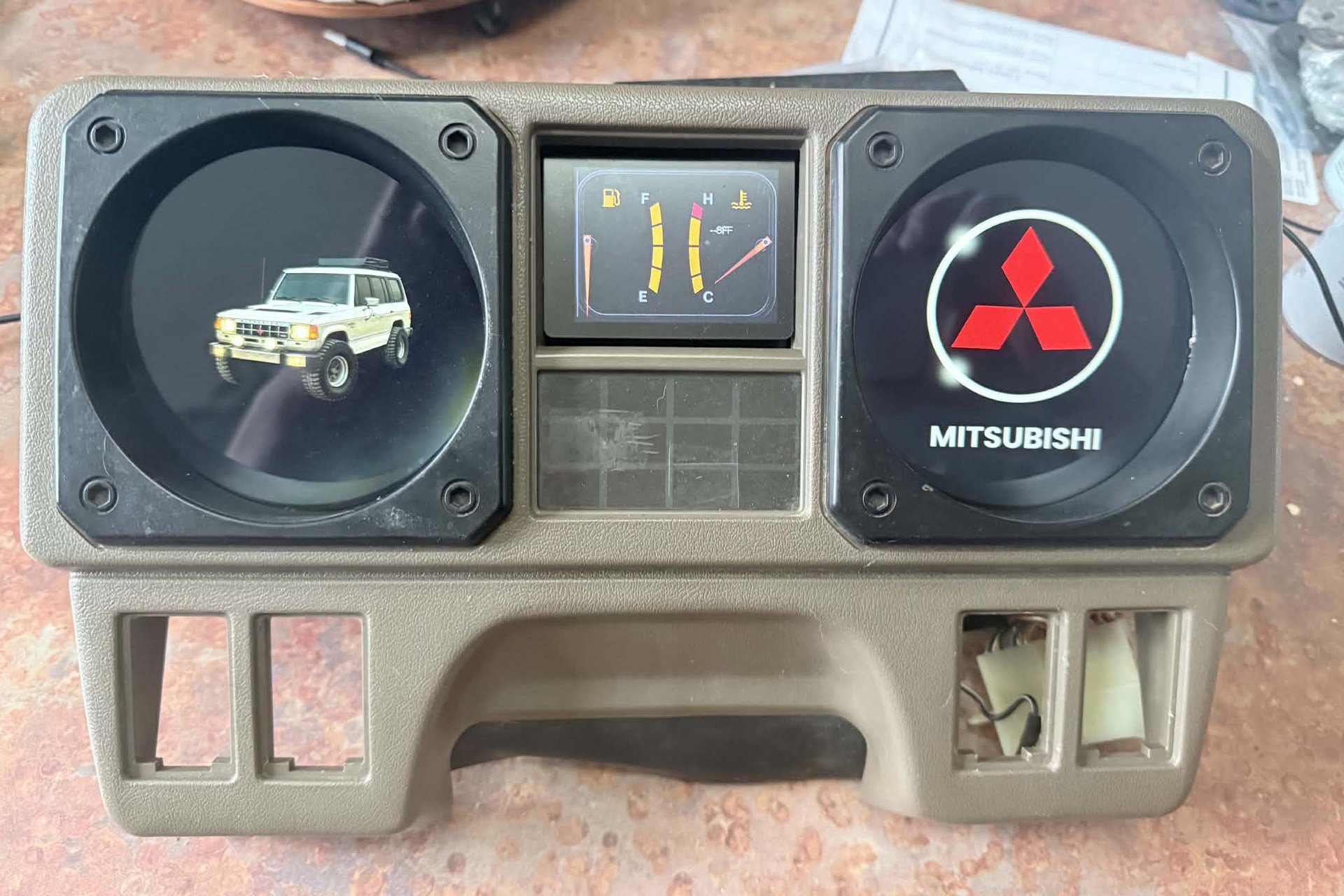


Tyeler Andersen’s 1991 Mitsubishi Montero runs a boosted LS V8 with three power settings: Street at 500 horsepower, Prison somewhere around 600 to 650, and Death north of 800. The names aren’t random bravado. Andersen rolled the truck once at 600 hp, so he figured maxing it out probably earns the label.
But the wildest part of this build isn’t under the hood. It’s behind the steering wheel.
Rather than slapping a generic touchscreen where the factory gauges used to live, Andersen built a digital cluster from scratch using an ESP32 microcontroller and Waveshare displays running LVGL, a graphics library that lets you design visual interfaces and convert them into code. The result looks almost indistinguishable from the original Montero instrumentation, right down to the needle sweep and odometer font. Except it boots up with a spinning 3D render of his personal truck.
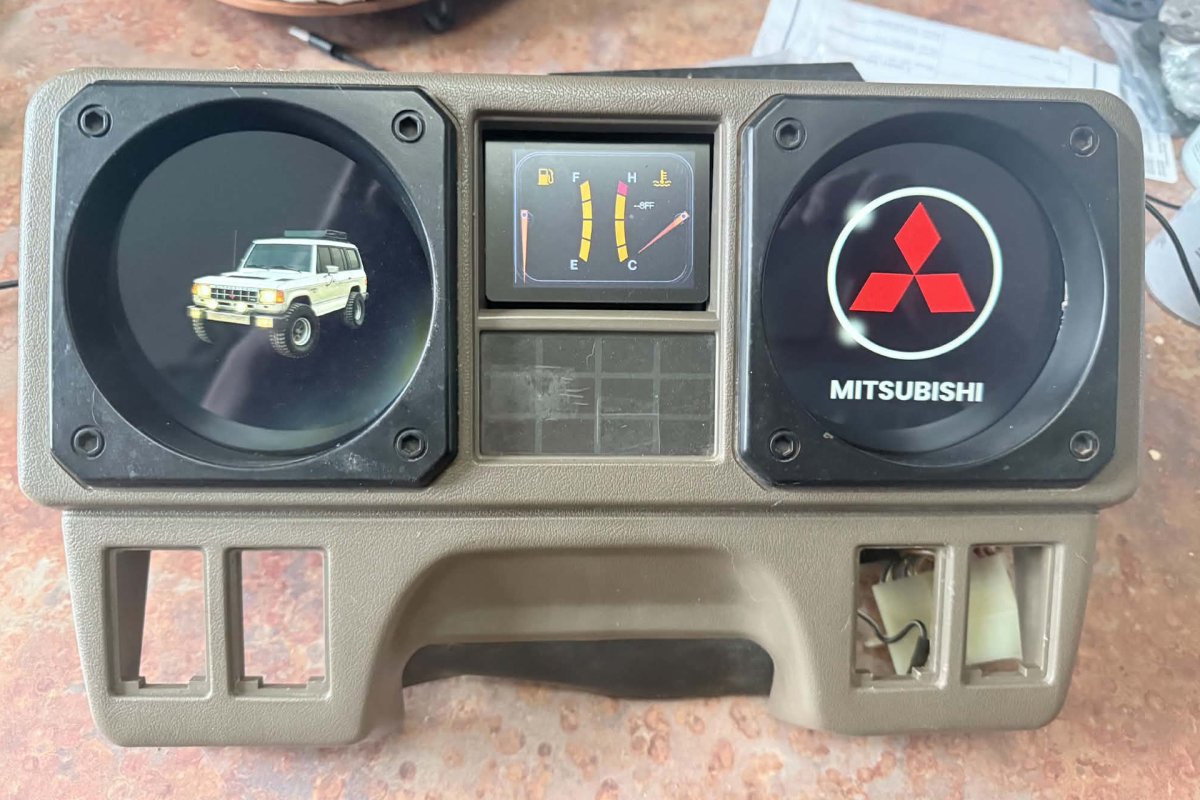
The process started with a cell phone photo of the stock cluster. Andersen fed it into ChatGPT and asked for an LCD-style recreation, then spent hours manually tweaking needle designs, trip meter layouts, fonts, and colors until the digital version felt right. Finding exact replica typefaces proved impossible, so he got as close as he could and moved on. Perfection wasn’t the goal.
He credits Travis.cea on YouTube for teaching him the foundational skills, but there was plenty of original problem-solving involved. The tachometer had to display rpm in real time, which demands constant processing power. The transfer case interface, by contrast, only updates when a new drive mode is selected, keeping the system from bogging down.
The whole setup cost about $300 in parts. That’s actually more expensive than sourcing a working factory cluster for a first-gen Montero. But Andersen’s truck doesn’t run a stock mechanical transmission anymore.
The factory gauges were cable-driven, and his electronic swap made the old unit incompatible. Building a custom digital solution wasn’t just cooler. It was the practical path.
This is what most automakers get wrong about digital gauges. Ford nailed it years ago with the Fox Body Mustang cluster by keeping the design rooted in the car’s identity. Too many modern screens feel like someone handed the instrument panel to a UI designer who had never sat in the driver’s seat.
Andersen, working alone in his garage with commodity hardware and open-source software, understood something billion-dollar companies keep missing: the gauges should feel like they belong in the vehicle.
The swipeable screens add functionality the original cluster never had. The transfer case controller lets him toggle between those three power modes with visual confirmation on the display. And because it’s all custom code running in VS Code, he can add or modify features whenever he wants.
At some point, the tools to do this kind of work became accessible enough that a guy with a $300 budget and some patience can build something more thoughtful than what rolls off a factory line. Andersen’s Montero is a one-off, a 34-year-old Japanese SUV with an American V8 making four-digit potential and a handmade digital dash that still looks like it came from Mitsubishi in 1991. The question isn’t whether more people will try this, but how long before the aftermarket catches up.
Share this Story