
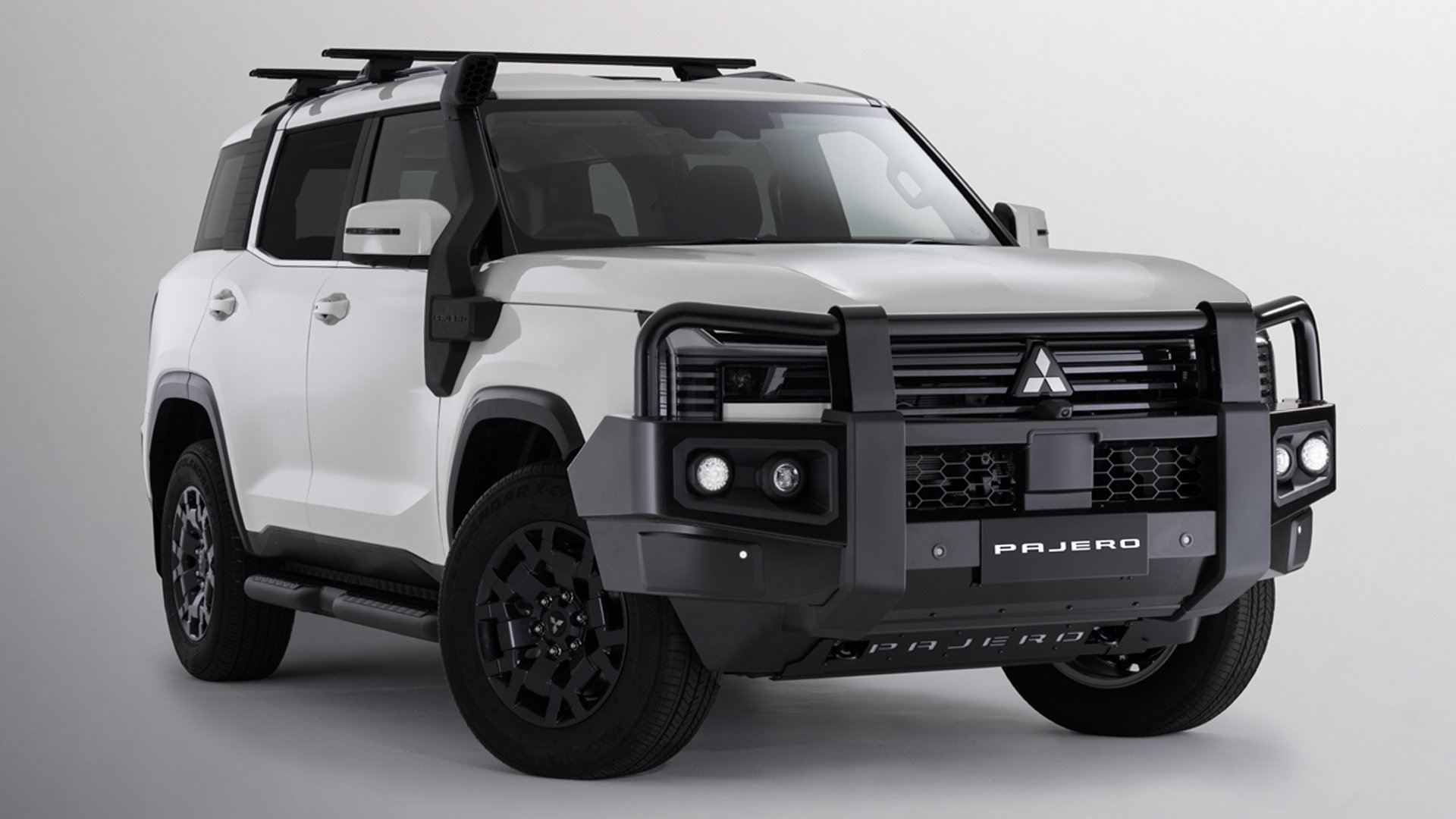


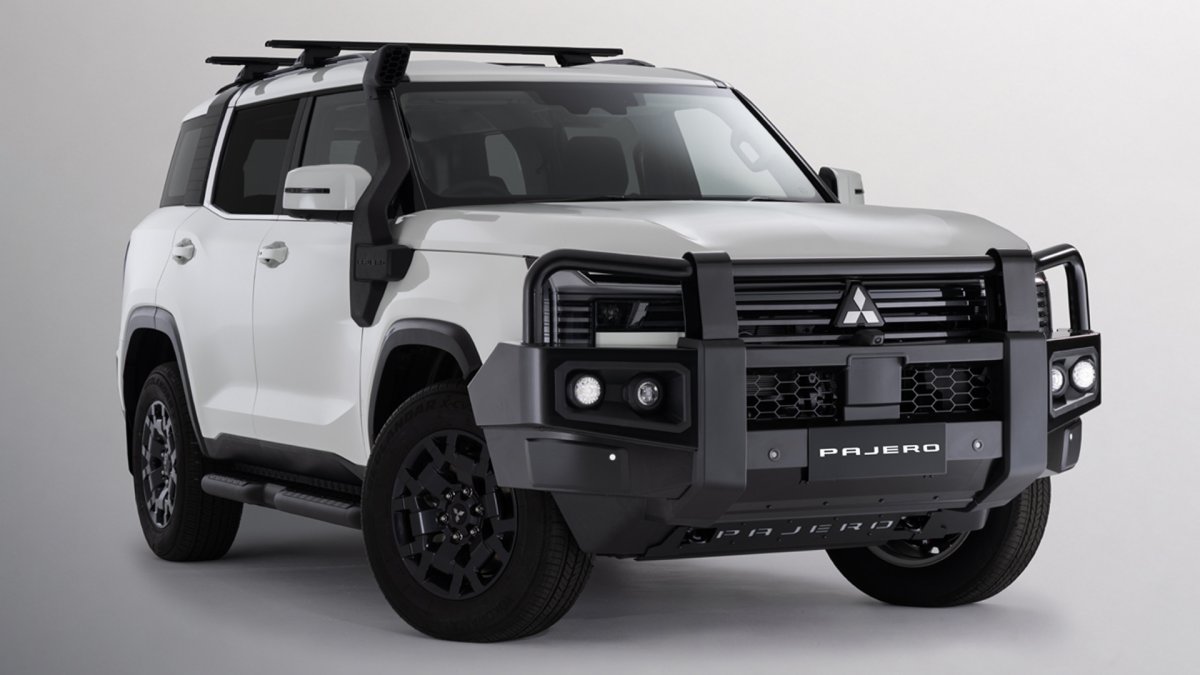
Mitsubishi dropped the new Pajero this week, and the teaser image from Australia tells you everything you need to know about who this truck is really built for. Bolted to the front is a massive steel bull bar, straight from the factory accessory catalog, flanked by a snorkel and underside skid plate. It looks like something out of a video game, but it is not.
Americans knew this truck as the Montero before it quietly exited the U.S. market two decades ago. The three-row off-roader kept selling overseas as a cheaper alternative to the Toyota Land Cruiser, and in Australia it never lost its relevance. The new generation is being positioned the same way, with Mitsubishi promising accessories “designed for Australian conditions.
The steel bumper may be manufactured by ARB or another aftermarket specialist, but it carries an OEM part number. Toyota offers the same kind of setup on the 300 Series Land Cruiser sold in Australia. These are not bolt-on vanity projects; they are survival equipment.
In the United States, front-end bull bars are mostly cosmetic, a suburban aesthetic borrowed from a world the truck will never see. Pedestrian safety regulations and front sensor arrays have all but killed the functional version here. In Australia, the calculus is completely different.
The country is roughly the same size as the contiguous U.S. but holds about a tenth of the population. Once you leave the coastal cities, you enter vast corridors of nothing, where kangaroos the size of linebackers and flocks of emus share the road with trucks doing highway speed in the dark. Collisions are not rare events. They are routine.
Andrew Collins, executive editor at The Drive and a former off-road tour guide in Australia, described the reality in blunt terms. He ran 17-day trips where the last traffic light appeared on day one and the next one didn’t show up until the final stretch. He lost count of how many kangaroos he hit. In some outback stretches, he wrote, they “bounce off your bumper like bugs.”
This is not a country with lax safety standards. Australia enforces speed limits more aggressively than the U.S., sets a lower legal blood alcohol limit, tightly regulates firearms, and puts beginner drivers through a far more rigorous licensing process. The bull bar exists not because regulators look the other way, but because the data justifies prioritizing vehicle and occupant protection over pedestrian impact standards in regions where the nearest pedestrian may be 200 kilometers away.
That distinction matters as American truck buyers increasingly dress their vehicles in aggressive front-end armor that serves no functional purpose while adding weight and reducing crash safety for anyone unlucky enough to be on foot. The accessories look the same. The justifications do not.
Mitsubishi has not released the full options list for the new Pajero, and pricing remains unknown. This is a truck aimed squarely at buyers who need a Land Cruiser but cannot or will not pay Land Cruiser money. The Australian market, where the Pajero name still carries weight, will be the proving ground.
Whether the new Pajero ever returns to the U.S. as the Montero is a question Mitsubishi has not answered. Given current pedestrian safety trends and tightening emissions targets, that steel bumper would never make it past homologation anyway.
Share this Story