
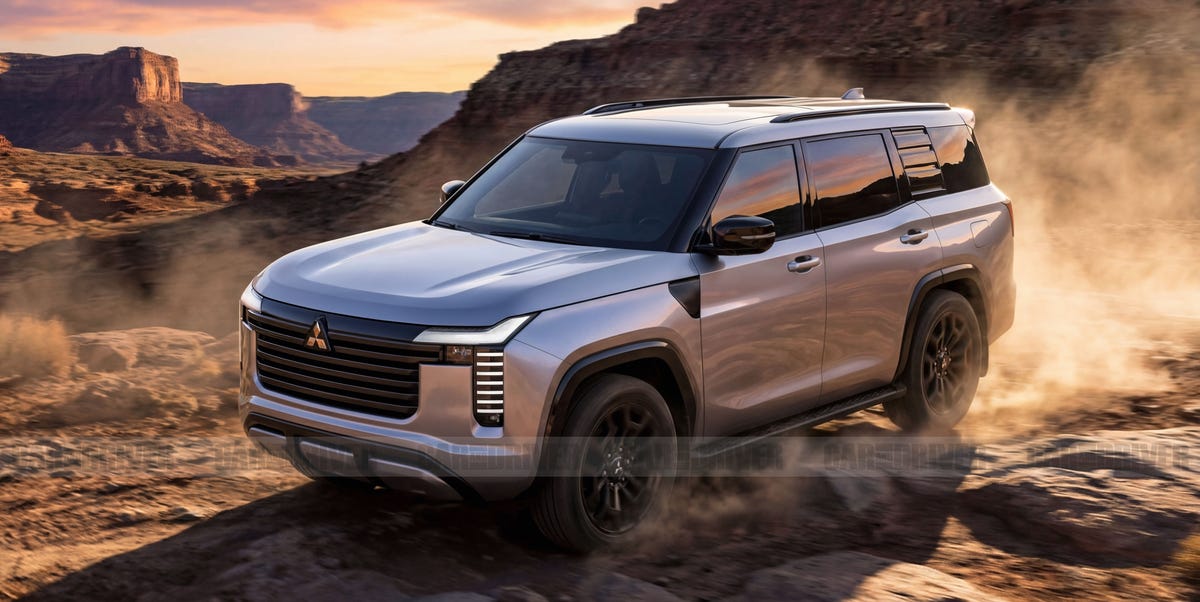


Mitsubishi gathered its North American dealers behind closed doors on June 5 and showed them something the brand has desperately needed for years: actual prototypes. Four new or overhauled models are coming between 2027 and 2030, anchored by a body-on-frame Montero SUV that would compete with the Toyota Land Cruiser. The catch? That flagship won’t arrive until the end of the decade.
The plan is called Momentum 2030, and it promises a new or upgraded model every year through March 2031. On paper, it’s ambitious. In practice, Mitsubishi is asking dealers and customers to remain patient with a brand that has been coasting on aging product for far too long.
The sequence starts with the Eclipse Sportback, a small electric SUV hitting showrooms late this year. By mid-2027, an upgraded Outlander Trail Edition arrives with more ground clearance, revised suspension, and tweaked AWD hardware. Neither of those moves the needle dramatically.
The real shake-up comes in the second half of 2028, when both the Outlander and Outlander Sport shift to entirely new platforms. The Outlander Sport prototype shown to dealers apparently wore a full adventure kit — roof rack, ladder, all-terrain tires, push bar — suggesting Mitsubishi sees the off-road lifestyle market as its lane. The larger Outlander gets sleeker LED headlights and a cleaner front end, pushing it in a more refined direction.
Then comes a mid-size pickup in 2029, built on Nissan’s Frontier platform. The design draws from the Mitsubishi Triton sold in Asia, and the truck represents the kind of platform-sharing arrangement that makes financial sense for a small-volume player. Mitsubishi isn’t spending the money to engineer a truck from scratch. It doesn’t have that kind of money.
The crown jewel is the Montero, and it carries the weight of nostalgia that Mitsubishi has been unable to cash in on for over two decades. The new SUV revives the Pajero nameplate in Asia, where it debuts later this year as a body-on-frame, three-row off-roader roughly the size of a Land Cruiser. It rides on the Triton’s platform, offers about 12 inches of ground clearance, and trades the iconic swinging rear door for a conventional hatch.
A North American version badged as Montero is targeted for 2030, according to Automotive News. Four years is a long time to wait for a halo product. The off-road SUV market that barely existed when the last Montero left U.S. shores in 2006 is now fiercely competitive.
Toyota brought back the Land Cruiser. Ford revived the Bronco. Jeep has the Wrangler locked down. By 2030, the field will be even more crowded.
Mitsubishi’s North American market share has been hovering near irrelevance for years, propped up by the Outlander and not much else. The brand sold roughly 102,000 vehicles in the U.S. last year — a rounding error compared to Toyota or Ford. Dealers need product now, not promises stretched across a five-year timeline.
Still, showing working prototypes to the dealer body is a different posture than PowerPoint slides and vague commitments. Mitsubishi has talked about North American reinvention before and delivered little. This time there are physical vehicles, shared platforms with Nissan to control costs, and a calendar with specific milestones.
Whether the market will still be waiting when the Montero finally arrives is the billion-dollar question Mitsubishi cannot answer yet.
Share this Story