
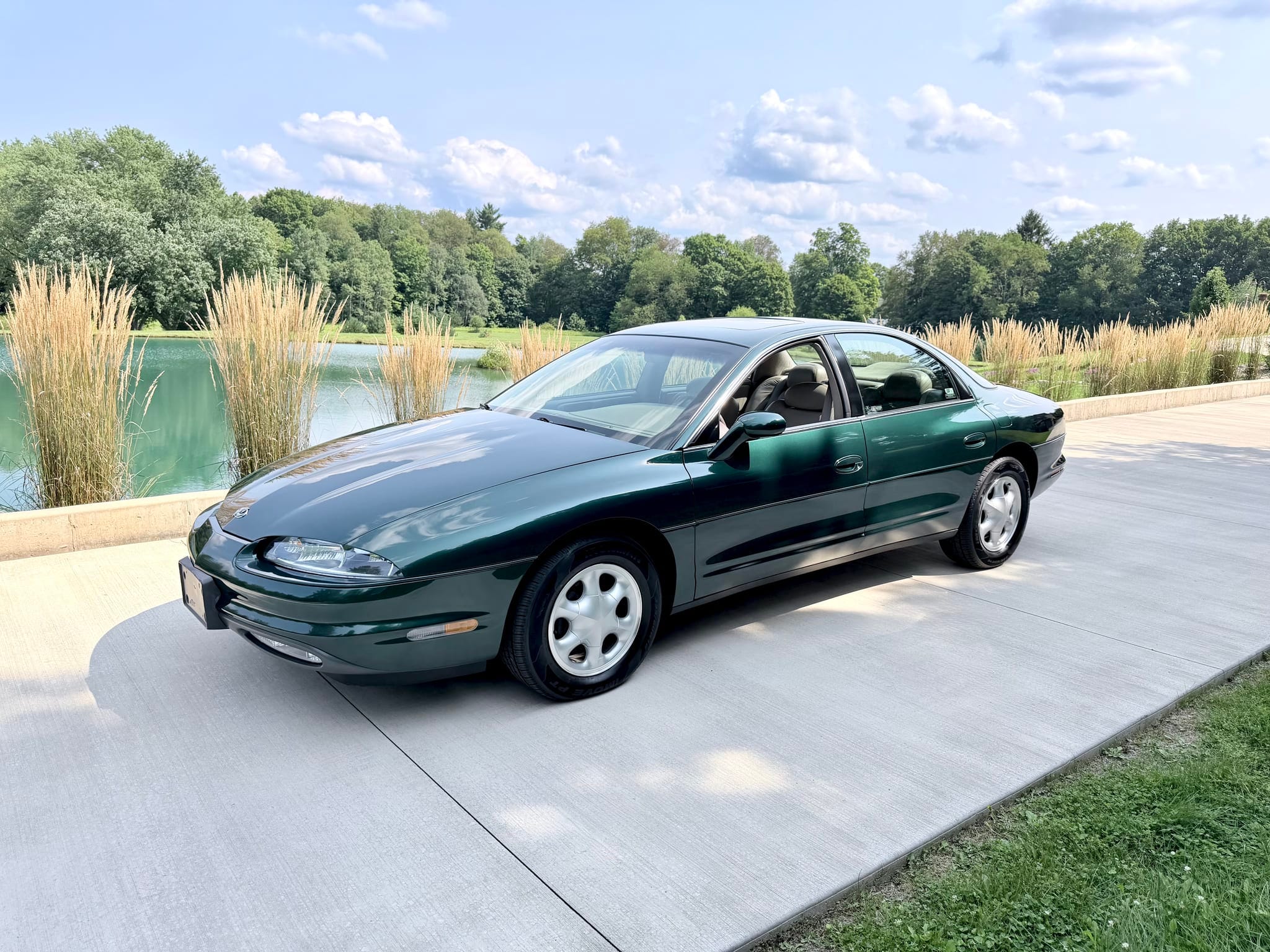


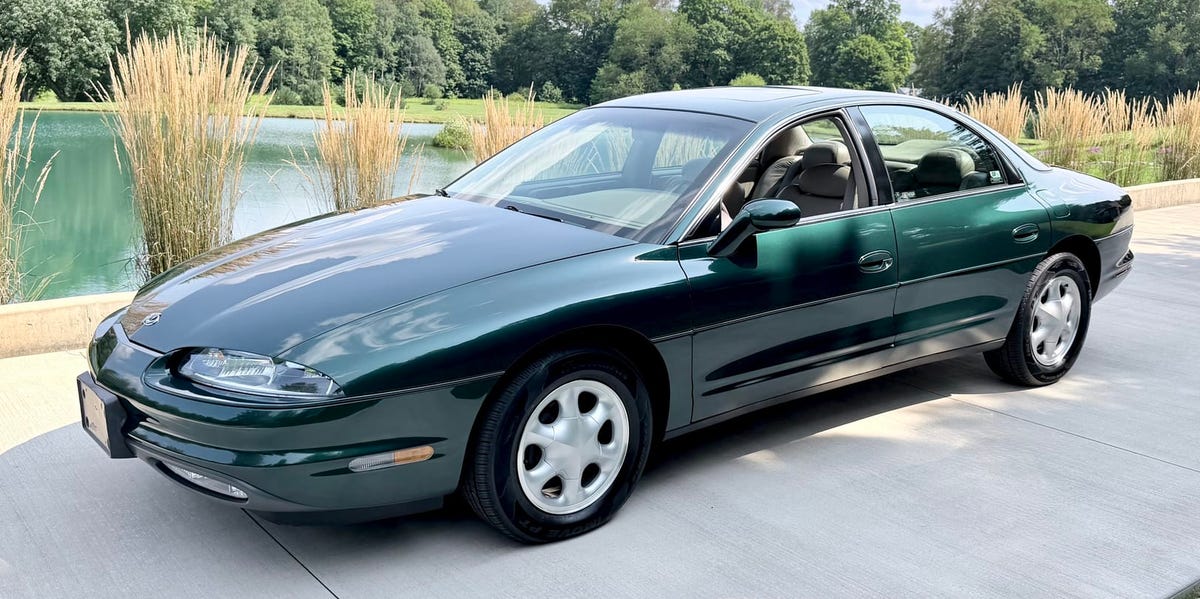
A 1995 Oldsmobile Aurora with just 8000 miles on its odometer is sitting on Bring a Trailer right now, looking like it rolled off the assembly line yesterday. Green over sandstone leather, a 4.0-liter V-8 under the hood, and three decades of near-total neglect in the best possible sense. The auction closes September 23.
This is the car GM built to save Oldsmobile. It didn’t.
The Aurora’s 4.0-liter was derived from Cadillac’s Northstar V-8, featuring double overhead cams and an all-aluminum block. It made 250 horsepower and 260 pound-feet of torque, routed through a four-speed automatic. Not exactly a sports sedan, but more than enough to eat highway miles with the quiet confidence of something twice its price.
What most people have forgotten, if they ever knew, is that a version of this same engine powered Oldsmobile’s Aerotech endurance racers. In December 1992, three of those machines circled a Texas test track at 180 mph, day and night, for more than a week. They racked up 47 world speed records.
Then Oldsmobile, in a move so perfectly Oldsmobile, apparently forgot to tell anyone about it. That failure to communicate was always the brand’s fatal flaw. The hardware was real, but the marketing was invisible.
The Aurora had a drag coefficient that rivaled European GTs, an interior that was genuinely plush, and a powertrain with legitimate racing pedigree. It should have been a turning point. Instead it became a footnote.
Oldsmobile limped along for another nine years before GM finally pulled the plug in 2004, ending a brand that had been building cars since 1897. The Aurora was the last serious attempt to give it a future, and the fact that a car this good couldn’t save the division tells you everything about how GM operated in the 1990s. Too many brands, too little differentiation, and a corporate culture allergic to letting any single nameplate break from the herd.
This particular example, with its vanishingly low mileage, exists as a museum piece for a brand that never got its own museum. Someone bought it new, drove it almost nowhere, and kept it preserved through the Clinton administration, the Bush years, the Obama era, and beyond. That kind of restraint borders on cruelty when the car was built to cross continents.
The first-generation Aurora, produced from 1995 to 1999, started around $31,000 new. Adjusted for inflation, that is north of $60,000 today, which puts it squarely in the territory of a well-equipped Genesis G80 or a base BMW 5 Series. The comparison is not flattering to the modern cars, because the Aurora’s V-8 gives it a character that no turbocharged four-cylinder can replicate.
Bring a Trailer auctions for cars like this tend to attract two kinds of bidders: collectors who see emerging value in unloved GM products, and enthusiasts who simply want a comfortable V-8 cruiser for weekend duty. Either way, the price will almost certainly land well below what this car cost new. That makes it one of the cheaper ways to own a genuine piece of automotive ambition, even if that ambition was ultimately wasted.
Oldsmobile ended production in April 2004. The last car off the line was an Alero, a forgettable compact that couldn’t have been further from the Aurora’s aspirations. Somewhere in that gap between the flagship and the farewell lives the entire story of how a 107-year-old brand simply ran out of reasons to exist.
Bidding is active. The odometer still reads 8000.
Share this Story