
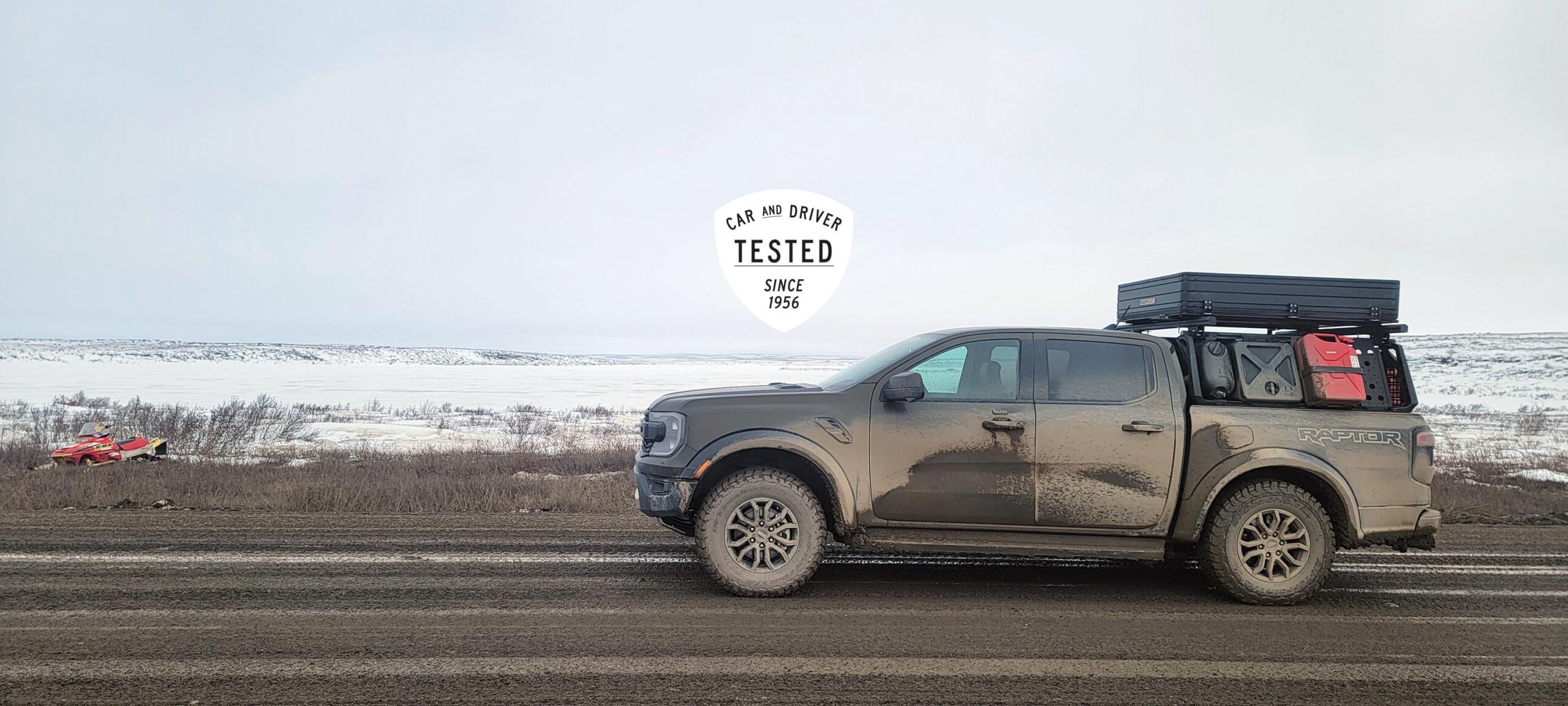


Car and Driver strapped 446 pounds of overland gear onto its long-term 2026 Ford Ranger Raptor, then took it to the test track. The truck got slower, thirstier, and, in one surprising twist, actually stopped shorter.
The setup included a bed rack loaded with gear pods, a water dispenser, three tanks of gas, and a rooftop tent perched on top of the five-foot cargo bed. All of it came back from an 8,000-mile round trip through northern Canada, still bolted on and ready to be measured against the truck’s baseline numbers.
Without gear, the Ranger Raptor weighs 5,358 pounds and hits 60 mph in 5.2 seconds. Loaded up at 5,804 pounds, that number ballooned to 5.8 seconds. The quarter-mile went from 13.9 seconds at 98 mph to 14.6 seconds at 93 mph.
None of that is shocking. Nearly 450 pounds of dead weight riding high on the frame is not a recipe for straight-line speed.
The fuel economy hit was predictable too, but the cause was more aerodynamic than gravitational. The rooftop tent, with its blunt edges punching a hole through the air at highway speed, dragged the truck’s 75-mph fuel economy from 18 mpg down to 16 mpg. Two miles per gallon may not sound catastrophic until you calculate it across an 8,000-mile expedition. That is roughly 55 extra gallons of fuel burned.
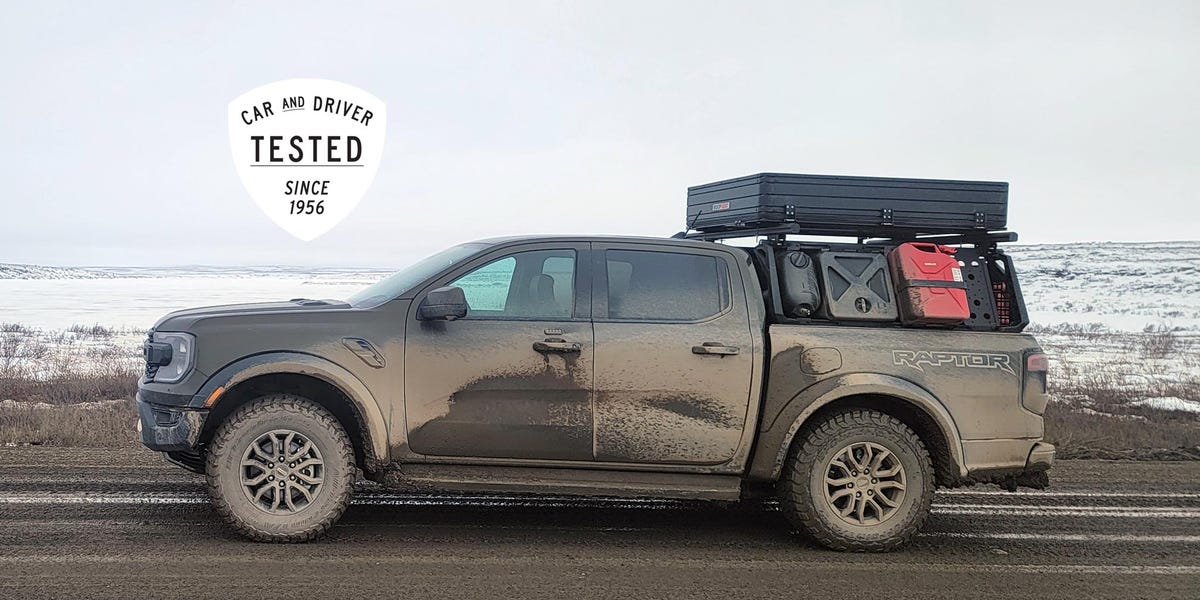
The surprise was in the brakes. The heavier Ranger Raptor stopped from 70 mph in 211 feet, a full 12 feet shorter than the lighter version.
The explanation is simple physics. With most of the additional weight sitting over the rear axle, the truck’s front-to-rear weight distribution shifted from a nose-heavy 55.2/44.8 split to a near-perfect 50.3/49.7 balance. That meant the rear BFGoodrich All-Terrain T/A KO3 tires were finally doing their fair share of the braking work instead of just going along for the ride.
It is a useful data point for anyone building an overland rig. You will lose acceleration and fuel economy, but if you load the weight correctly, you can actually improve your truck’s emergency stopping ability. That is not nothing when you are descending a gravel switchback in British Columbia.
The broader lesson here applies to every overlander who bolts a full campsite onto a midsize pickup and then wonders why the thing drives differently. The Ranger Raptor’s twin-turbo 3.0-liter V-6 makes 405 horsepower, which is plenty for a truck this size. But horsepower does not overcome drag coefficients, and no engine tune fixes the aerodynamic penalty of a canvas box on the roof.
Car and Driver noted that passersby loved the look. A truck bristling with gear pods and a folding tent has a militaristic, expedition-ready appeal that turns heads at gas stations. Whether those admirers would accept 14.6-second quarter-miles and 16 mpg highway is another question entirely.
The magazine plans to strip the overland accessories and install a tonneau cover, which should claw back most of the aero losses. That swap alone will tell us something valuable about how much of the fuel economy penalty came from weight versus wind resistance.
For now, the numbers confirm what experienced overlanders already know but rarely quantify. Every pound and every square inch of frontal area costs something. The Ranger Raptor just happens to be the first truck with hard data attached to the trade-off.



Share this Story