


Volkswagen of America rolled out a suite of updates to its IQ.Drive advanced driver assistance system for model-year 2027 vehicles last week, touching the Atlas, Golf, ID. Buzz, and Tiguan. Buried in the list of new features is a telling detail: one of the most useful upgrades requires a paid subscription after a one-year trial expires.
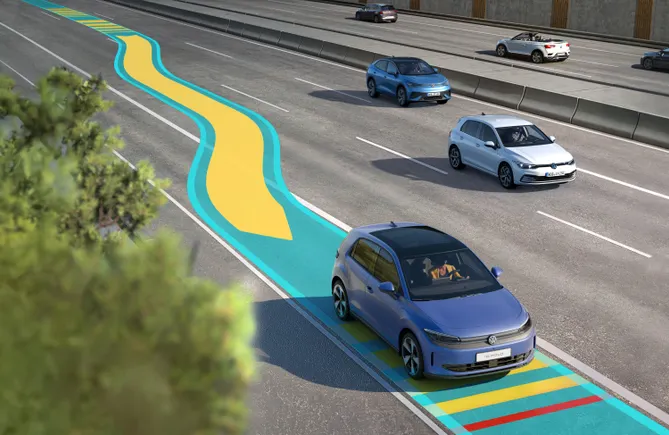
The feature is called Road Experience Management. It uses cloud-based data, including real-world lane markings, signage, and street lighting, to fill gaps that cameras alone can’t cover. If painted lane markers are faded or missing, the system relies on map data to keep the ID. Buzz centered in its lane.
It is exclusive to the electric van and bundled into VW’s In-Vehicle Premium subscription tier. Pricing after the free year has not been disclosed.
The rest of the IQ.Drive updates are standard hardware and software additions that don’t require a monthly fee. Travel Assist now lets drivers initiate automatic lane changes at speeds above 45 mph by flicking the turn signal stalk. Rear radar sensors check adjacent lanes, and a new “on-hold wait-to-clear” function will pause the maneuver for up to 12 seconds if traffic is present.
A green arrow animation tells drivers when the path is open.
Adaptive cruise control gets a predictive algorithm designed to smooth out speed transitions and reduce the lag caused by traffic-sign recognition. Before adjusting speed automatically, the system pops up a prompt. Drivers accept or reject the change by tapping the accelerator or pressing the “Res” button on the steering wheel.
Emergency Assist Plus is the most dramatic addition. If the system detects a possible medical emergency, it can steer the vehicle to the shoulder or the farthest right lane, shift into Park, flash the hazards, honk the horn, unlock the doors, turn on the lights, and initiate an emergency call. It only works when Lane Assist or Travel Assist is already active.
On the Atlas, ID. Buzz, and Tiguan, a new rearview camera system standard on select trims can detect pedestrians behind the vehicle while reversing at speeds between 1 and 6 mph, applying the brakes automatically.
VW is not alone in layering these features across its lineup. An AutoPacific survey of 19,000 licensed drivers this year found automated parking, lane change assist, and automatic emergency braking among the 15 most desired features out of 160 options. Driver trust in these systems also climbed between 2024 and 2026.
That rising trust is precisely what makes the subscription play worth watching. Automakers have spent years conditioning buyers to rely on driver-assist technology, and now the question is how much of it stays baked into the purchase price and how much migrates to recurring revenue.
BMW tried charging a subscription for heated seats in some markets and retreated after backlash. Tesla charges $99 a month for its Full Self-Driving package. VW is carving a middle path, keeping most features standard while gating one data-dependent capability behind a paywall.
Thomas Zorn, VW’s VP of vehicle safety in the U.S., framed everything around customer protection and confidence. The company is also in the middle of a bruising restructuring that could eliminate up to 50,000 jobs globally and is pivoting toward more rugged vehicles for American buyers.
Whether Road Experience Management stays subscription-only or eventually folds into the base package may depend entirely on how many ID. Buzz owners let that free trial lapse.
Share this Story