
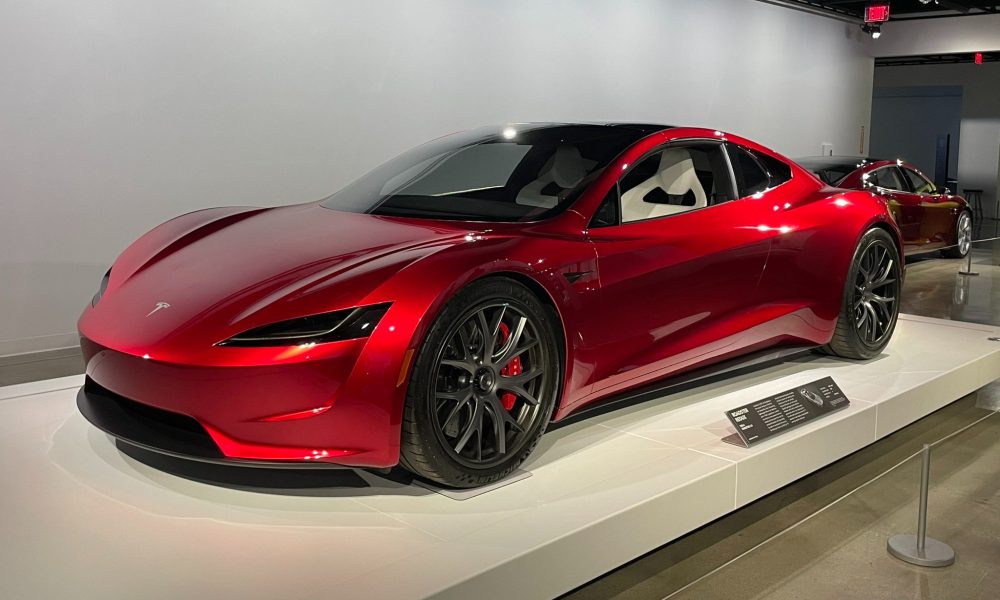


A patent granted to Tesla on September 29 describes a ducted-fan system designed to suck the upcoming Roadster onto the pavement, generating downforce at any speed, including a standstill. The filing landed two weeks before the Roadster’s outdoor unveiling event, which was recently delayed due to weather concerns.
The concept is simple and old. A ducted package sits in the rear of the car. An underbody inlet between the rear wheels feeds air through a duct rising to a wide outlet in the diffuser, where four axial fans separated by vertical strakes pull air from beneath the floor.
Gordon Murray figured this out in 1978. His Brabham BT46B used a rear-mounted fan to extract air from under the car, generating so much grip that Niki Lauda won its only race by over 30 seconds. Formula 1 promptly banned it. Nearly half a century later, Tesla wants to put something functionally similar into a street car.
The engineering logic is straightforward. Electric motors deliver peak torque instantly, but that torque is worthless if the tires break traction. Conventional aero devices like wings and diffusers only work when air is already moving fast across their surfaces, so at launch or in tight corners, passive aero contributes almost nothing.
Tesla’s patent claims the fans produce downforce independent of vehicle velocity. The system runs off the high-voltage battery and is controlled by the vehicle’s computers, so output can be dialed up or down in real time. Need extra grip for a standing launch? Fans spin up. Cruising on a highway where drag matters? They ease off.
The filing even claims the active airflow can reduce overall drag rather than add to it. That touches every performance metric Tesla has promised, including a sub-two-second 0-60 time and a top speed north of 250 mph. Active downforce at low speed would let those tires hook up harder during acceleration, shorten braking distances, and sharpen turn-in before a wing has enough airflow to matter.
Packaging remains the obvious question. Four fans in a rear diffuser have to deal with road debris, water ingestion, noise, and the heat management that comes with drawing power from a battery already feeding motors hungry enough to hit 250-plus mph. A patent is a document, not a production part.
But the timing here is hard to ignore. The Roadster event required restricted airspace, and the FAA granted it. Expectations for a SpaceX cold-gas thruster package persist, with Musk having suggested the car could hover. Pairing cold-gas thrusters with an active ground-effect fan system would be genuinely without precedent in a production vehicle.
The Brabham BT46B was too effective for racing. Tesla appears to be betting that what was too effective for competition is exactly effective enough for the street. Whether it can actually manufacture the system, manage its durability, and keep regulators comfortable with a fan car doing two-second launches on public roads is a set of problems no patent filing can answer.
The unveiling, weather permitting, is two weeks away.
Share this Story