
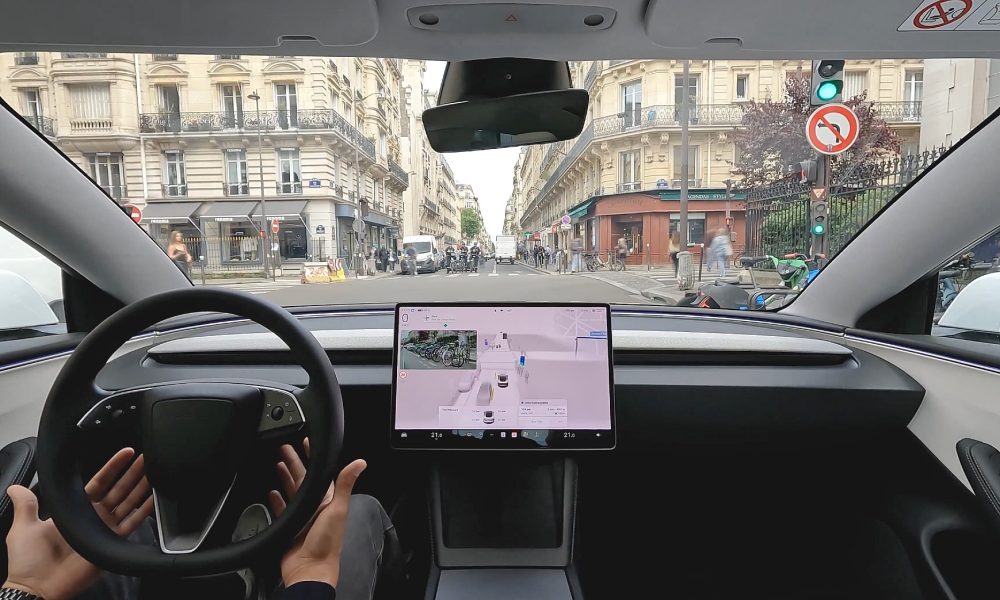


Elon Musk confirmed Monday with a single word what the industry already knew. No automaker has ever accepted Tesla’s open offer to license Full Self-Driving software. Not one.
The exchange happened on X, where Sawyer Merritt noted that Tesla has invited rivals to license FSD for years with nothing to show for it. Musk’s reply: “Exactly.” He made the same complaint back in November, calling the reluctance “crazy.” Tesla has been floating the offer publicly since at least 2021.
The easy comparison is to the Supercharger network. Tesla opened NACS to competitors, Ford and GM signed on within months, and the plug became the North American standard. Boom Supersonic founder Blake Scholl predicted FSD would follow the same path. It has not, and the reasons go deeper than corporate pride.
NACS was a connector. A physical plug spec. Adopting it required swapping a port and updating some firmware.
FSD is an entire nervous system. Licensing it means adopting Tesla’s eight-camera layout and its onboard compute hardware. A licensee’s vehicle would be a Tesla underneath someone else’s sheet metal. That is a fundamentally different proposition than plugging into a charger.
The data problem is even thornier. A licensed FSD stack would feed the same telemetry back to Tesla that its own fleet generates. Every intervention, every edge case, every route pattern from a competitor’s customers would flow straight into Tesla’s servers. For any automaker trying to build its own autonomy program, or simply trying to keep intervention rates and build quality data private, this is a deal-breaker dressed up as a partnership.
The timing makes the refusal look increasingly expensive. Waymo and Zoox are logging hundreds of thousands of unsupervised autonomous miles. Every automaker still selling Level 2 driver-assist systems that trail FSD is ceding the autonomy conversation to companies that are actually running driverless cars on public roads.
Licensing FSD would let a GM or a Ford skip a decade of development and billions in R&D. That math is obvious. But the cost on the other side of the ledger, the permanent dependency on Tesla’s hardware architecture and the surrender of fleet intelligence data, makes the calculus brutal. You do not hand your opponent a live feed of your weaknesses.
This is the tension no one at these companies will say out loud. They need to catch up. They cannot afford to catch up on their own. And the fastest route to competitiveness runs straight through the one company they least want to empower.
Some will try to split the difference. Partnerships with Mobileye, Qualcomm, or smaller autonomy startups offer a middle path, slower and less proven but without the surveillance trade-off. Whether those alternatives can close the gap before robotaxi networks make traditional car ownership less relevant is the real question hanging over Detroit.
Musk frames the refusal as irrational. From Tesla’s side, it is. Every car running FSD expands the training data pool, accelerates improvement, and deepens Tesla’s lead regardless of whose badge is on the hood. The offer is generous in exactly the way that benefits Tesla most.
The automakers see that clearly enough. They just have not figured out what to do about it. The offer sits on the table, untouched, growing more uncomfortable to ignore with every autonomous mile someone else logs.
Share this Story