
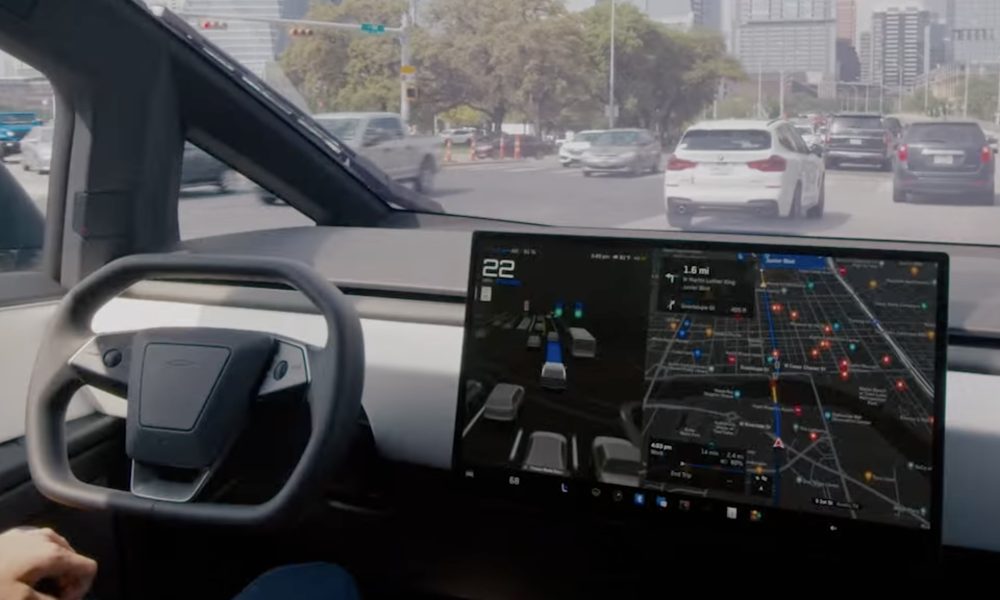


A Tesla owner in Texas posted a clip this week showing his car seize control of the steering just before he hit a curb. Spencer, who goes by @scotsrule08 on X, said the system “worked flawlessly,” reengaging Full Self-Driving on its own to avoid the collision. Ashok Elluswamy, Tesla’s head of AI, reposted the video with a line that read like a tagline: “A guardian angel always looking out for you.”
The feature is called Automatic Collision Evasion, and it shipped with FSD (Supervised) v14.3.9 inside software update 2026.27.6 earlier this month. A follow-up build, 2026.27.10, went out September 19 with refinements. A third, 2026.27.11, is now reaching another batch of vehicles. The rollout is staged, deliberate, and limited to HW4 hardware.
HW3 owners get FSD v14.2 Lite in the same updates. It does not include collision evasion. That distinction matters because a large share of Tesla’s fleet still runs on HW3.
Tesla’s release notes describe two scenarios where the system activates. The first is an imminent frontal collision where braking alone won’t cut it. The car can steer, brake, or accelerate around the hazard, but only on highways below 85 mph, with no pedestrians or cyclists in the frame and no slippery roads detected.
The second scenario covers driver inattention. Reaching into the back seat, looking away from the road, or accidentally disabling FSD can all trigger the system to take over. Spencer’s curb incident appears to fall into this category.
Once the car intervenes, the accelerator goes dead and light brake pressure won’t cancel the maneuver. The driver has to apply firm, deliberate steering force to regain control. A chime signals when the system is ready to hand the car back.
This is Tesla doing something no other automaker has shipped at scale. GM’s Super Cruise and Ford’s BlueCruise will disengage and hand control back to the driver when they detect trouble. Tesla’s approach does the opposite: it takes control away from the driver when the driver is the problem.
That is a fundamentally different philosophy, and it carries a different kind of liability.
The feature also represents a shift in how Tesla frames FSD itself. For years, the pitch has been about convenience, about the car driving so you don’t have to. Collision evasion repositions FSD as a safety net, something that watches even when you think you’re in charge. It turns the AI from a chauffeur into a co-pilot with override authority.
Elluswamy has already previewed what comes next. He said FSD v15 will bring earlier hazard prediction, faster reaction time, and better collision avoidance. No timeline has been given for that release.
The legal and regulatory framework around a car that can override its driver mid-maneuver remains thin. NHTSA has not issued specific guidance on systems that commandeer steering from an attentive driver who may simply disagree with the car’s assessment of danger. The line between saving a driver and overruling one is not always clean.
Tesla’s release notes try to draw that line with constraints: speed limits, road conditions, the absence of vulnerable road users. Whether those guardrails hold up in the messy reality of American roads, where cyclists appear from blind spots and rain starts mid-highway, is something no owner video can answer yet.
One clip of a curb save does not validate a system. But it does confirm the feature is live, functional, and making decisions faster than the person behind the wheel. The next test won’t be a curb. It will be a scenario where the car’s judgment and the driver’s judgment collide, and only one of them can be right.
Share this Story