
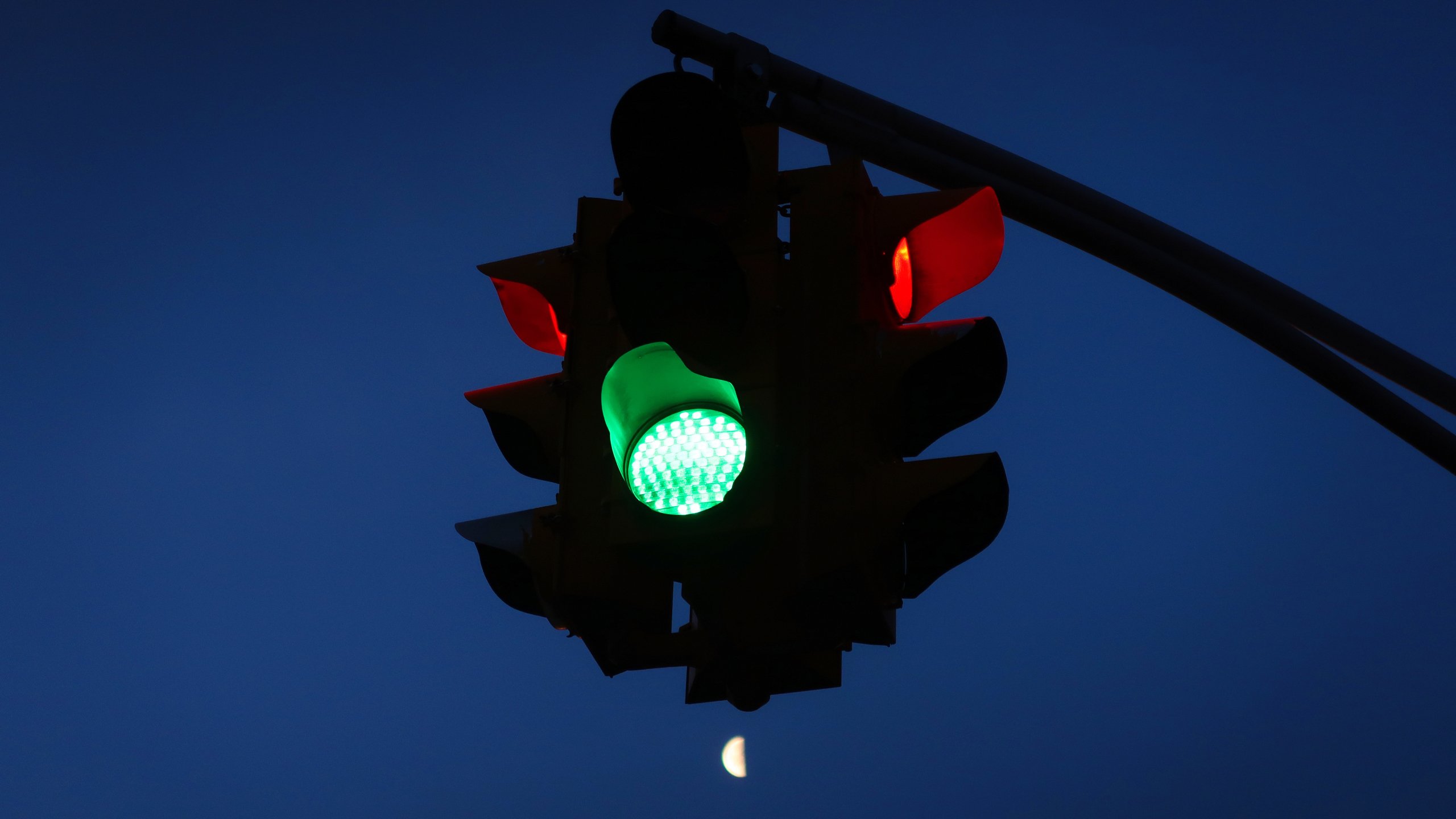


Albuquerque, Portland, and a handful of other cities are flipping the script on traffic signal timing with a deceptively simple idea. Make every light red by default. Then reward drivers who obey the speed limit with greens.
The strategy is called “rest in red,” and it inverts decades of traffic engineering orthodoxy. Instead of the classic green wave, where synchronized signals reward momentum, this approach punishes haste. Drive the limit and you sail through. Push five over and you sit at a red, watching the seconds tick away.
Portland’s trial dropped average speeds on one corridor from 39 mph to 30, which happened to be the posted limit. A North Carolina pilot running the system around the clock recorded a 43 percent reduction in total crashes. Those are not marginal gains.
Jennifer Turner, director of municipal development for Albuquerque, told the Associated Press that drivers figure it out fast. “If you come to Albuquerque right now and you’re driving that corridor, you will learn pretty quickly that if you are speeding, you stop,” she said.
The psychology is elegant. Nobody likes sitting at a red light. So instead of building enforcement infrastructure, installing speed cameras, or deploying police cruisers, cities are using the traffic signals they already own to make speeding feel pointless.
The punishment is not a ticket. It is wasted time. And wasted time, it turns out, is a more effective deterrent than a fine most people will contest or ignore.
Critics raise the obvious concern: more red lights could mean more red-light running. It is a fair worry in theory. But the early data suggests otherwise.
When the system is calibrated correctly, drivers who comply barely notice it. They just get greens. The ones who don’t comply get stopped by a red that was going to change anyway. The incentive structure bends behavior before frustration sets in.
The approach works best on roads engineered for high daytime volume that turn into empty straightaways after dark. Those are precisely the corridors where late-night speeding and serious crashes tend to spike. Keeping signals red until a vehicle actually approaches, then timing the green to match a lawful speed, turns the infrastructure itself into a calming device.
Long Beach, California, and Boulder, Colorado, have run similar trials. Long Beach even tested warning signs telling speeders what was happening, a move that started back in 2012. Los Angeles was still using the strategy as recently as 2017, though published results from those California experiments remain elusive.
The nostalgia crowd will hate this. Every neighborhood forum has that person who insists traffic lights used to be perfectly timed, back when the town had two subdivisions and a farm. What they are really remembering is low volume and uniform commuting patterns.
The green wave worked fine when everyone drove the same direction at the same hour. Modern traffic is messier than that.
Rest in red does not promise a utopia of uninterrupted greens. It promises something better: a system that makes the speed limit feel like the path of least resistance. Cities that have tried it are seeing fewer crashes and lower speeds without writing a single ticket.
The question now is whether departments of transportation with bigger budgets and more complex networks will adopt it, or whether the idea stays confined to pilot programs in mid-size cities while everyone else keeps arguing about speed cameras.
Share this Story