
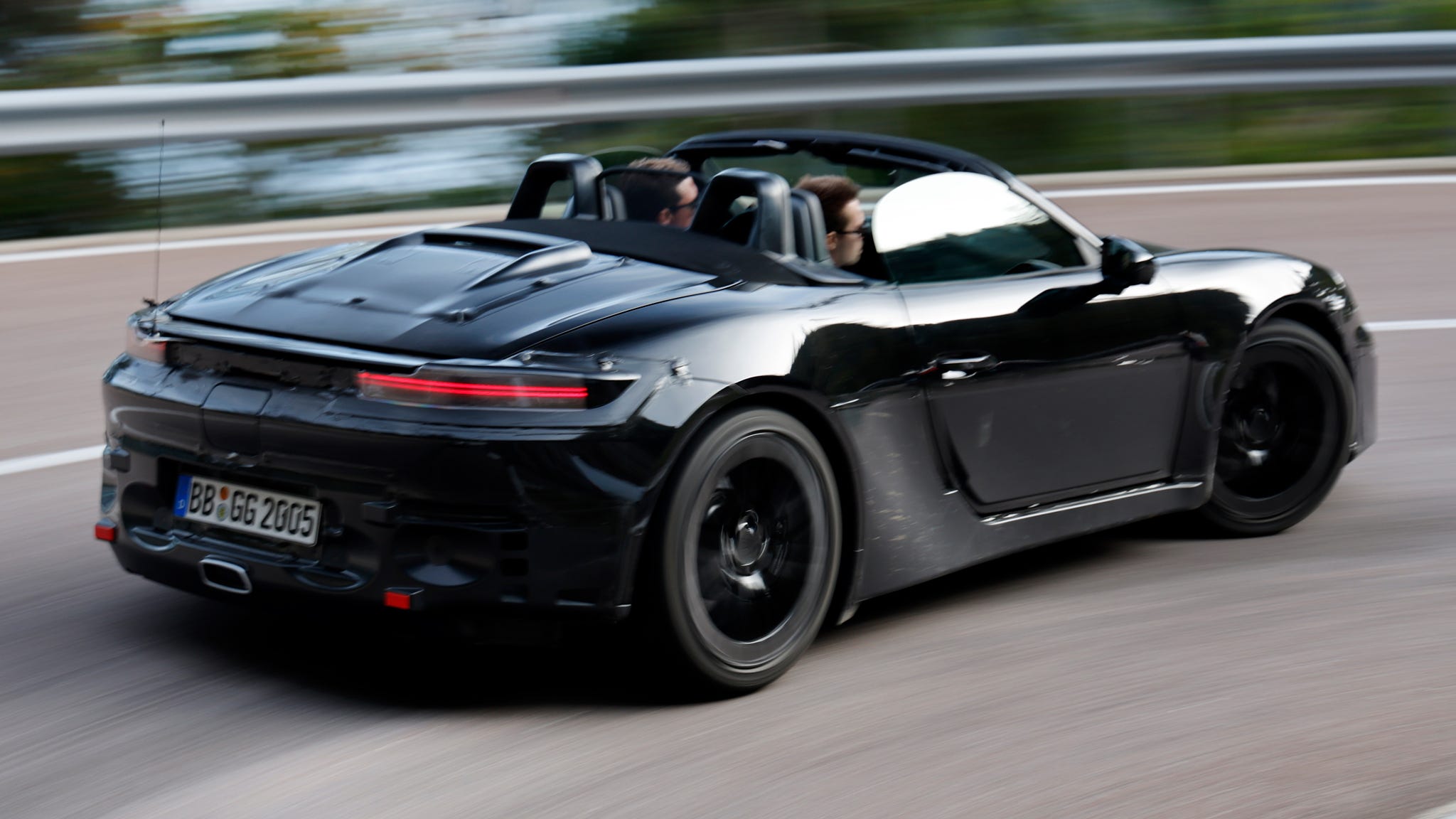


Porsche built an electric Boxster that mimics flat-six throttle blips on downshifts. Let that sink in for a moment. The company that defined the mid-engine sports car experience has decided the future of that experience requires pretending there’s still a gearbox.
During a ride-along at Porsche’s Weissach test facility, a prototype of the all-electric next-generation Boxster was put through its paces with a journalist in the passenger seat. The verdict from that shotgun run: it felt like a regular Boxster. Porsche clearly considers that the highest possible compliment.
The battery pack sits behind the seats, mimicking the weight distribution of a mid-mounted engine. Porsche calls this its E-Core arrangement, and the placement preserves the low seating position that Boxster owners expect. The grip, according to the ride-along, was helped by the extra mass.
Then there’s E-shift, Porsche’s system for simulating gear changes. Other automakers fake shifts by cutting torque momentarily, creating a brief hesitation that feels like something broke. Porsche went the opposite direction.
It engages a split-second overboost to let occupants physically feel the transition. The result is synthetic upshifts and downshifts that apparently fool your body even if your brain knows better.
The artificial exhaust note reportedly channels the GT3’s high-revving flat-six. Porsche isn’t being subtle about what it’s doing here. This is an EV wearing a combustion costume, and the company is betting that enthusiasts will buy the illusion if the physics feel right.
On the technical side, Porsche claims its new cylindrical cell technology delivers roughly 20 percent more range and charges 50 percent faster than its current EV lineup, without adding weight. Materials costs dropped 15 percent. Michael Steiner, Porsche’s deputy chairman and board member for R&D, offered those figures.
If they hold up in production, that’s a meaningful step for a brand whose Taycan already charges faster than most competitors.
The electric Boxster and its hardtop sibling, the Cayman, are expected to debut late next year as part of the next-generation 718 family. The prototype was early enough that camouflage and secrecy still surrounded the exterior, but the drivetrain apparently spoke for itself.
What Porsche has built here is a deliberate contradiction. An electric car engineered to feel as analog as possible. A vehicle with no transmission that simulates shift points, powered by a silent drivetrain dressed up in the sound of six horizontally opposed cylinders.
The company is treating the combustion sports car experience not as something to move past, but as something to reverse-engineer from scratch using electrons.
The professional driver behind the wheel noted the instant torque made launches faster. The car absorbed rumble strips without drama. The brakes were strong under hard pedal input.
These are the fundamentals, and Porsche apparently nailed them in prototype form.
Whether buyers accept a Boxster that smells like nothing instead of premium unleaded is the real question. Porsche is gambling that if you close your eyes in the passenger seat and can’t tell the difference, the answer is yes.
The car isn’t finished yet. Production is still more than a year out, and early prototypes have a way of flattering themselves on home turf with factory drivers at the wheel. But Porsche has shown its hand. It wants the electric Boxster to feel like denial, like maybe the flat-six never really left.

Share this Story