
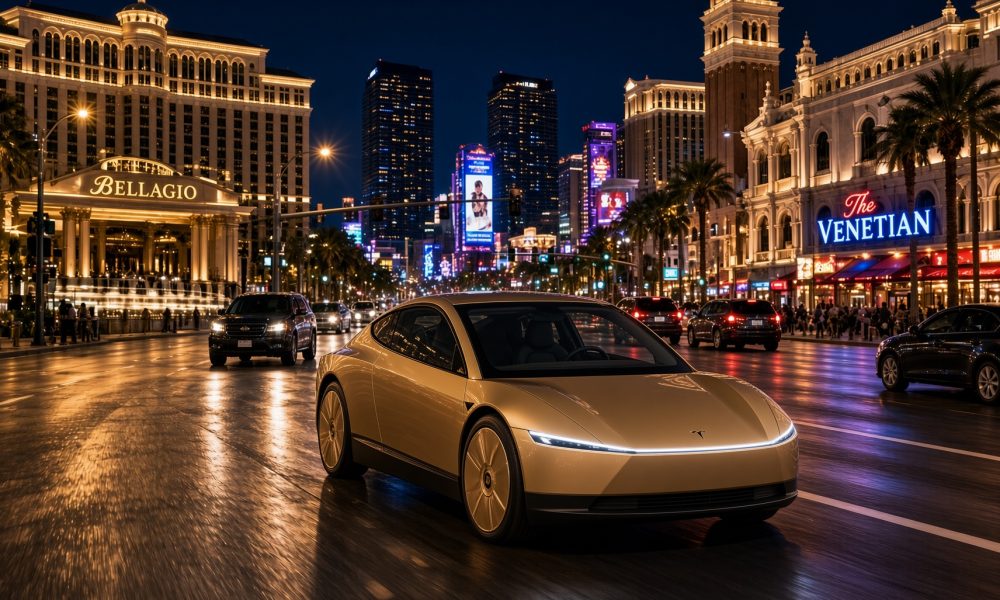


Ten vehicles on a narrow strip of Las Vegas Boulevard. That was what Tesla had two weeks ago. On Thursday, the Nevada Transportation Authority voted to give the company a permit for 5,000 driverless cars across all of Clark County, a 500-fold expansion approved in a single four-hour meeting.
The decision replaces an interim order issued in July that confined Tesla’s robotaxi operation to a tight geofence on the Strip, capped speed at 45 mph, and banned airport pickups. Those were tighter restrictions than what Tesla already runs in Austin, where Cybercab testing has been underway for months with fewer geographic limits.
Tesla originally asked for 5,000 vehicles back in June. Regulators trimmed that request to 10 when they granted the interim permit. Thursday’s vote gives Tesla the number it wanted from the start, no negotiation, no phased rollout written into the permit itself.
For context, Zoox, Amazon’s robotaxi unit, has operated in Nevada since 2025 and was capped at 100 vehicles before this decision. Tesla’s new ceiling is 50 times that figure. On paper, at least, it is not a close race.
Tesla’s people at the meeting said they will not flood Clark County with 5,000 cars overnight. Commercial rides are expected to begin within 30 days, pending the standard regulatory checklist: vehicle inspections, insurance filings, fare approval. The same steps every operator in the state has to complete before carrying a paying passenger.
The real constraint is not the permit. It is software. Tesla executives have pointed to FSD v15 as the release that unlocks unsupervised robotaxi operations at scale. Until that version rolls out widely, fleet size will remain a function of what the code can handle rather than what a regulator allows.
The Nevada expansion lands in the middle of a broader push. Tesla is preparing to open Cybercab rides to the public in Austin as early as this month and recently launched a sweepstakes for seats at the launch event. The company is clearly trying to build momentum across multiple states at once, treating regulatory wins as both operational milestones and marketing fuel.
Tesla’s Robotaxi account on X responded to the Nevada news with five words: “The golden future is upon us.” That kind of triumphalism plays well with the investor base but glosses over the gap between a permit ceiling and an actual fleet on the road.
Morgan Stanley analyst Andrew Percoco flagged that gap just last week, writing that Tesla “will require clearer evidence that Robotaxi is scaling” to justify the elevated capital spending Elon Musk has committed to. A 5,000-vehicle permit is not the same as 5,000 vehicles carrying passengers. Percoco wants ride counts, utilization rates, and margins, not regulatory headlines.
The spending question extends beyond Tesla proper. SpaceX, now publicly traded, burned nearly $16 billion on AI infrastructure in the second quarter alone, much of it tied to compute capacity that supports both xAI workloads and the broader autonomy stack Tesla depends on. Musk told SpaceX employees last week that AI revenue would surpass every other business line “probably in September,” a claim that puts enormous pressure on execution across all his companies at once.
Nevada has opened the door wide. Whether Tesla can walk through it with actual cars, carrying actual passengers, at a pace that satisfies Wall Street, is a question the permit alone cannot answer. The 30-day clock is ticking.
Share this Story