
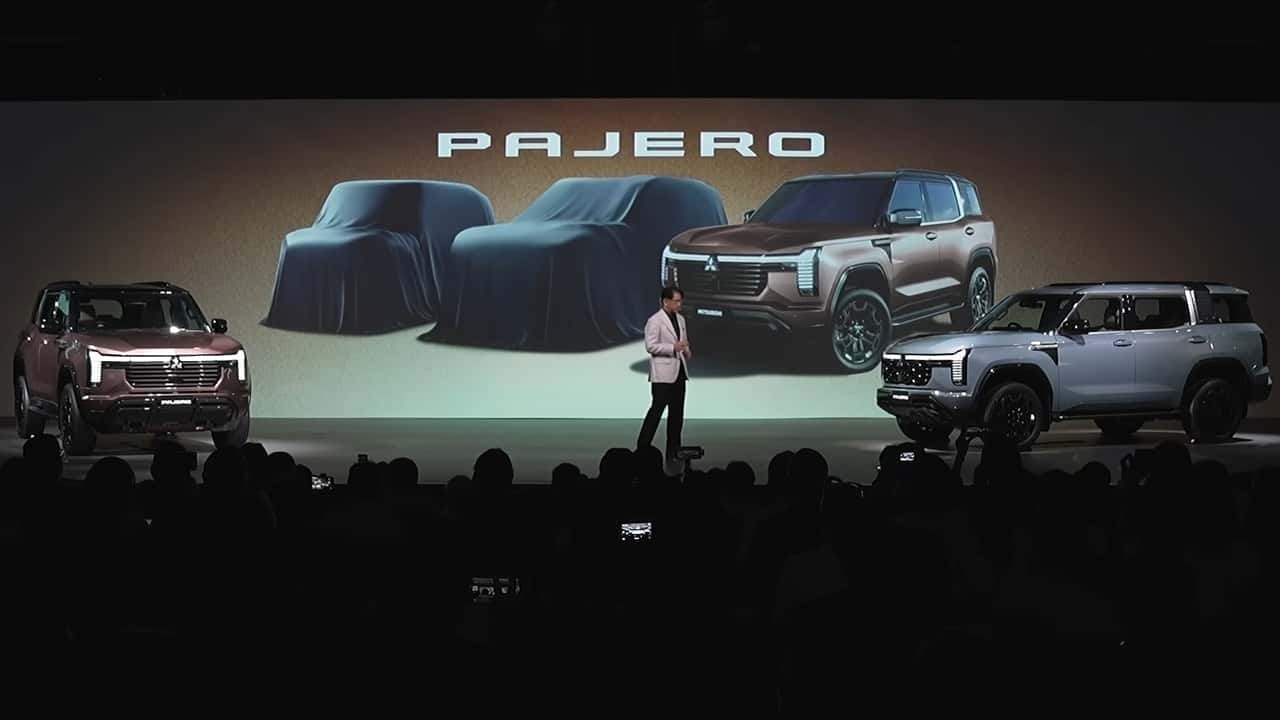


Five years after killing off the Pajero, Mitsubishi isn’t just bringing it back. The company is turning a single nameplate into an entire lineup, revealing plans for compact and small SUVs to sit beneath the full-size flagship that debuted this week.
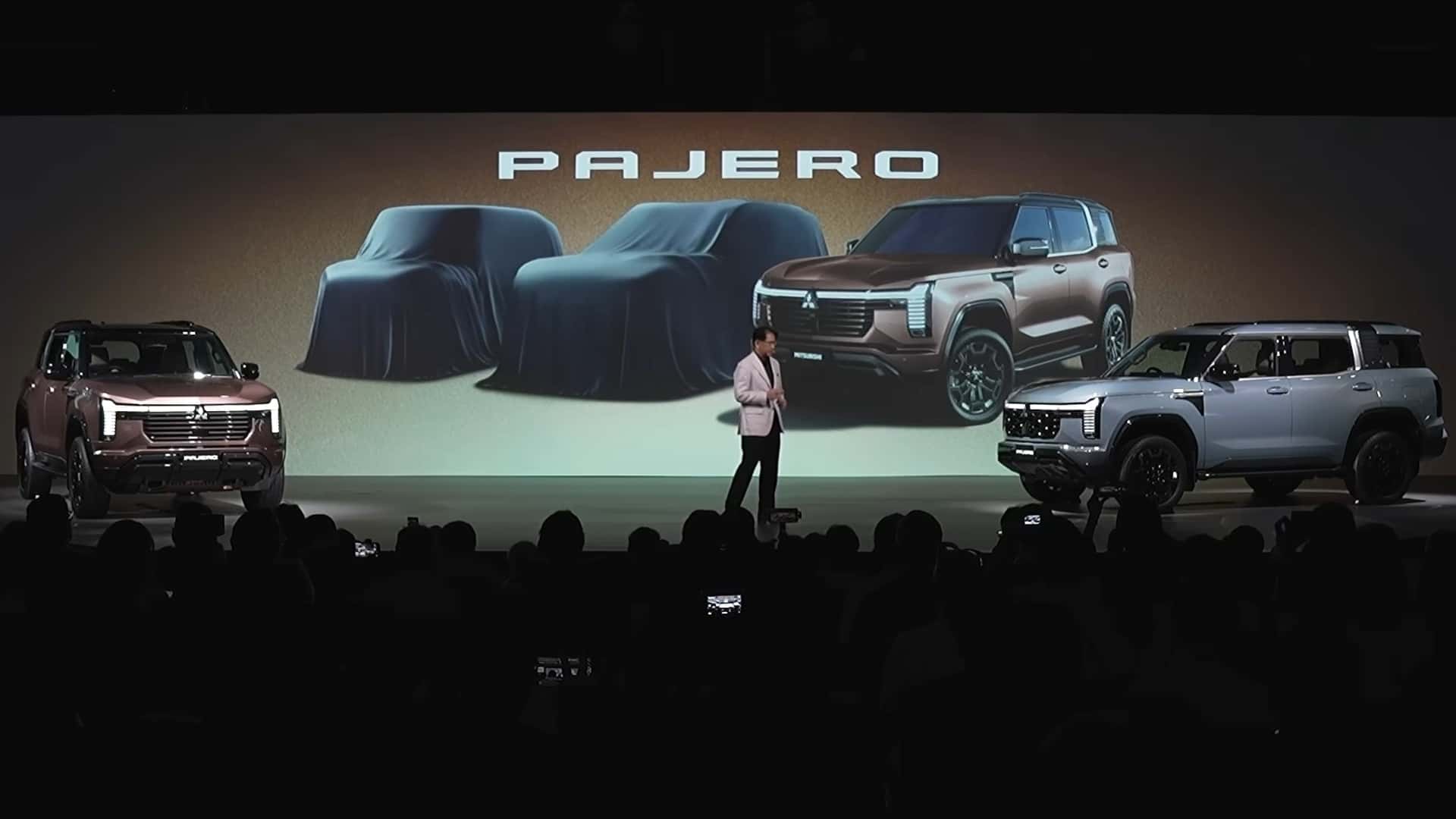
During the world premiere, two covered vehicles flanked the new Pajero on stage. They were clearly smaller, and Mitsubishi confirmed they represent future compact and entry-level models wearing the same badge. No specs, no timelines, no powertrain details. Just shapes under sheets and a promise.
The flagship itself is no pretender. At 4,920 millimeters long and riding on a ladder-frame platform derived from the Triton pickup, it has three rows, proper off-road hardware, and the kind of dimensions that put it squarely against the Toyota Land Cruiser. Production starts in Thailand before a rollout across more than 100 countries.
North America is not on the list. Not yet, anyway. A recent teaser image suggests Mitsubishi hasn’t completely closed that door, but nothing is confirmed.
The real tension here sits with the two smaller models. Mitsubishi hasn’t said whether they’ll share the flagship’s body-on-frame construction or move to unibody platforms. The smart money is on unibody, particularly for the smallest of the three, which looked almost comically petite next to the full-size truck.
Building another ladder-frame platform from scratch would be expensive, and Mitsubishi isn’t exactly flush with cash. That creates an identity problem. The Pajero name earned its reputation through decades of Dakar Rally victories and genuine off-road capability.
Slapping it on a compact crossover with independent rear suspension and all-season tires is a different proposition entirely. Mitsubishi has been down this road before, and not always successfully. The Eclipse Cross still stings for enthusiasts who remember the Eclipse as a turbocharged sports car, not a small SUV with a hyphenated suffix.
Toyota has managed to stretch the Land Cruiser name across multiple sizes without destroying its credibility, but that required decades of careful positioning and a commitment to off-road engineering at every price point. Mercedes is attempting something similar with the smaller G-Class variant it has in the works. Both companies have deeper pockets than Mitsubishi.
The boxy styling visible under those covers suggests Mitsubishi at least wants the smaller Pajeros to look the part. Whether they can back up the appearance with mechanical substance will determine if this family strategy works or backfires.
Mitsubishi has seven new models in its near-term pipeline, and the Pajero family accounts for a significant chunk of that plan. The company is treating this as a cornerstone of its recovery, not a nostalgia exercise. In some markets, the vehicles will carry the Montero name instead, continuing a regional naming tradition that dates back decades.
The flagship launches first, and it has the credentials to justify the revival. A real frame, real low-range gearing, real ground clearance. Everything the Pajero was supposed to be.
What comes next is less certain. Two smaller SUVs wearing a legendary name, built by a company that needs them to sell in volume but can’t afford to alienate the loyalists who kept the Pajero’s reputation alive during its five-year absence. Mitsubishi is betting it can thread that needle across three different vehicle sizes and more than 100 markets simultaneously.

Share this Story