
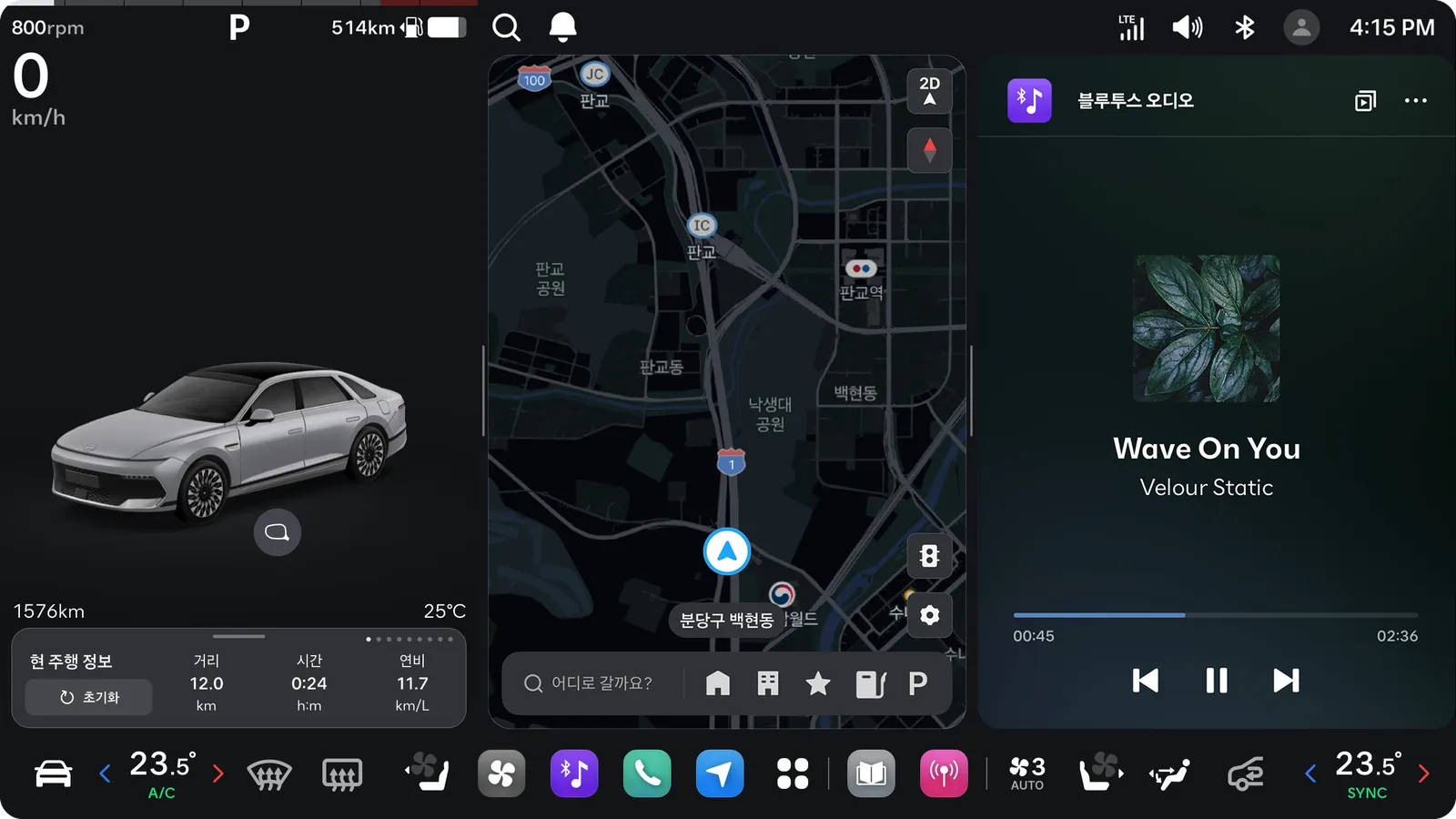


Hyundai Motor Group started shipping its Pleos Connect infotainment system this month, kicking off what the Korean automaker calls its transition to software-defined vehicles. The target is audacious: 20 million vehicles running the platform by 2030. That’s not a typo. Twenty million.
The system debuts in Hyundai’s Grandeur sedan in South Korea, a flagship most Americans have never seen. A global rollout follows, including the upcoming Ioniq 3 EV headed to Europe later this year. Conspicuously absent from the announcement: any timeline for the United States.
Pleos Connect runs on Google’s Android Automotive OS, the same open platform General Motors adopted years ago and the same one Google recently announced it would open-source for software-defined vehicle development. Hyundai is hardly alone in this bet, but the scale of its ambition sets it apart. Building a proprietary infotainment layer on top of Android Automotive and then committing to push it across Hyundai, Kia, and Genesis is a massive engineering and logistics undertaking.
The system pairs a central touchscreen with a driver display and, notably, physical buttons for commonly used functions. Steering wheel controls and a row of buttons below the center screen let drivers bypass the touchscreen entirely for climate, audio, and other frequent adjustments. That’s a direct response to the backlash that swept the industry after brands like Volkswagen and Tesla buried basic controls in nested menus.
Hyundai says the button layout came from driver behavior research conducted at UX studios in Irvine, Seoul, Frankfurt, and Shanghai. It’s a refreshing reversal from the touch-everything trend that plagued so many cabins over the past few years.
Then there’s Gleo AI, the voice assistant baked into Pleos Connect. It’s built on a large language model and handles multi-step voice commands in a single request — ask it to set navigation to a restaurant, lower the cabin temperature, and pull up the owner’s manual, all in one sentence. At launch, Gleo AI focuses on vehicle controls and convenience features, with Hyundai promising it will grow through over-the-air updates.
The navigation system leans on real-time traffic data crowdsourced from other Hyundai vehicles, feeding live map updates to calculate routes. Screen icons have been simplified, and menus have been reorganized around the functions drivers actually use most often. Hyundai’s engineers are openly acknowledging that previous systems were too complex — a rare admission baked into the product itself.
A third-party app marketplace rounds out the package. YouTube and Spotify come preloaded without requiring a phone connection. Hyundai has also launched “Pleos Playground,” a developer portal for building in-vehicle apps, with plans to expand into gaming, entertainment, and fleet management.
User profiles are portable. Customers can create personalized settings and carry them across any Pleos Connect vehicle, a feature that matters most if the system actually reaches the scale the company envisions.
The underlying architecture is zonal — high-performance vehicle chips, centralized controllers, and cloud infrastructure designed to handle continuous software updates. Hyundai’s software subsidiary 42dot, acquired in 2022, built the Gleo AI stack. The Pleos OS platform itself was announced at a developer conference in Seoul in March 2025.
Every major automaker is chasing this playbook right now. Volkswagen has CARIAD. GM has Ultifi. Stellantis has its STLA platforms. None of them have publicly committed to a number like 20 million units by the end of the decade.
Hyundai is declaring that within five years, this system will touch more cars than most brands sell in a decade. Whether that confidence is justified depends on execution, not ambition.
Hyundai has a strong track record of delivering hardware on time. Software is a different animal entirely, one that has humbled bigger companies with deeper pockets. The silence on U.S. availability suggests Hyundai knows it isn’t ready everywhere yet — smart enough to ship where it’s ready, and we’ll see if the rest of the world gets it before the ambition outpaces the engineering.

Share this Story