
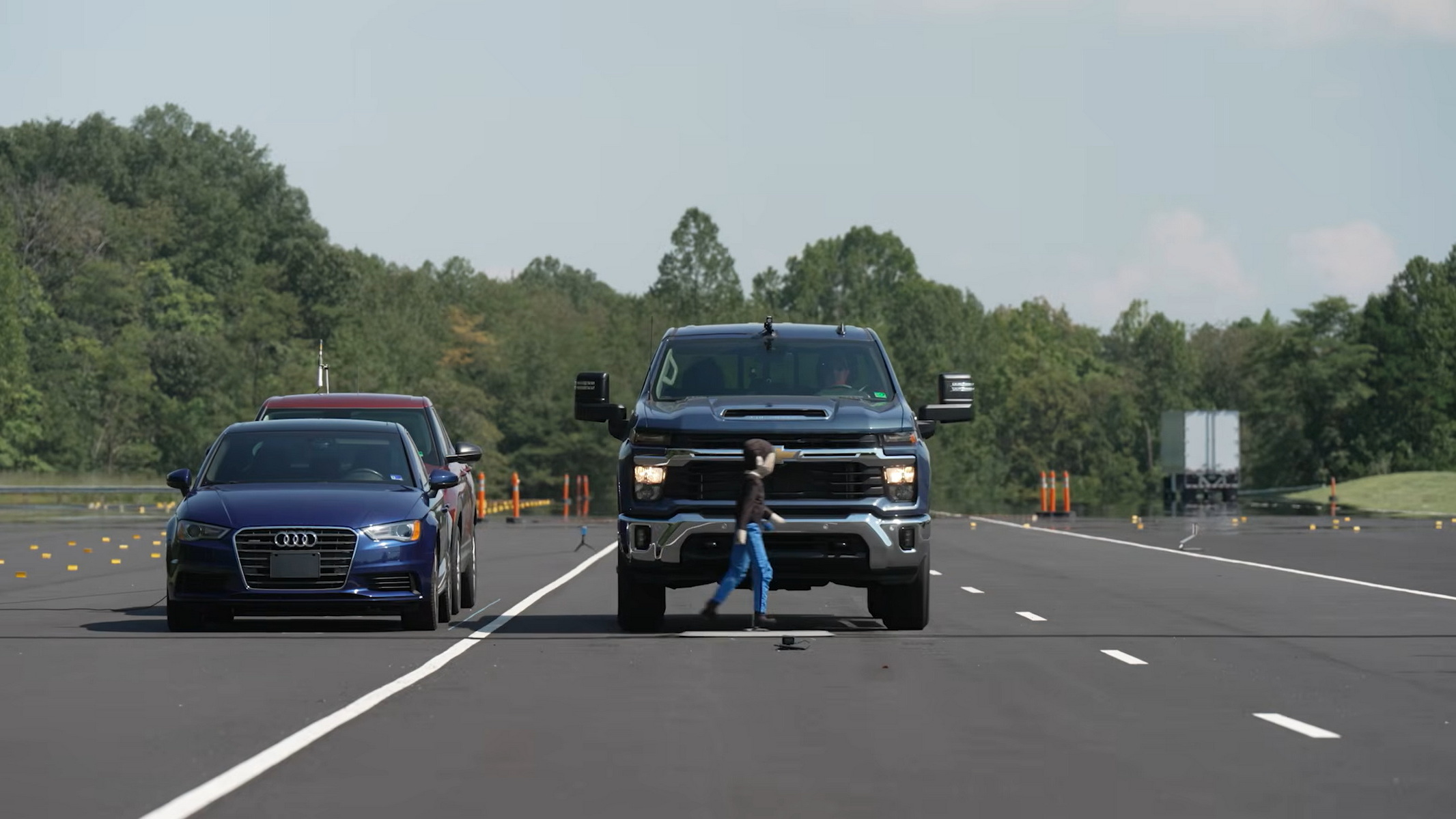


Every heavy-duty pickup truck the IIHS tested failed to earn even an acceptable rating for vehicle-to-vehicle crash prevention. Three of the four received the worst possible score.
The Chevrolet Silverado 3500HD, GMC Sierra 3500, and Ford F-350 all earned poor ratings. The Ram 3500 scraped by with a marginal. These are Class 3 trucks with gross vehicle weight ratings between 10,001 and 14,000 pounds. When they hit something, the something loses.
The IIHS tested 11 commercial vehicles total, four pickups and seven cargo vans, evaluating their ability to detect and avoid cars, motorcycles, semi-trailers, and pedestrians. Motorcycles posed the biggest problem. Most trucks failed to warn drivers or slow down when approaching one.
Some reduced speed, but none produced warnings early enough to satisfy testers. Then came the pedestrian tests, and the results got worse.
In multiple scenarios, trucks struggled more to detect a child-sized pedestrian in broad daylight than an adult pedestrian at night. The IIHS suspects the combination of towering front ends and cameras mounted near the rearview mirror creates a blind zone that swallows small figures. Some systems initially recognized the child, then lost track as the kid got closer to the truck.
The technology worked right up until the moment it mattered most.
The Ford F-350 and Ram 3500 managed acceptable pedestrian ratings. The Silverado 3500HD and Sierra 3500 earned marginal. But even the better scores came with ugly footnotes about those child-detection failures.
Nighttime was no refuge either. Several systems couldn’t slow down for adult pedestrians when headlights were set to low beam. That’s how most people actually drive after dark.
The vans painted a mixed picture. The Mercedes-Benz Sprinter 2500 was the sole vehicle in the entire group to achieve a good vehicle-to-vehicle crash prevention rating. Chevrolet’s BrightDrop 400 and the Rivian RCV-Delivery 500 both earned good pedestrian ratings.
At the other end, the Chevrolet Express 2500 and GMC Savana 2500 scored poor in both categories. Neither offers automatic emergency braking, which tells you everything about how long those platforms have been collecting dust.
A regulatory gap sits at the center of this mess. Many commercial vehicles are exempt from the same safety mandates that apply to passenger cars, right down to certain airbag requirements. Crashes involving heavy-duty and medium-duty trucks and light vans killed 6,215 people in 2024, accounting for 16 percent of all U.S. traffic fatalities.
That number has a body count and no corresponding federal standard pushing manufacturers to fix it. “These results are a wake-up call for commercial vehicle makers,” said IIHS President David Harkey.
The trucks keep getting taller, heavier, and loaded with more screens and driver-assist features. Buyers pay premium prices for technology packages marketed as safety upgrades. Yet when the IIHS put the systems through structured, repeatable tests, the machines couldn’t reliably spot a child standing in the road ahead of them during the middle of the day.
The vans at least show it can be done better. A Sprinter proved that a large commercial vehicle can detect and react to another vehicle in time. A BrightDrop and a Rivian delivery van demonstrated that pedestrian detection doesn’t have to fall apart at child height.
The pickup manufacturers have no technical excuse left, only a question of whether anyone will force their hand before the next round of testing.
Share this Story