
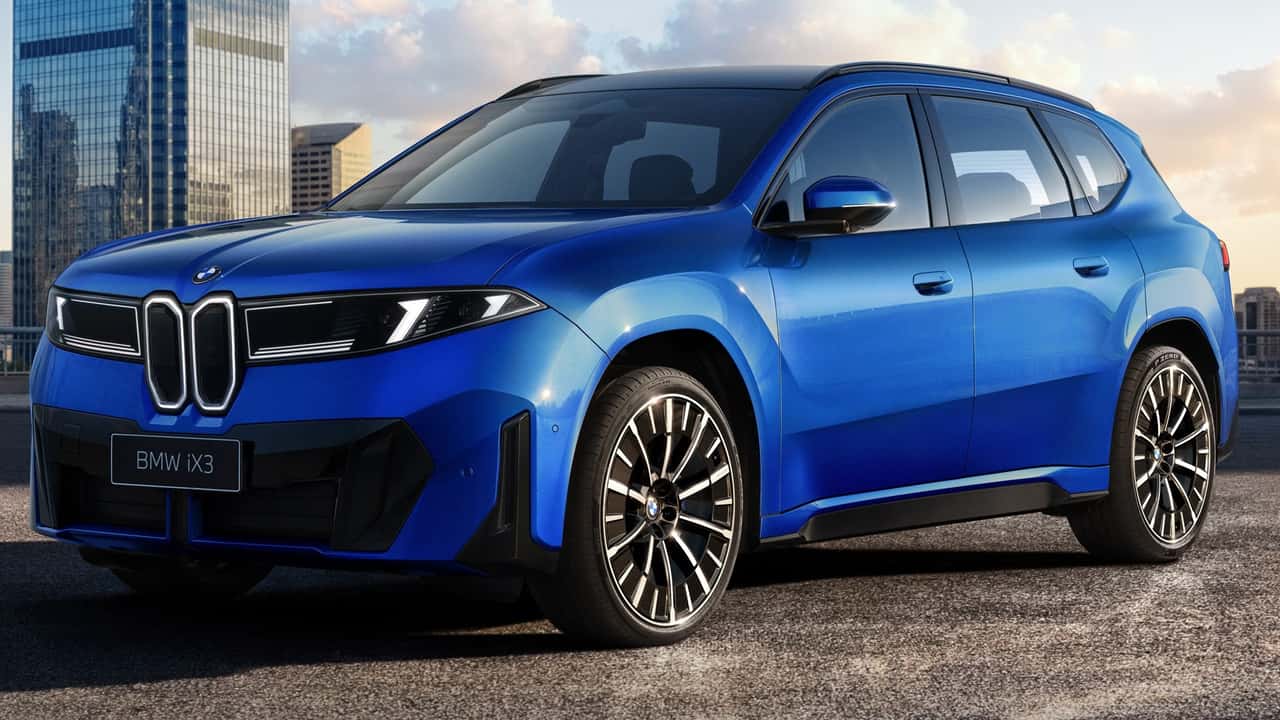


BMW just pulled the covers off a China-specific, long-wheelbase version of its second-generation iX3, and what’s underneath the sheet metal tells you everything about where the German automaker thinks the real EV war is being fought.
The 2026 iX3 L, unveiled ahead of the Beijing Auto Show, stretches the Neue Klasse-based NA5’s wheelbase by 108 mm to 3,005 mm. It will be built at BMW’s Shenyang plant starting this summer, a facility that previously cranked out every single first-generation iX3 sold worldwide. The standard-wheelbase car rolls off a brand-new line in Debrecen, Hungary.
But the real story isn’t the extra legroom. It’s the brain transplant.
Where the European iX3 runs BMW’s own Panoramic iDrive system, the Chinese variant is expected to get Huawei’s HarmonyOS Next infotainment, Alibaba and DeepSeek AI models, Amap 3D navigation, and Momenta’s full-scenario advanced driver-assistance suite. BMW gutted its own software stack and handed the keys to China’s tech giants. That’s not localization. That’s capitulation to a market where homegrown digital ecosystems are table stakes and anything less gets you ignored.
The hardware underneath stays pure NA5. An 800-volt architecture feeds dual motors producing a combined 469 horsepower and 645 Nm of torque. The 108.7-kWh NMC battery pack supports 400-kW DC fast charging, good for a 10-to-80-percent fill in 21 minutes.
BMW quotes a 900-km range on China’s generous CLTC cycle, which roughly aligns with the standard car’s 805-km WLTP figure. Zero to 100 km/h should land somewhere in the low fives, a tick behind the short-wheelbase car’s 4.9-second sprint.
Look closely and you’ll spot another concession. The iX3 L ditches the standard car’s flush pop-out door handles for conventional pull-up units. China banned the aerodynamic handles that BMW and half the industry adopted in the name of drag reduction. So they changed them. No argument, no workaround.
The tailgate badge reads “iX350L,” a nomenclature likely confined to the Chinese market. A new centrally mounted camera sits atop the rear spoiler, presumably feeding the Momenta ADAS hardware.
This move has ripple effects. In Malaysia, China-built EVs face a 5-percent import duty versus 30 percent for cars from Europe. The existing iX1 L from China already undercuts what the German-built standard-wheelbase iX1 would otherwise cost. If BMW routes the iX3 L through the same pipeline, Southeast Asian buyers could end up with a longer, techier car for less money than the Hungarian-built version.
Meanwhile, the standard iX3 is already racking up orders. In South Korea, pre-orders crossed 2,000 units within a week of opening on March 19, priced from 86.9 million won. BMW even proved the car’s range credentials last November by driving 1,007.7 km from the Debrecen factory to Munich headquarters on a single charge, arriving with 2 percent battery remaining.
The second-generation iX3 represents BMW’s first real Neue Klasse volume play after years of promises. The original iX3 was a compliance car built on a combustion platform, limited to a single rear motor making 286 horsepower with 460 km of WLTP range. The new car is a different animal entirely, purpose-built on BMW’s dedicated NCAR-NA electric architecture with Gen6 cylindrical cells using recycled cobalt, lithium, and nickel.
A high-performance iX3 M is also on the schedule, with production slated to begin in July 2026.
BMW is running two parallel strategies with one car. In Europe and Korea, it sells a premium EV on its own terms with its own software. In China, it surrenders the digital experience to local players who simply do it better.
The iX3 L isn’t just a stretched SUV. It’s an admission that winning in China means playing by China’s rules, down to the door handles.

Share this Story