
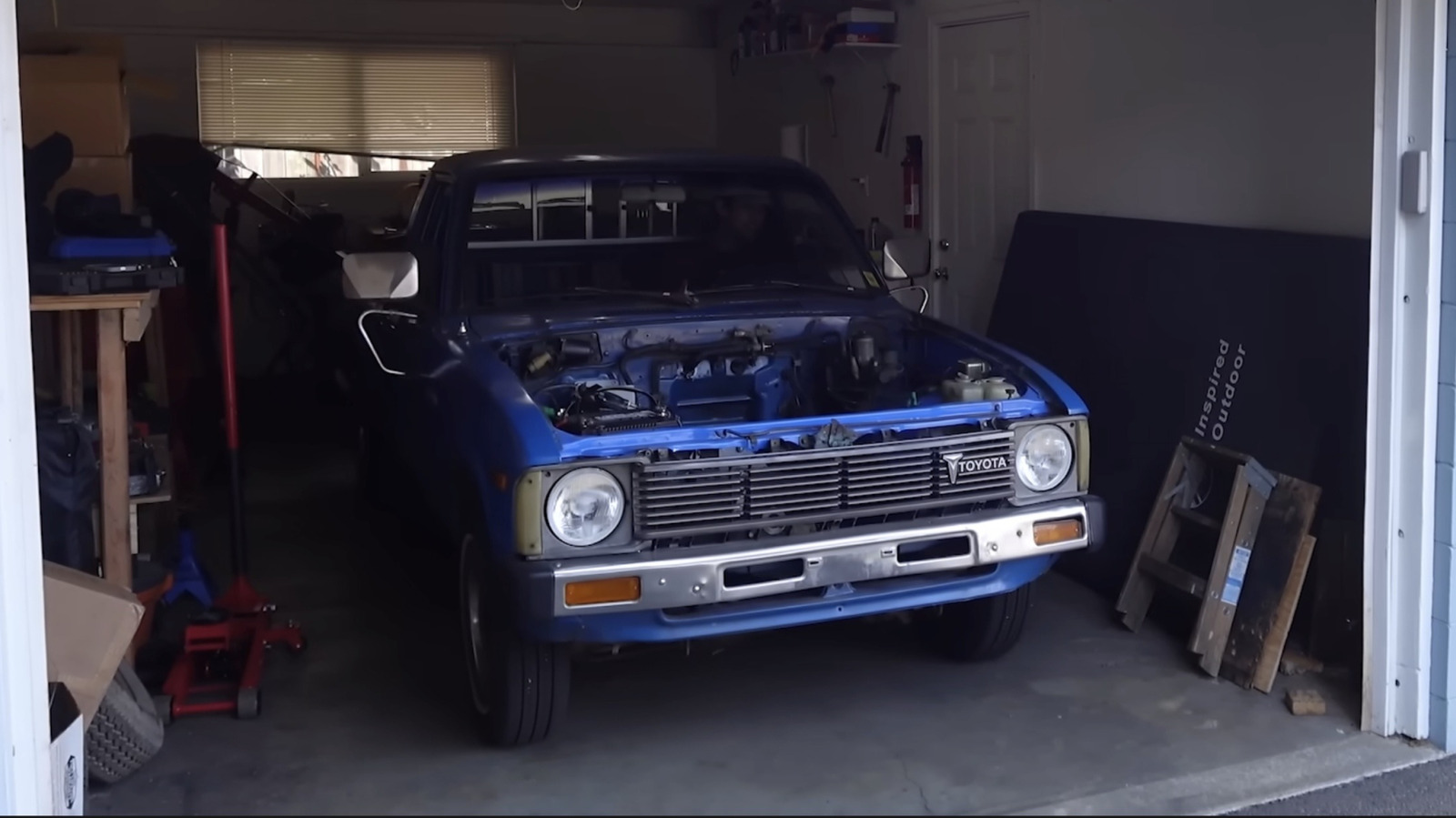


The Slate Truck rolled onto the market at $24,950 as the cheapest new EV you can buy. A YouTuber just built something arguably more interesting from a busted 1982 Toyota Pickup and a pile of secondhand parts.
The contrast is almost too perfect. Slate has been generating buzz as the bare-bones electric pickup for the masses, but a first ride left Jalopnik’s Daniel Golson cold — loud cabin, crank windows, hard plastic everywhere, awkward step-in height. Acceptable in a truck from the Reagan era, maybe. Not in 2026.
So what happens when you actually start with that Reagan-era truck?
YouTuber B_Serious spent the past year converting a dead-engine ’82 Toyota into a running, driving electric pickup, and he recently took it on its first successful test drive. The donor had a blown 22R four-cylinder and a manual transmission. The engine went in the trash. The five-speed stayed.
An EV doesn’t need a transmission, but keeping it solved two problems. It connected the electric motor to the existing driveline without fabricating a new one, and it provided reverse without rewiring motor polarity. It also gave the truck something the Slate will never have: a clutch pedal and a shifter.
The motor is a Netgain Warp 9 DC unit, bought used off Craigslist. It bolts to the stock transmission through an adapter plate, and scrap steel ties it to the factory motor mounts. The battery pack uses five cells pulled from a Tesla Model S, totaling just over 26 kilowatt-hours and an estimated 75 to 85 miles of range.
That’s roughly a third of the Slate’s revised 205-mile figure. But range is a scalable problem — more cells, more miles. And if we’re being honest about how most pickup trucks actually get used, 80 miles covers a lot of days.
The details are where the build gets charming. Someone scrawled “Unleaded Fuel Only” on the battery pack housing. The charge port lives behind the original fuel filler door.
The gas pedal is gone, replaced by a drive-by-wire unit from a 2009 Prius — still a genuine Toyota part, just forty years newer than the truck around it. The original ignition key still fires everything up, electric powertrain included.
A Zilla motor controller manages throttle input. Battery management and charging electronics handle the high-voltage side. The system also charges the standard 12-volt battery to keep the old truck’s original lights, gauges, and accessories alive.
None of this is quick or simple. Slate pitches its DIY customization angle — bolt-on accessories, thirty minutes to two hours in your driveway. This Toyota conversion consumed a year of garage time and skills most buyers don’t have.
There’s no public cost breakdown, which is the one number that would make this comparison genuinely useful. A running ’82 Toyota with a blown motor might cost a thousand dollars or five thousand, depending on rust and location. A used Netgain motor, Tesla battery modules, controller, adapter plate, wiring, and all the small parts add up fast. It could land anywhere from $8,000 to north of $20,000 in parts alone, before you price your own labor at zero.
But that’s the whole point. The Slate sells affordability and simplicity. This Toyota sells none of that. It sells the satisfaction of making something dead breathe again with voltage instead of gasoline, using junkyard parts and stubbornness.
Two philosophies, both claiming the soul of the cheap electric truck. One is a product. The other is a project. The fact that a forty-year-old corpse of a Toyota can even be mentioned in the same sentence as a new production vehicle tells you something about where the Slate’s bar actually sits.


Share this Story