
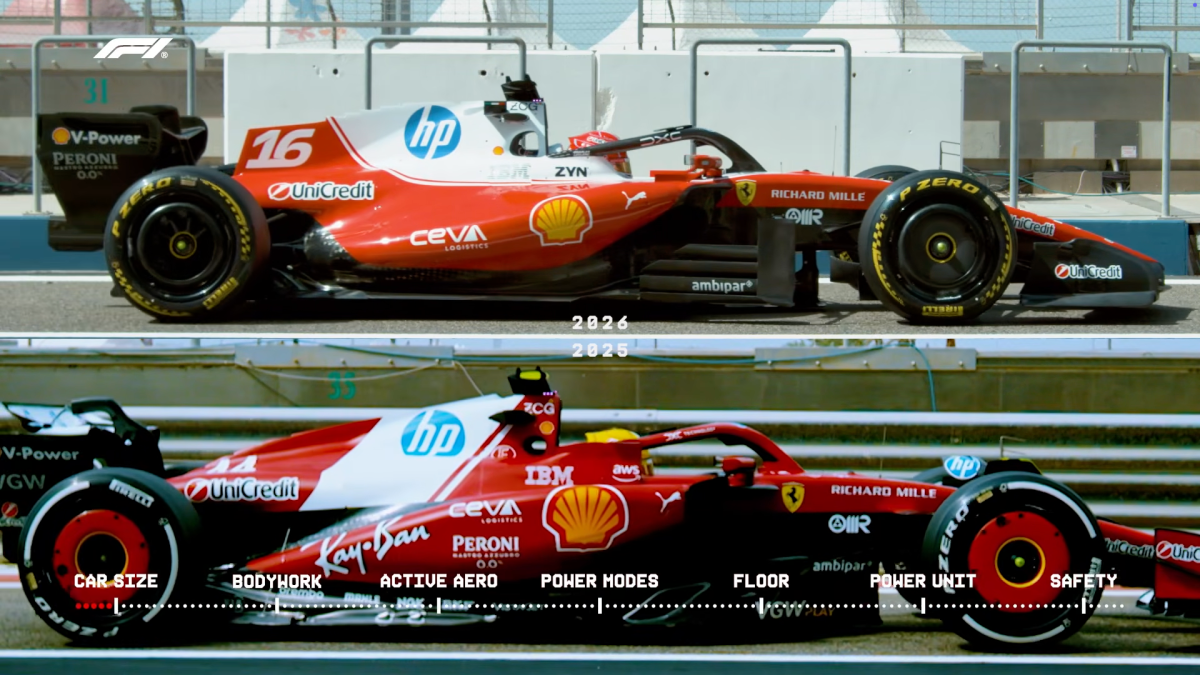


Formula 1 has spent years promising smaller, lighter, more agile race cars. The 2026 regulations deliver on that promise — sort of. The new machines are indeed shorter than their predecessors, but let’s not kid ourselves about what “shorter” actually means in this context.
Three years ago, a direct comparison between a 2023 Alpine F1 car and a Chevrolet Suburban made jaws drop across the internet. The single-seat, open-wheel race car measured approximately 221.3 inches from nose to rear wing. The Suburban, a three-row family hauler that can seat eight adults and swallow a mountain of luggage, came in at roughly the same length.
The world’s most advanced racing machines had somehow ballooned to the dimensions of an American highway barge. The FIA clearly got the message.
The 2026 technical regulations mandate a wheelbase of 3,400 mm, or about 133.8 inches. That’s a reduction of nearly eight inches from the previous 3,600 mm requirement. It sounds significant on paper, and in the wind tunnel it absolutely matters.
But here’s the thing. Wheelbase and overall length aren’t the same measurement. The FIA doesn’t actually cap total length — teams are free to extend their front wings and bodywork as they see fit.
So while the core structure of the car has been trimmed, the final nose-to-tail number depends on aerodynamic choices that are still being refined behind closed doors.
Using the old Alpine as a rough baseline and subtracting that eight-inch wheelbase reduction, a 2026 F1 car lands somewhere around 213 inches long. A 2025 Chevy Tahoe measures 211.3 inches. That puts the new generation of grand prix machinery about two inches longer than a full-size SUV — and still longer than most vehicles you’ll encounter in a suburban parking lot.
So F1 has graduated from Suburban territory to Tahoe territory. Progress, sure. Revolution? Not exactly.
The length reduction isn’t happening in isolation, though. The 2026 rules also shave nearly four inches off the car’s width. Minimum weight has been lowered, and floor dimensions have been tightened.
These are meaningful changes that will cascade through every aspect of aerodynamic performance and handling. Engineers across the grid are reworking their entire design philosophies around the new constraints. The resulting cars should look noticeably different on track — leaner, perhaps a touch more nimble in tight corners.
Several display cars wearing 2026 liveries have already been spotted at events, including models dressed in Audi and Red Bull colors. These are showpieces, not functional racers, but they offer a tangible sense of the proportional shift. Standing next to one, the size difference from current-gen cars is apparent.
Whether it’s apparent enough to change the public perception of F1 cars as rolling aircraft carriers remains to be seen.
The real test comes when these machines hit actual circuits. Smaller dimensions combined with revised aerodynamic rules — including active aero elements and dramatically reduced downforce from underbody tunnels — should produce cars that behave very differently from the ground-effect monsters that have dominated since 2022.
For now, though, the headline writes itself with a smirk. Formula 1 spent years engineering its cars to the size of a Suburban. It took a regulatory overhaul to trim them down to a Tahoe. That’s the state of modern grand prix racing — even the “small” cars are enormous.
Share this Story