
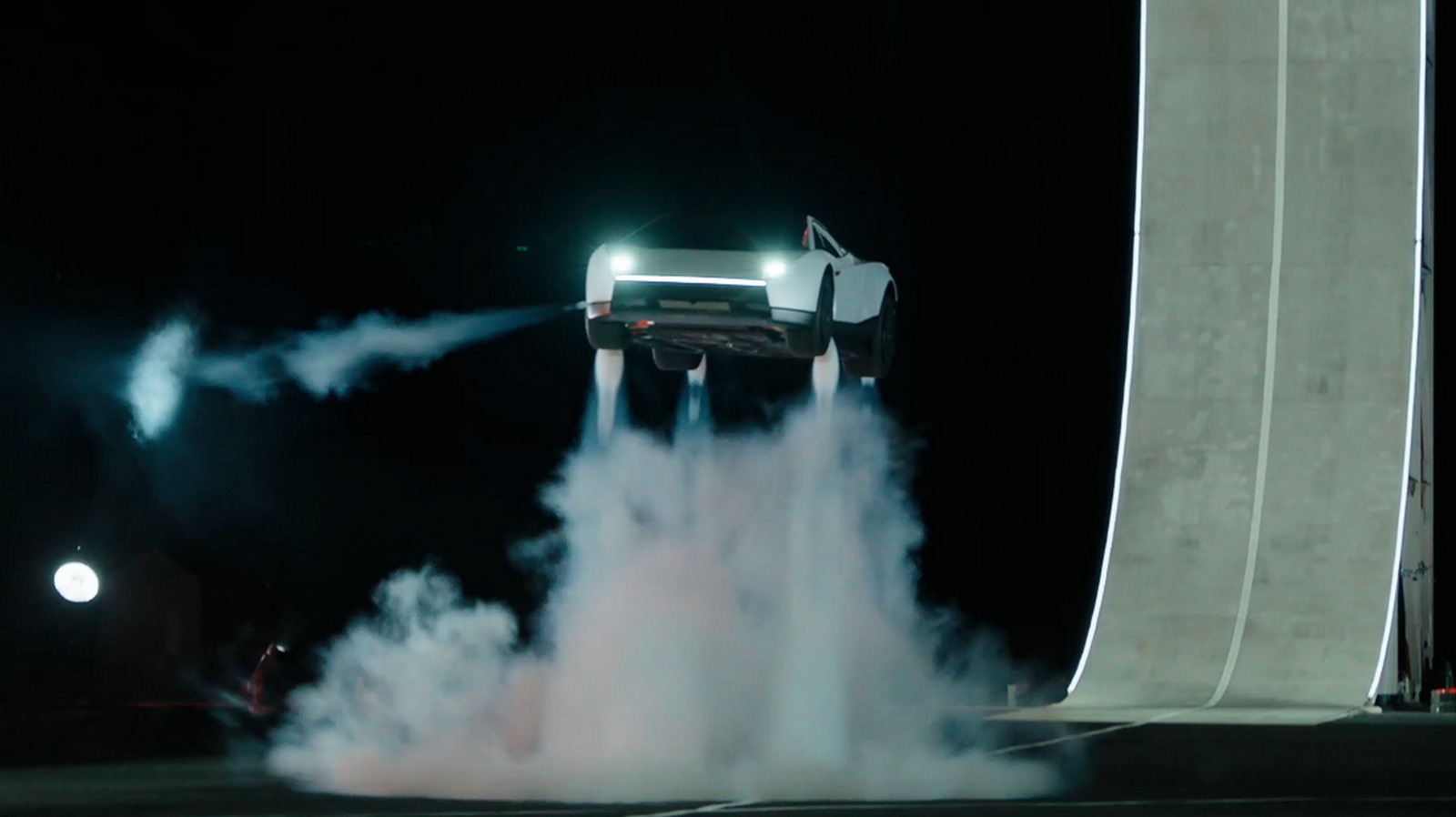


Tesla drove its new Roadster up a vertical ramp, launched it off the end, flipped it mid-air using cold-gas thrusters, and stuck the landing. Then it did a barrel roll over the rest of the Tesla lineup. Then it ran 0-60 mph in 0.81 seconds. All of this happened on stage at a reveal event that felt more like a SpaceX demo than a car launch.
And none of it changes the fact that this car won’t reach production until 2028.
That’s nearly 11 years after Tesla first showed us a Roadster prototype in 2017. The company dropped the “2.0” branding and any pretense of continuity with the original. This is just “Roadster” now. The design has shifted from the curvy coupe we saw almost a decade ago into something angular and aggressive, like a Cybertruck that shrunk in the wash and borrowed a Lamborghini Reventon’s cheekbones.
The numbers behind the spectacle are legitimately wild. Fans underneath the car generate up to 2Gs of downforce at standstill. Ten cold-gas thrusters, developed with SpaceX, let the car maneuver in the air.
Those thrusters draw from a pair of 600-liter tanks filled with ultra-high-pressure atmospheric air that the car can replenish while driving. Elon Musk says it’s just regular air, compressed and stored onboard.
The McMurtry Spérling drove upside down over a year ago using ground-effect suction. That was a first. But nobody has combined suction fans with rocket thrusters that let a car leave a ramp, rotate in mid-air, and land cleanly on its wheels. Tesla did that on stage, and credit where it’s earned.
But then the presenters used phrases like “for real” and “actually” while discussing the production timeline, which tells you everything about how even Tesla’s own team reads the room. They know the audience has been burned before.
Here is what Tesla did not mention during the reveal: range, horsepower, motor configuration, battery capacity, driven wheels, factory location, production volume, initial markets, or any roadmap between now and 2028. For a car that has existed in some form since 2017, the gaps in basic specification data are extraordinary.
Tesla’s website lists three trims. Performance requires a $50,000 deposit. Thrust, the variant capable of the sub-one-second 0-60 claim, costs $250,000.
Rocket is a single-seat flying version available by invitation only. No price listed for that one.
Nobody addressed what happens to the thousands of reservation holders who put down deposits years ago on a car that looked completely different and promised completely different things. Configuration timelines, order positions, delivery windows, all absent.
Steer-by-wire, brake-by-wire, and throttle-by-wire are confirmed. The braking system is expected to be Brembo’s Sensify. The rear spoiler adjusts downforce dynamically in both high and low modes. These are production-relevant details, and they were treated almost as afterthoughts compared to the aerial gymnastics.
The tension here is obvious. Tesla built something that can fly, flip, and land under its own power on stage. That is a real engineering achievement, not CGI, not a render.
But the company has now revealed this car twice across nine years without producing a single customer unit. The original Roadster prototype promised a 1.9-second 0-60 time and a 620-mile range. Those claims have been floating in the ether since 2017, unverified, undelivered.
Putting on a show is one skill. Building cars at scale, passing federal safety certification with rocket thrusters bolted to the chassis, and actually delivering them to driveways is an entirely different discipline. Tesla has two years to prove it can do both.
Share this Story