



Thirty-three years ago, Audi rolled a sedan out of Ingolstadt that carried the weight of a brand still clawing back from the unintended acceleration scandal that nearly killed it in America. The 1992 Audi 100CS, reviewed in Car and Driver’s December 1991 issue and recently resurfaced in the magazine’s archive, reads today like a time capsule of a company that understood its survival depended on building a car nobody could dismiss.
The pitch was straightforward. A new 2.8-liter V-6 making 172 horsepower and 184 pound-feet of torque, wrapped in a body that looked trimmer than the car it replaced even though it was actually a bit longer. Audi pointed its finger at the BMW 525i and Mercedes-Benz 300E 2.6 as direct competitors, both rear-drive, both more expensive. The confidence was deliberate.
Car and Driver’s William Jeanes, then a former editor-in-chief of the magazine, found a car that punched cleanly if not ferociously. Zero to 60 in 8.4 seconds with the five-speed manual, a top speed of 135 mph, and a quarter-mile in 16.5 seconds at 85 mph. None of those numbers made anyone’s palms sweat, but they were respectable for the segment at the time.
The real story was how the thing felt. Jeanes described an “elusive” quality of leanness, a car that moved like a middleweight fighter despite gaining 250 pounds over the outgoing model, tipping the scales at 3,389 pounds. Torsional rigidity jumped 30 percent, and you could feel it the moment you dropped into the seat.
Between 60 and 135 mph, where wind and tire noise had been tamed with unusual care, the 100CS turned into a long-distance companion that justified the $34,000 price tag.
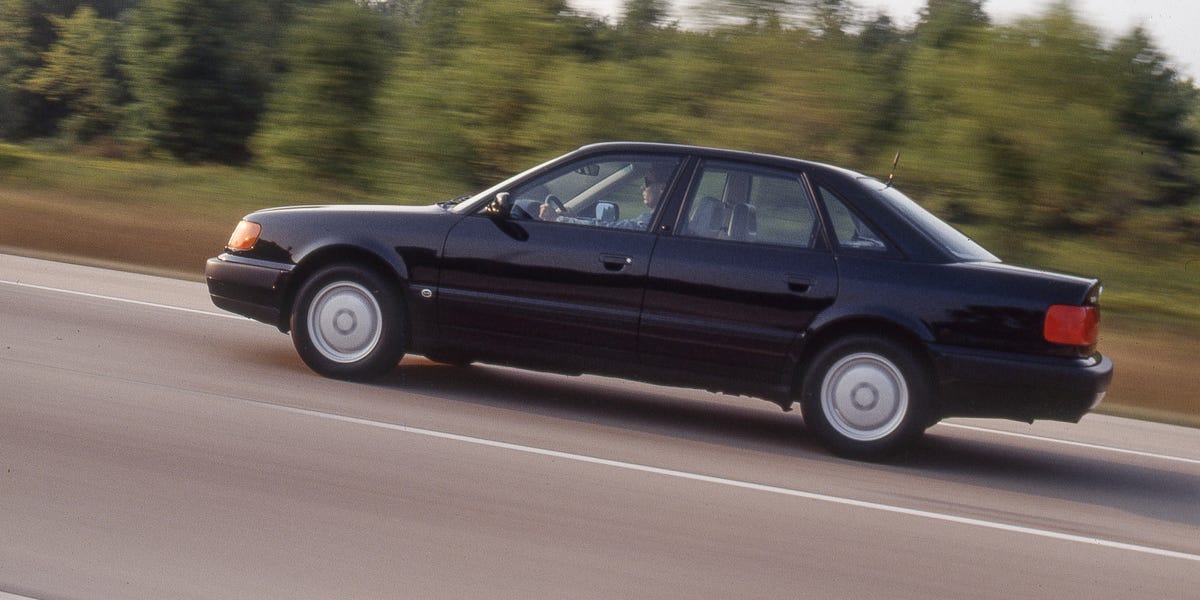
That price, adjusted for inflation, would be roughly $78,000 today. For a front-wheel-drive sedan with 172 horsepower. The market has changed in ways that make those numbers almost incomprehensible, but in 1991, this put the 100CS in direct contention with the Acura Legend and BMW 525i.
Audi was asking buyers to cross-shop against rear-drive prestige with nothing more than build quality, interior design, and that new V-6’s smoothness.
The interior was the car’s quiet weapon. Jeanes praised it without reservation: legible gauges by day, red-lit faces at night, climate control that worked exactly right, genuine wood trim used with restraint, and seats that were “orthopedically responsible.” A leather-wrapped steering wheel that both tilted and telescoped and a driver’s airbag were selling points in 1991.
Not everything landed. Don Schroeder’s counterpoint in the same review zeroed in on a shifter that felt like it was “connected by spindly rubber rods and bungee cords to a very distant five-speed.” Stopping from 70 mph took 206 feet, a number Jeanes acknowledged “hardly sets a record.” Skidpad grip of 0.79 g was adequate, not athletic, and 17 mpg observed fuel economy was thirsty for a car making less power than a modern Camry.
But the 100CS was never about raw performance. It was about proving Audi could build a complete car, one that felt engineered rather than assembled, at a moment when American buyers still associated the four rings with a 60 Minutes segment they couldn’t forget.
The brief Audi gave its engineers was disarmingly simple: do everything better. Reading Jeanes’s review three decades later, the fascinating part isn’t whether they succeeded. It’s that a company fighting for its American life chose refinement over flash, substance over spectacle.
The 100CS was the foundation on which the A6 would eventually be built, and the philosophy embedded in that original car, the idea that a sedan should feel lean and willing rather than bloated and overwrought, is one Audi has struggled to maintain as its cars have grown larger, heavier, and more dependent on screens. The engineers in Ingolstadt got the brief right once. Whether they still remember it is a different question.


Share this Story