
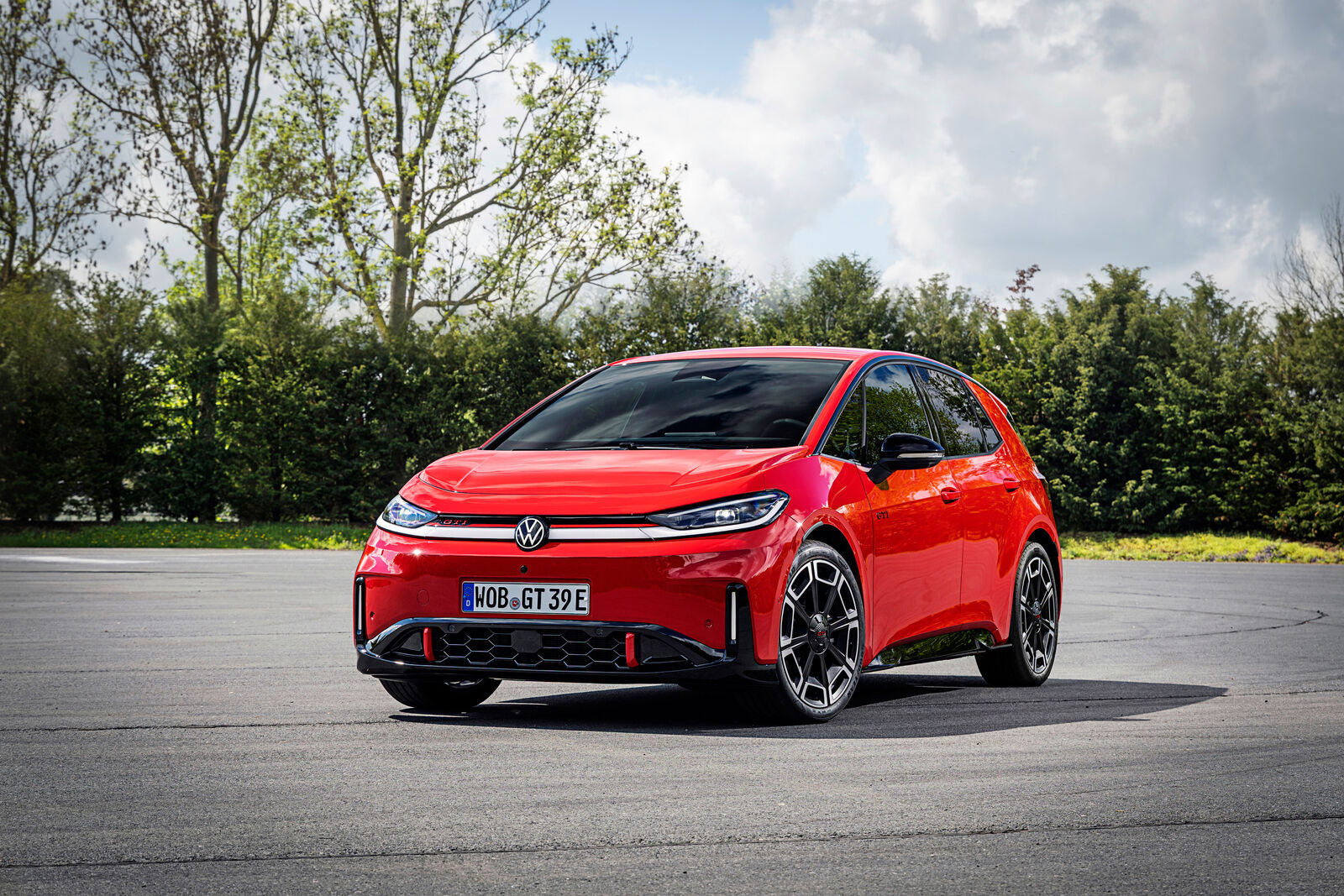


Volkswagen just dropped the most powerful GTI in the nameplate’s 50-year history, and it doesn’t have a combustion engine. The ID.3 GTI packs 240 kW, or 326 PS, through a single electric motor driving the rear wheels. That is not a typo.
The car that defined front-wheel-drive hot hatches now sends its power to the back. The 0-to-100 km/h sprint takes 5.6 seconds, which sounds brisk but not brutal for a car making 545 Nm of torque with zero lag.
A 79 kWh lithium-ion battery feeds the motor, promising up to 601 km of range on the WLTP cycle and DC fast charging from 10 to 80 percent in about 29 minutes at up to 183 kW. Top speed is electronically capped at 200 km/h. Pre-sales start at the beginning of 2027.
VW is calling this a “near-production concept vehicle,” which is corporate speak for “the car is done, the pricing isn’t.”
The spec sheet tells one story. The design tells another, one that’s trying very hard to remind you this is still a GTI. The red stripe across the front grille is there, traced directly back to the 1976 original.
The tartan check seat pattern returns in a “new interpretation.” There’s a red 12 o’clock marking on the steering wheel. Tornado Red paint, color code LY3D, is offered because it appeared on the first-generation Golf GTI facelift.
VW has even engineered a dedicated GTI button at 6 o’clock on the steering wheel. Press it and the cabin floods red, the digital cockpit reconfigures, the chassis stiffens via the adaptive DCC dampers, and Launch Control becomes available. The press release mentions “the sound of a combustion engine” before cutting off, which suggests some form of synthesized engine noise accompanies the mode.
The irony writes itself.
Standard equipment includes 20-inch alloy wheels called “Wörthersee,” named after the Austrian lake where GTI faithful have gathered for decades. Progressive steering, a sport chassis, and five color options round out the package. The car rides on the same MEB platform as the ID.3 Neo, but VW has stretched the proportions and eliminated the two-tone black roof of the outgoing ID.3 GTX, giving the GTI a longer, sleeker silhouette.
Here is the tension Volkswagen cannot engineer away. The GTI badge has meant one very specific thing since 1976: a front-wheel-drive hatchback with a turbocharged engine, accessible enough for a young buyer and sharp enough to thrill on a back road. Every single element of that formula has been altered.
The engine is gone. The driven wheels have swapped ends. The price, still unannounced, will almost certainly climb beyond what a Golf GTI costs today.
What remains is the red stripe, the plaid seats, and a corporate conviction that heritage can be transferred through design cues alone. VW is betting that the letters G, T, and I carry enough emotional weight to survive a complete mechanical reinvention.
The competition is not sitting still. The Hyundai Ioniq 5 N already proved that a performance EV can generate genuine driver enthusiasm without leaning on a legacy badge. The upcoming Alpine A290 and Renault 5 E-Tech are chasing the same affordable hot-hatch EV space in Europe.
Whether the ID.3 GTI connects with the faithful or alienates them will depend on one thing VW hasn’t revealed yet: how it actually drives. Rear-drive weight distribution and 545 Nm of instant torque could produce something genuinely special, or it could feel like a marketing exercise wrapped in plaid upholstery.
Wolfsburg is asking loyal GTI buyers to make a leap of faith. The badge says GTI. Everything underneath says something else entirely.
Share this Story