
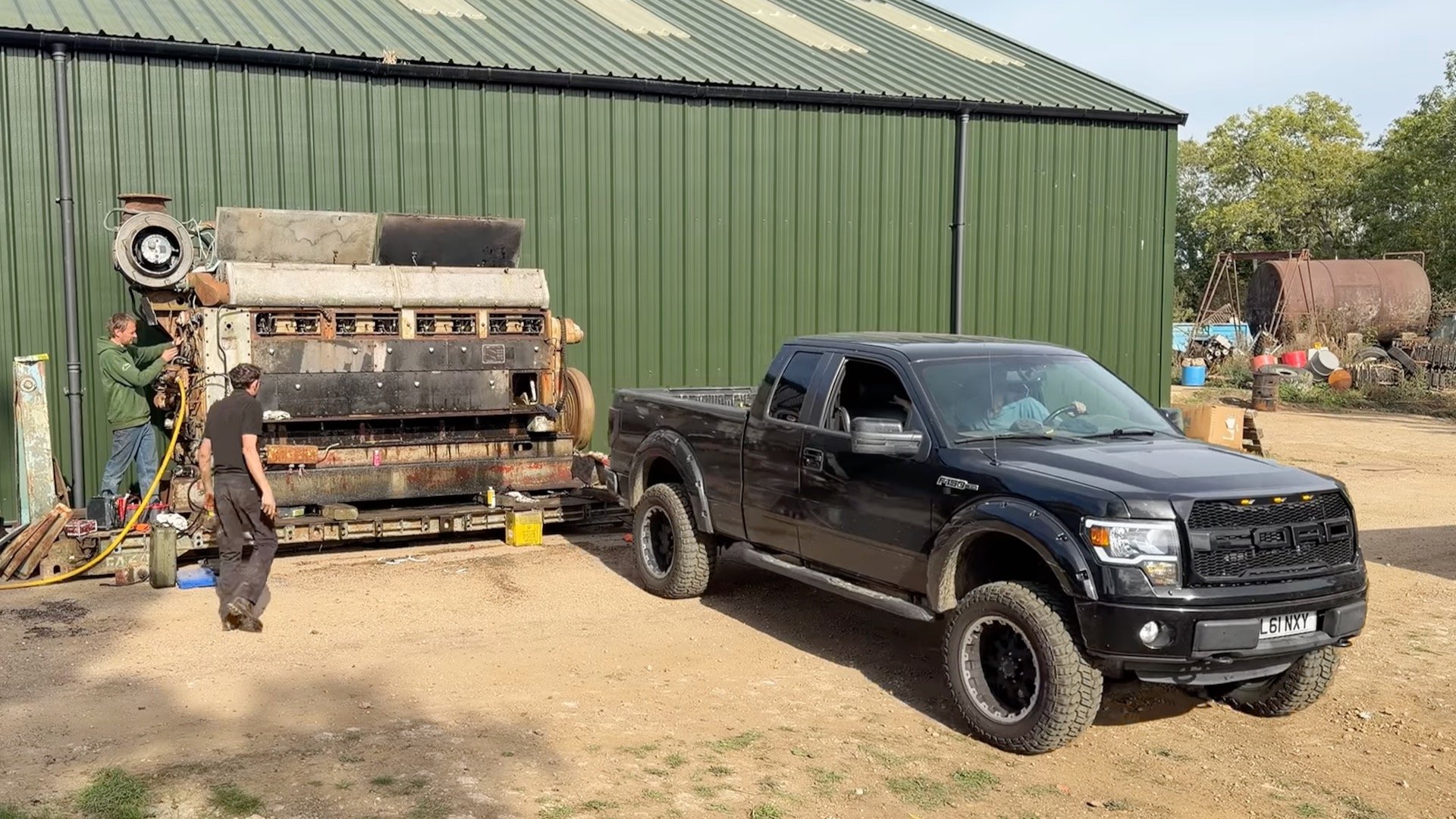


Most engines need a battery and a starter motor. This one needed a Ford F-150 and a ratchet strap.
YouTuber Mr Hewes, known for resurrecting vintage military and agricultural machinery, recently dragged a Mirrlees Blackstone JS8 back from the dead. The engine is a 102.4-liter straight-eight turbodiesel, originally delivered to the U.K. Air Ministry in 1953. It likely spent its working life powering a generator set on a Royal Air Force base, humming away in obscurity until someone shut it down and walked away.
That was a long time ago. The engine’s logbook showed just 720 hours of accumulated run time across more than seven decades of existence. Not exactly high mileage, but neglect did what neglect always does.
The oil passageways were full of water. Valves were stuck, injectors were frozen, and the oiling system was completely nonfunctional. Hewes and his team had to manually pump and vacuum water out of every passage before the engine could even think about turning. These are the same ailments that plague a barn-find small block, just multiplied by a factor of ten in every dimension.
Getting the JS8 to rotate freely was only half the battle. The engine was designed to start on compressed air, a common setup for large industrial diesels where electric starters would need to be absurdly oversized. But the compressed air supply Hewes had on hand wasn’t up to the task.
Plan B involved shoving the flywheel with a forklift pushing a handle. That didn’t work either.
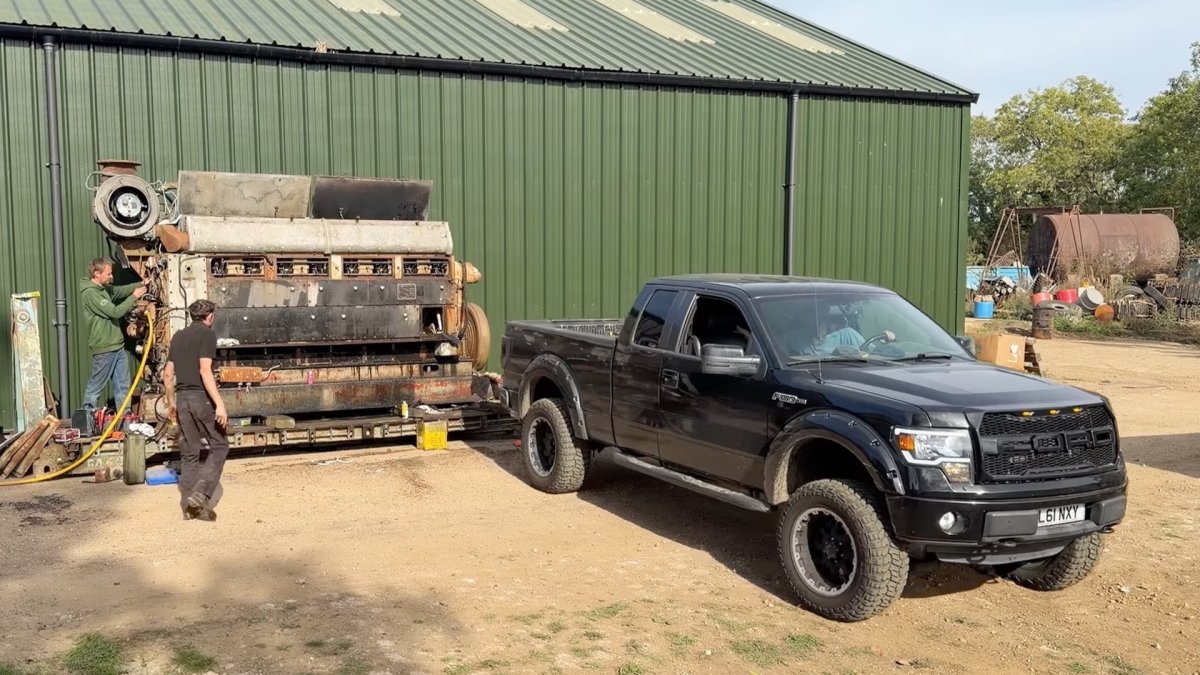
Plan C was pure brute force. The team wrapped a ratchet strap around the flywheel, hooked the other end to an F-150, and pulled. The truck spun the flywheel fast enough to fire the diesel, and 102.4 liters of British postwar engineering coughed back to life in a cloud of smoke that probably set off environmental alarms three counties over.
Hewes is no stranger to oversized powerplants. He previously collaborated with fellow YouTuber Scott Nothing To Do With You on a Rolls-Royce Meteor engine from a Centurion tank. That was a 27-liter V12, and the JS8 makes the Meteor look like a lawnmower engine.
Gensets like this were the silent backbone of Cold War infrastructure. Tucked into basements or bolted to concrete pads outside critical buildings, they existed to keep the lights on when everything else failed. The British military ordered thousands of them. Most were scrapped, and a few survived in the kind of damp, forgotten corners where old iron goes to rust.
The full video runs nearly an hour, and most of it is the painstaking, unglamorous work of clearing water, freeing stuck components, and improvising solutions when the proper starting equipment doesn’t exist anymore. The dramatic startup is the payoff. The hours of tedious mechanical archaeology are the price.
Hewes hasn’t said what comes next for the JS8. Whether it becomes a functional generator again or simply a running display piece, the fact that a 72-year-old, 102-liter diesel can be woken up with hand tools and a pickup truck says something about how these things were built. They were made for a world that expected them to last, and they did.





Share this Story