
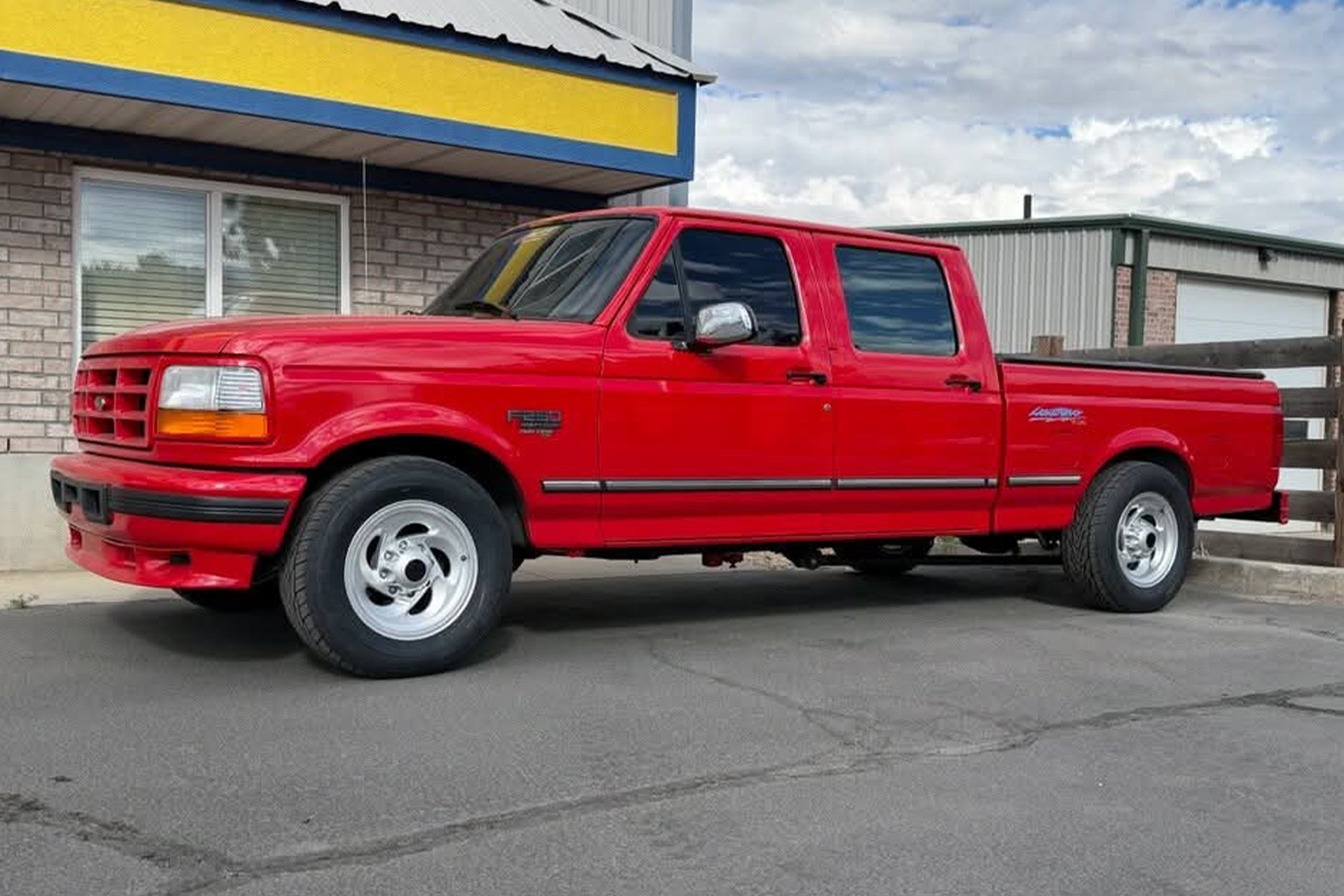


Ford sold the first-generation F-150 Lightning as a V8 street rod in a pickup suit. It was raw, loud, and completely impractical for actual truck work. Nobody at Dearborn ever thought to drop a diesel into the formula, but Chris Rutledge did.
Rutledge, working with Complete Performance and Edge Products, took a bone-stock F-250 with 127,444 miles on the clock and turned it into something Ford’s product planners never imagined. It’s a 7.3-liter Power Stroke Lightning clone making roughly 600 horsepower to the wheels.
Before the purists start hyperventilating, Rutledge and his brother Paul have a documented history of preserving factory-condition OBS Fords. They’ve kept more cherry trucks alive than most collectors ever touch. This one got the hot rod treatment because Rutledge earned the right to do it.
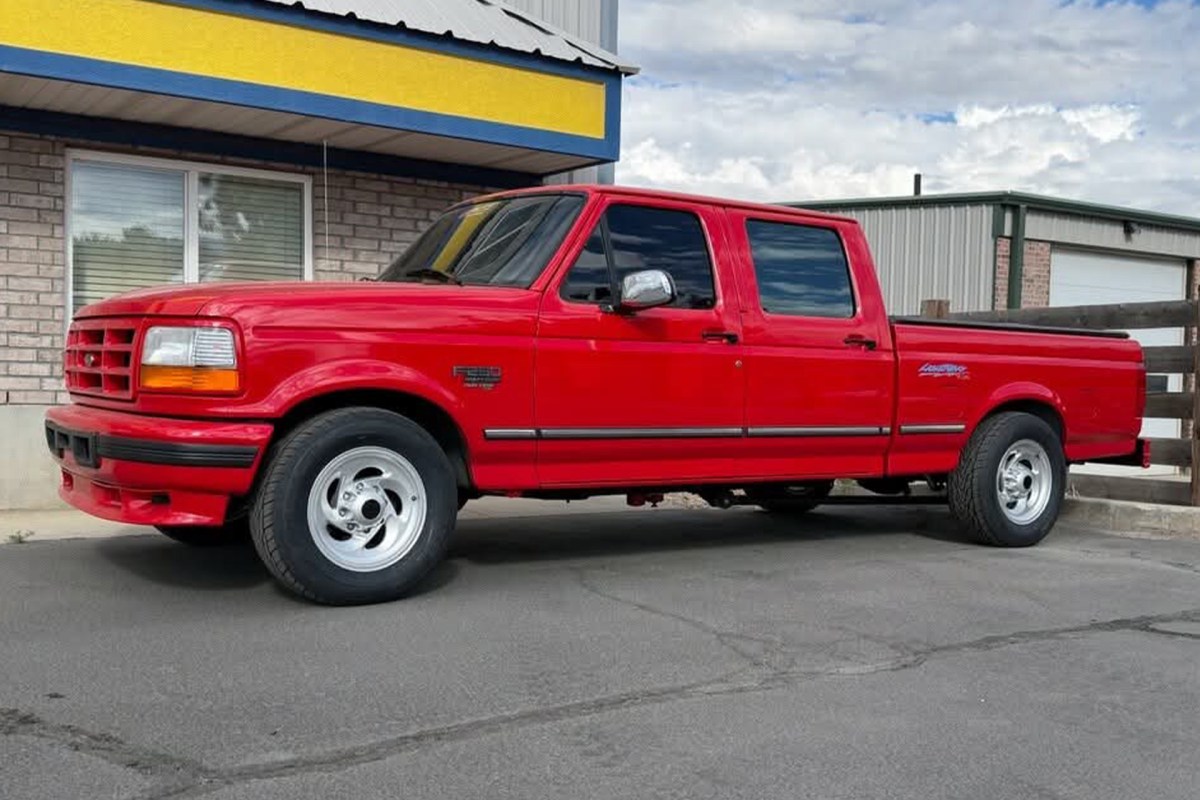
The cosmetics came first. The grille, headlight bezels, and bumpers were all paint-matched in the same shade of red, eliminating every trace of chrome exactly as Ford did on the original Lightning. A lower lip spoiler finishes the front end, diamond plate on the rear bumper got the same treatment, and “Lightning 7.3L” decals replace the original badging.
The wheels tell the real story of obsession. The original Lightning rollers only came in a five-lug pattern, useless on a heavy-duty truck. So John at Trinity Wheel Company bought an authentic Lightning wheel, 3D-scanned it, and recreated the design in CAD for an eight-lug application.
Trinity plans to offer the design commercially, but Rutledge’s truck got the first set. From ten feet away, most people would never question it. That’s the whole point.
Under the hood is where this build separates itself from the usual show truck crowd. A KC Turbos Gen 3 Stage 3 turbocharger sits on a factory T3 mount with a later Super Duty pedestal and collector. That combination spools fast enough to make the truck feel alive off the line.
Full Force Diesel injectors and custom PHP Hydra tunes round out the fueling side. The result is 600 wheel horsepower from an engine Ford originally rated at 235.
Rutledge was deliberate about parts compatibility. A Banks Power intercooler kit bolts up without fabrication because the turbo setup uses platform-specific mounting. A DieselSite Adrenaline high-pressure oil pump keeps oil volume where it needs to be under boost. Nothing on this truck requires one-off bracketry that would leave Rutledge stranded if something failed on a Tuesday commute.
The transmission is the next piece. An upgraded E4OD automatic, built by Brian’s Truck Shop, is waiting to go in. It’s rated well beyond the truck’s current output.
Rutledge dismissed the idea of swapping in a 5R110 or 6R140, noting neither offers a meaningfully better overdrive ratio. But when a 10-speed swap came up in conversation, his composure cracked just enough to suggest the idea has legs.
Rutledge drives this truck on the street. Six hundred horsepower in a 7,000-pound pickup is serious but not unmanageable, and he treats it as a daily. The longer-term plan is competition in the National Hot Rod Diesel Association’s Sportsman class, where the F-250 would line up against other diesel trucks on a drag strip.
Ford built the Lightning to prove a pickup could be a muscle car. Rutledge took the concept and applied it to the platform Ford never touched, with an engine Ford never considered fast enough to deserve the name. The fact that Trinity is already eyeing commercial production of those eight-lug Lightning wheels suggests he is not the only one who thinks Dearborn left something on the table.
Share this Story