
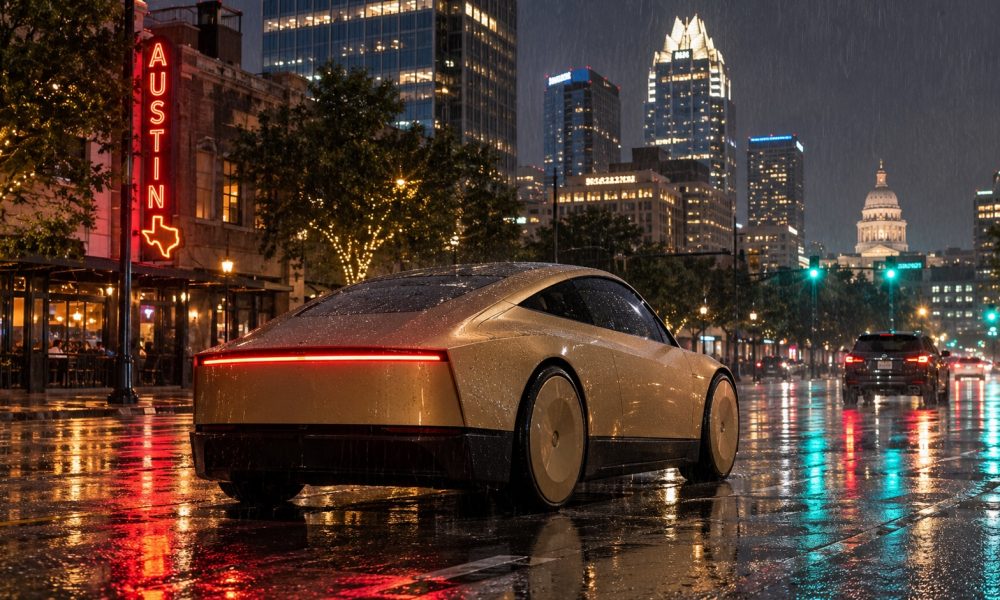


When the Cybertruck rolled onto a Los Angeles stage in November 2019, it had no windshield wipers at all. Lasers were the rumor. A single oversized blade was the production reality.
Seven years later, the truck is on death row, and the lasers are back.
Lars Moravy, Tesla’s Vice President of Vehicle Engineering, floated the idea on a new episode of Jay Leno’s Garage released Monday. This time the target is not a pickup. It is the robotaxi.
“If you fire them in a focused area, you can clean the sheet of water and create a barrier,” Moravy said. “When you think about autonomy, it might be a good solution to only clean the area where the camera is.”
He was candid about the limits. Clearing a full windshield would take too many lasers to be practical. He gave no timeline and called it something Tesla is considering, not a confirmed feature.
The engineering has been sitting in a drawer for years. Tesla filed for “Pulsed Laser Cleaning of Debris Accumulated on Glass Articles in Vehicles and Photovoltaic Assemblies” in May 2019. The patent was granted in September 2021, and a divisional version was approved on March 31, 2026.
The system detects debris, identifies it, and pulses the beam at a calibrated rate so it never cuts deeper than the glass. Windshields, side windows, camera lenses and solar panels are all named in the filing.
Elon Musk once admitted the Cybertruck’s wiper bothered him more than any other part of the truck. He never solved it there. Now he doesn’t have to.
Last week Musk announced Cybertruck production will wind down around mid-2027, clearing the line for more Cybercab output. On Monday he said the order rate “far exceeds our production rate” and that Tesla “will have to return deposits for a lot of people.”
Tesla is still taking Cybertruck orders anyway.
Once the truck goes, the consumer lineup shrinks to the Model 3 and Model Y. No pickup, no utility vehicle.
Engineering attention follows the money. Right now, the money is riding in cars with nobody behind the wheel.
That shift is why a smeared lens matters more than it used to. A private owner notices a dirty windshield and deals with it. A Cybercab heading to its next pickup has no one aboard to check.
Tesla has been patching the problem the old-fashioned way. Model Y Robotaxis in Austin were spotted in January with washers on their side repeater cameras. A lens cleaning patent granted in May describes a fluid and wiper assembly for vehicle cameras and for Optimus’ eyes.
Fluid runs out. Blades wear down.
Across a fleet, both become a line item. A laser removes both.
The fleet keeps growing. Tesla launched unsupervised Robotaxi service in San Antonio on Monday, its eighth city and fifth in Texas.
The day-one geofence covers roughly 274 square miles, Tesla’s largest launch zone yet. Austin’s service area expanded the same day to about 443 square miles.
Houston, Miami and Tampa are already live. All three take heavy seasonal rain.
The same Leno episode put the host in a Model Y L running Full Self-Driving (Supervised). The car pulled over on its own for an approaching ambulance. “We got it on self-driving mode! I’m not touching anything,” Leno said.
Moravy and design chief Franz von Holzhausen drew the line plainly. With FSD (Supervised), the owner is responsible. On a Robotaxi ride, Tesla is the operator, and Tesla carries the risk.
So when rain hits a camera in Tampa, the problem belongs to Tesla alone. The wiper that bugged Musk in 2019 is about to become his liability.
Share this Story