
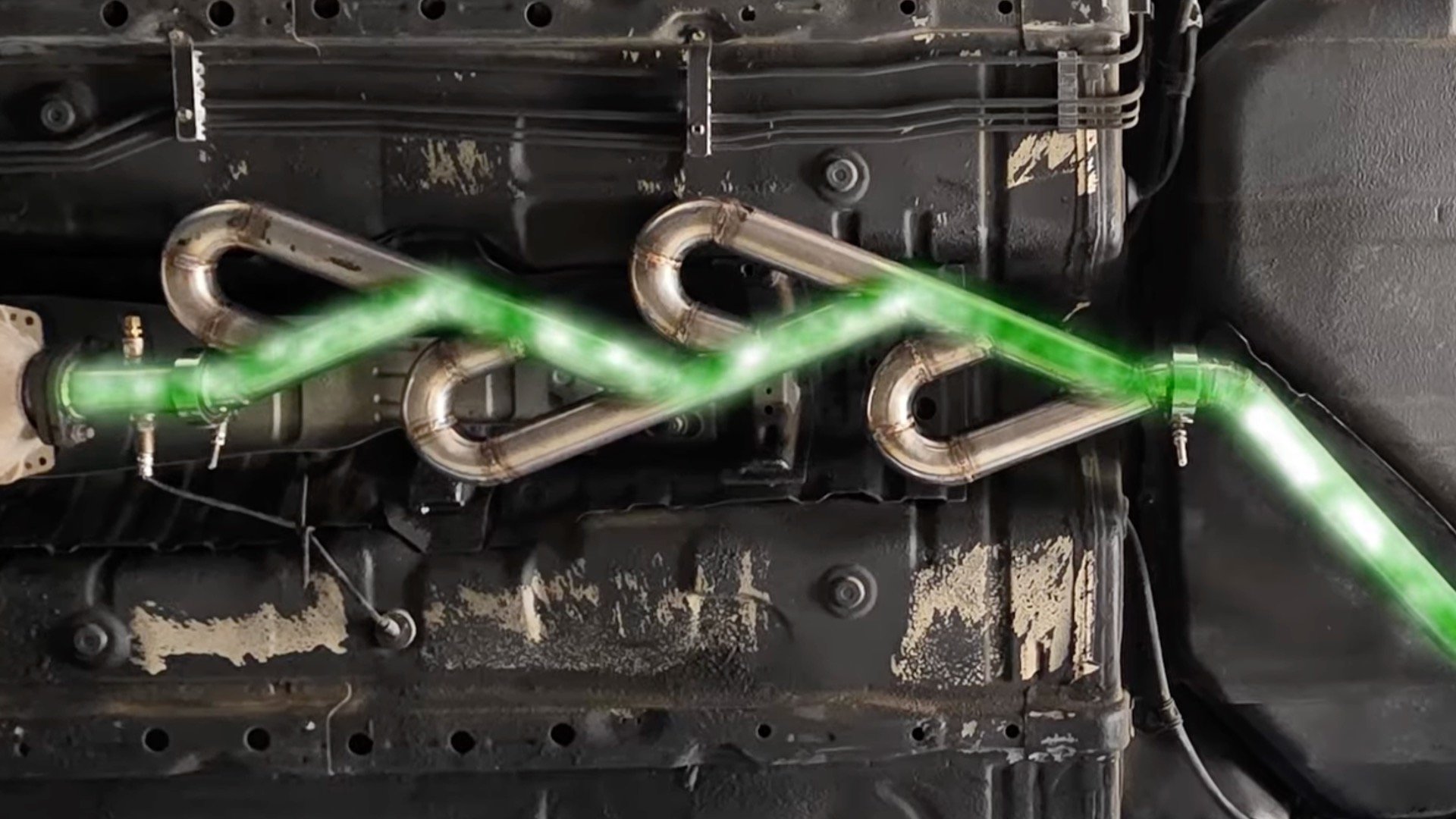


A YouTube fabrication team welded a 104-year-old fluid valve design into a Mitsubishi Lancer Ralliart’s exhaust system, bolted the car to a dyno, and confirmed what any competent exhaust engineer could have told them over lunch. It doesn’t work.
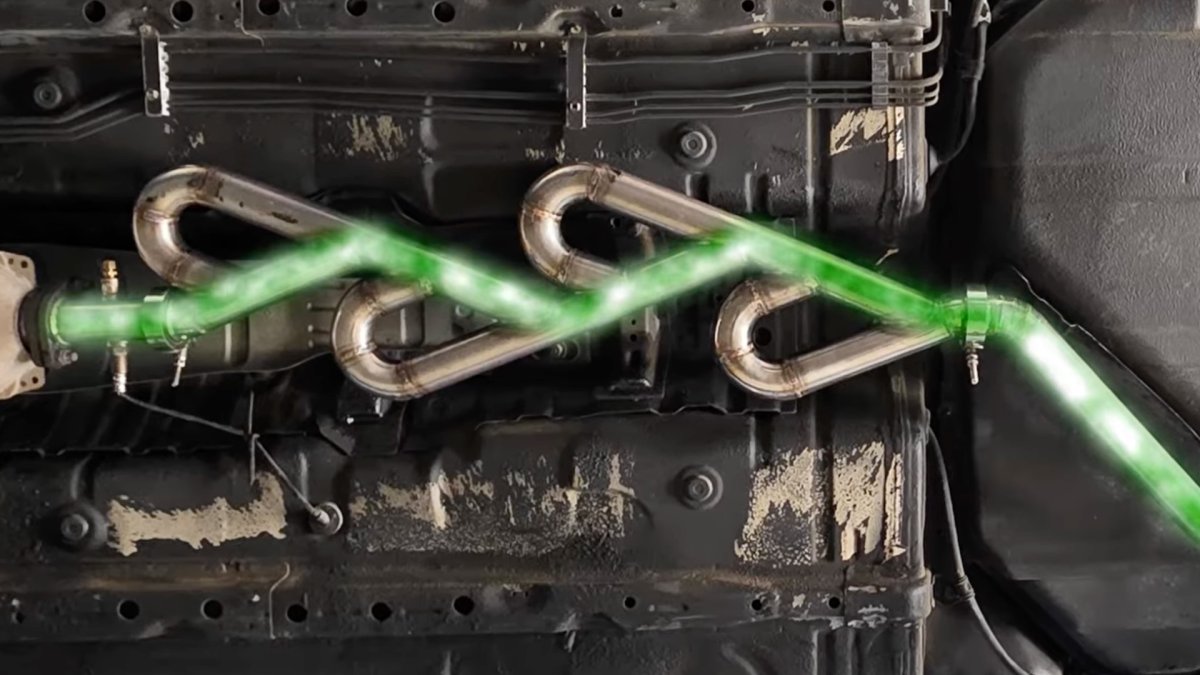
The Fabrication Series channel built a Tesla valve exhaust, a design patented by Nikola Tesla in 1920 that uses looping, heart-shaped channels to allow flow in one direction while blocking it in reverse. No moving parts. Originally meant for liquids, not the hot, compressible gases screaming out of a four-cylinder engine.
The team could only fit four of the valve’s looping channels under the car. A proper Tesla valve needs many more to function well, but packaging constraints killed that idea before the first pull.
With the valve oriented in the correct flow direction, the Ralliart made 142 horsepower averaged across three dyno runs. The stock exhaust produced 146 hp. A four-horsepower deficit isn’t catastrophic, but the back-pressure gauge told a less flattering story.
The valve was choking the engine even when flow was moving the “easy” way.
The noise, or rather the absence of it, was the one genuinely interesting result. The Tesla valve exhaust was essentially silent. Everything audible on the dyno came from under the hood, no muffler needed when your exhaust piping acts like a labyrinth.
Flipping the valve around so the engine had to push exhaust through the blocking direction made things predictably worse. The engine still started, which itself undermines the Tesla valve’s core premise. Gases compress, liquids don’t.
That fundamental difference means the valve can slow exhaust flow and build enormous back pressure, but it can’t actually stop it. The reversed orientation averaged 134 hp and generated noticeably more heat. The engine struggled to build revs, laboring against its own exhaust like breathing through a clogged straw.
This is the kind of experiment that’s fun to watch and painful to think about. The Tesla valve was never designed for exhaust gases. Bolting one to a car and discovering it doesn’t work well is like putting snow tires on a boat and being surprised when it doesn’t handle better on the lake.
The team deserves credit for actually building the thing and putting numbers on it rather than just speculating. Too many internet arguments about exhaust design live in the theoretical. Dyno sheets settle debates, and these settled this one quickly.
Back pressure is the enemy of naturally aspirated performance, and a Tesla valve generates it in abundance regardless of orientation. The silence is a neat party trick, but you can achieve similar noise reduction with a properly designed muffler and lose far less power doing it.
Justin from The Fabrication Series pointed out the core flaw himself in the video. Compressible gases render the Tesla valve’s one-way blocking principle mostly useless. Pressure builds, but flow continues.
It’s the same basic concept that makes turbochargers work, using exhaust energy against restriction. Except a turbocharger gives something back. A Tesla valve exhaust just takes.
The channel has previously tested other unconventional exhaust shapes, building a catalog of what works and what doesn’t through actual measurement rather than forum speculation. This latest entry falls firmly in the “doesn’t” column, and nobody with a thermodynamics textbook is surprised.





Share this Story