
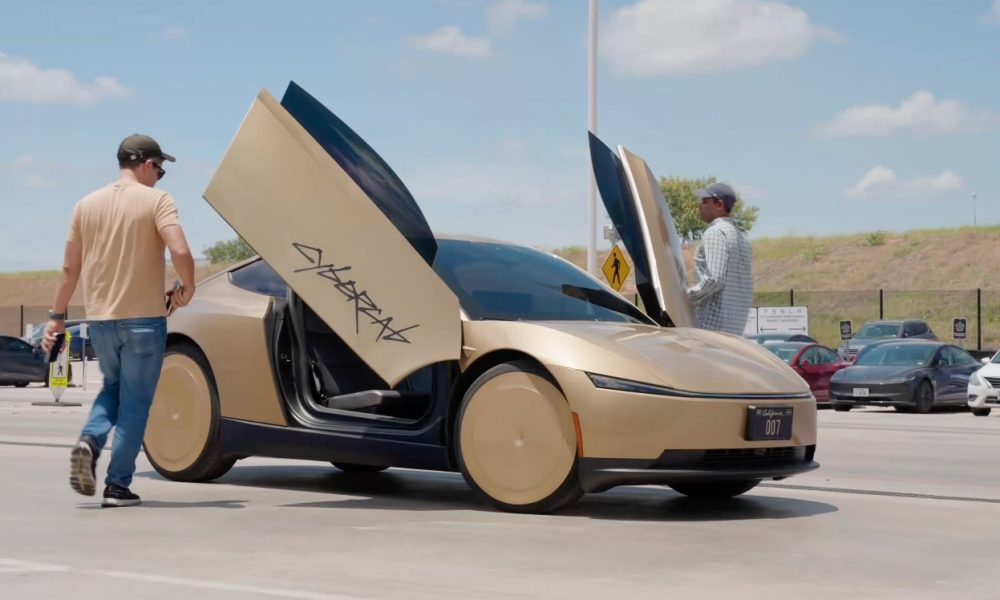


Tesla started giving public rides in a vehicle with no steering wheel and no pedals on Thursday in Austin, Texas. That sentence would have read like science fiction five years ago. Now it’s just a line item in the company’s week.
The Cybercab is a two-seat autonomous vehicle built from scratch for driverless operation. No manual controls in the cockpit. Passengers get a screen, climate controls, a seat adjustment, and a ride.
Tesla says it has now logged 1 million unsupervised autonomous miles on its Robotaxi fleet, which until this point ran modified Model Y vehicles across parts of Texas and Florida. The Cybercab additions change the calculus. This is no longer a conventional car with the steering wheel software-locked — it’s a purpose-built machine that cannot be driven by a human under any circumstances.
The specs filed with regulators are modest by Tesla standards: a 48-kilowatt-hour battery, a single 219-horsepower front motor, 3,113 pounds curb weight, and an EPA-adjusted range somewhere between 290 and 300 miles. CEO Elon Musk framed it less as a car and more as “a super comfortable lounge on wheels with a great TV and epic sound,” equipped with Starlink V5 for 4K video and gaming during the ride.
The same day it launched rides, Tesla quietly posted a web form titled “Help Us Build Our Robotaxi Network.” It invites companies to express interest in fleet purchasing, mobility hubs, infrastructure partnerships, and event collaboration. No pricing, no delivery timeline, no configurator. Just a name, an email, and a dropdown menu.
That form is doing real work. Tesla has talked about a $25,000 to $30,000 price target per Cybercab, and the company appears ready to let third-party operators buy vehicles and place them on Tesla’s ride-hailing platform in exchange for a cut. Several high-profile investors have already said publicly they want in, and the form gives them somewhere to raise their hand instead of waiting for a sales page that doesn’t exist yet.
Regulatory approval for unsupervised operation still varies wildly by state, and that’s the single largest bottleneck between a geofenced Austin demo and a national service. Tesla has registered dozens of Cybercabs with Texas authorities. Scaling beyond that requires a patchwork of permissions that no automaker or tech company has fully cracked.
Within hours of the Austin launch, Tesla’s Asia account announced Cybercab appearances in Hong Kong, Tokyo, Beijing, and Shanghai later this month. No test rides, no service areas — just static displays designed to build anticipation. China already has a thriving autonomous ride-hailing market dominated by Baidu’s Apollo Go and Pony AI, so Tesla would be entering as a latecomer in the one region where driverless taxis are already routine.
The Asia tour mirrors earlier playbooks. Cybercab toured Europe in late 2024 and showed up at U.S. shopping centers that December. Each stop generated attention without requiring a single autonomous mile on foreign roads.
Back in Austin, the Cybercab is operating within a defined geofence, and production is ramping at Gigafactory Texas. Tesla is simultaneously selling the dream to fleet buyers, showing off the hardware to Asian audiences, and logging real rides with real passengers in a vehicle that offers zero human override.
The gap between a controlled Austin demo and a profitable global robotaxi network remains vast. But as of Thursday, at least one version of the future is circling the streets without anyone behind a wheel that doesn’t exist.
Share this Story