
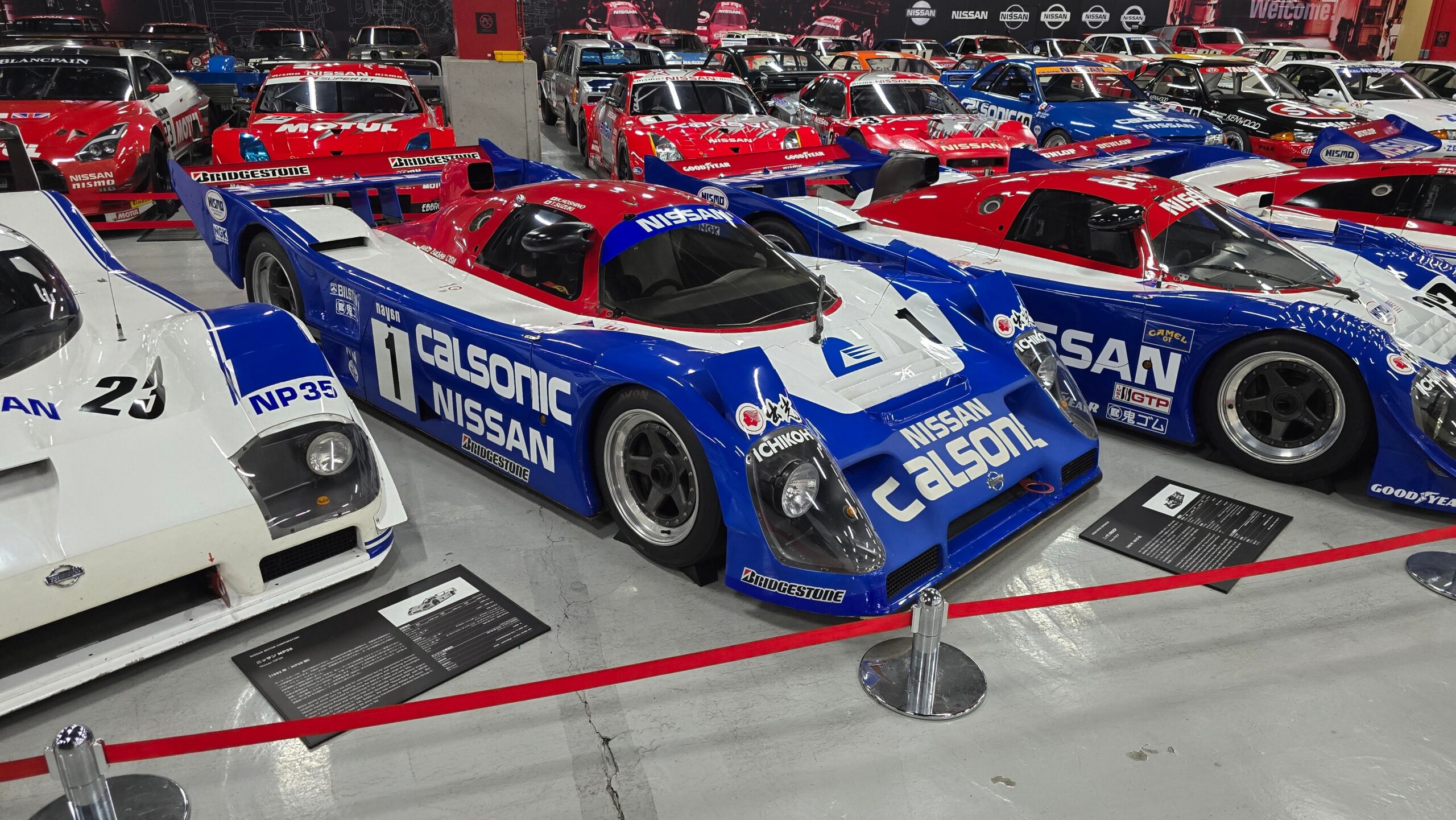


Three hundred cars. That’s how many machines sit inside Nissan’s Heritage Collection in Zama, Japan, a facility that functions less like a museum and more like an automotive vault where every sin and triumph of a 90-year-old company lives under one roof.
Car and Driver recently walked the floor, and what they found tells a story Nissan’s current boardroom probably doesn’t love hearing right now.
Start with the 1998 R390 GT1, the Le Mans weapon that most Americans only knew as pixels in Gran Turismo. Four long-tail versions finished in the top 10 at Le Mans that year, the No. 32 car grabbing third overall. Its 3.5-liter V-8 made north of 641 horsepower through a six-speed sequential box.
Nissan built a road car just to satisfy homologation. That’s commitment to a cause that today’s Nissan, bleeding cash and cutting models, can barely imagine.
Then there’s the 1987 MID4-II concept, a mid-engine test bed running a twin-turbo VG30DETT V-6 with 325 horsepower. It pioneered HICAS rear-wheel steering and the multilink rear suspension that ended up in the R32 Skyline. Nissan was once brave enough to consider putting its engine behind the driver.
That courage evaporated somewhere between the third Altima refresh and the current financial crisis.
The 1973 Safari Rally-winning Datsun 240Z still wears its wounds. Metal wire holds one headlight to the body. Dented panels that survived the punishing East African stages were never smoothed out.
A 2.5-liter inline-six making 222 horsepower dragged this thing through hell and back. Nissan kept it exactly as it crossed the finish line. There’s a lesson in that.
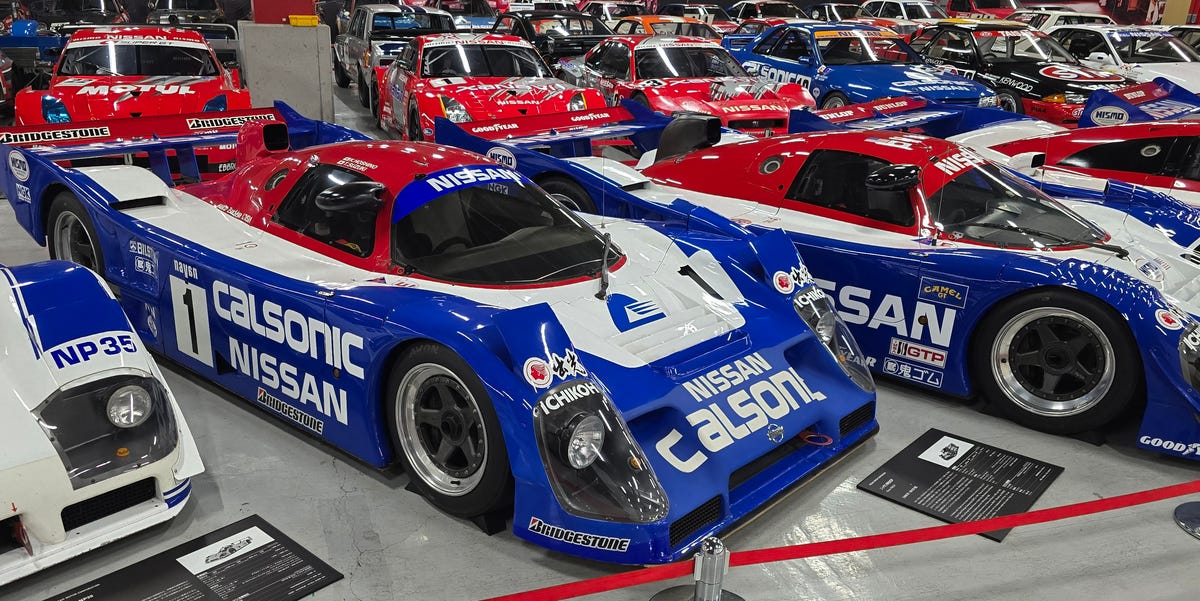
The Skyline lineage alone justifies the pilgrimage. The 1972 KPGC10 Hardtop 2000GT-R, lighter and shorter than the sedan, racked up 50 domestic touring-car wins in under three years. Its 2.0-liter S20 inline-six made just 158 horsepower, but the car was so dominant it became Japan’s first true performance icon.
Nearby sits the 1983 Skyline Super Silhouette, a Group 5 monster with a turbocharged 2.1-liter four-cylinder pumping out at least 562 horsepower wrapped in a body kit that looked like it was designed during a fever dream. Factory driver Masahiro Hasemi campaigned this thing at Fuji. It now lives in half a dozen video games.
The 1992 Pulsar GTI-R, Nissan’s World Rally Championship entry that never made it to American shores, sits with its hood scoop and SR20DET turbo four making 227 horsepower through all four wheels. Its best WRC result was third in Sweden. Not dominant, but wildly ambitious.
Even the oddballs shine. The 1964 Datsun Baby, a mid-engine trainer for children with a 199-cc engine limited to 18 mph, was built in a run of just 100 units. The 1947 Tama Electric Car made 4.5 horsepower from a lead-acid battery pack and could swap its battery modules on rollers, a concept that companies like NIO would rediscover seven decades later.
The 1991 Future Electric Vehicle concept predated the Leaf by nearly 20 years, promising a quarter-mile in 20 seconds from dual AC induction motors making a combined 54 horsepower.
What connects all 300 machines is ambition. Nissan once built rally weapons, Le Mans prototypes, mid-engine concepts, children’s safety trainers, and electric experiments simultaneously. The company threw ideas at walls with the confidence of an engineer who hadn’t yet met an accountant.
Walking through Zama today is like reading the diary of someone who used to be fearless. The cars haven’t changed. The company around them has.
Every gleaming race car and battered rally survivor in that collection is a receipt for what Nissan used to spend its energy on, and a quiet indictment of where that energy goes now.
Share this Story