


The 2027 Nissan Z doesn’t arrive with more power. It arrives with more nostalgia — carefully packaged, focus-grouped, and color-matched to a car most of its buyers have only ever seen on Instagram.
Nissan just detailed five design changes to the refreshed Z, and every single one of them points backward. A split grille referencing the original 240Z. Wheels mimicking the 300ZX. A green paint job chasing the ghost of Grand Prix Green from 1969. A tan interior because the S30 had one. Even the digital gauge cluster now plays a startup animation cycling through all seven generations of Z, as if the car needs to remind you of its own résumé every time you turn the key.
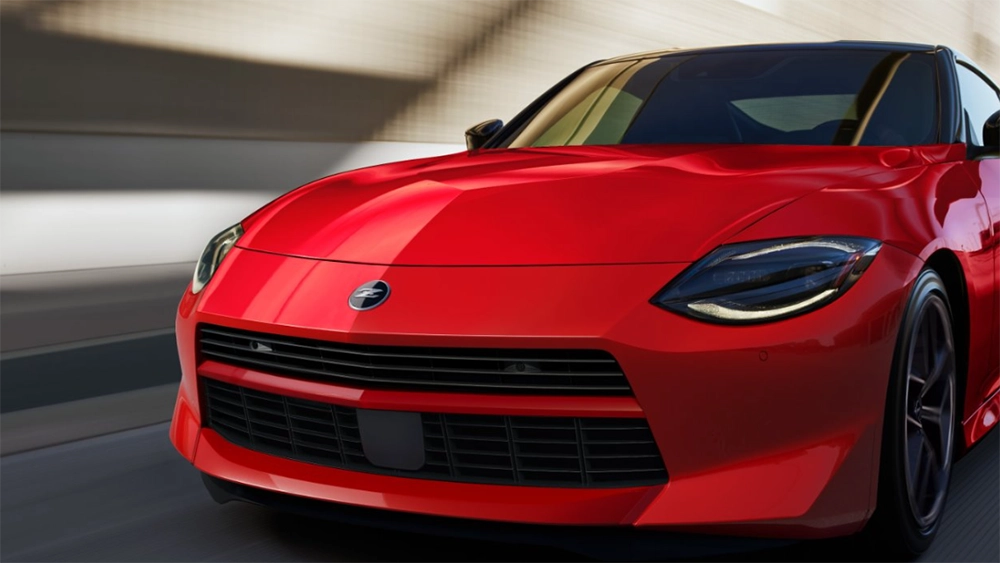
The most significant visual change is up front. The large open grille that drew mixed reactions at launch now gets a horizontal bar slicing through it, echoing the S30’s face. Paul Hawson, Nissan’s director of Advanced Product Planning and Strategy, was blunt about the motivation: “There was a lot of discussion around the front face and the big grille,” he said. Translation — people complained, and this is the fix, dressed up as heritage.
Engineers had to repackage the front parking sensors to make it work. That’s the kind of detail that tells you this wasn’t a casual design choice. Someone spent real hours and real money solving a problem created by splitting a grille in the name of a car built 56 years ago.
The new Shinkai Green Pearl Metallic — “deep sea” in Japanese — is genuinely interesting from an engineering standpoint. Green paint fades badly in sunlight, so Nissan’s paint engineers blended ultra-fine yellow and blue pigments that read as green but resist UV degradation better than traditional green formulations. A mild metallic flake adds depth. Pair it with the new tan interior on a Performance grade and you get a handsome sports car that looks like it wandered out of a 1972 road test.
Performance models also get new 19-inch RAYS alloy wheels wearing Bridgestone Potenza S007 tires, with the rears a half-inch wider than the fronts. The ten-spoke design references the Z31’s machined wheels from the mid-1980s. Program design director Shinichiro Irie noted the thin spokes were chosen partly to show off the big brake rotors and red calipers. Form serving function, or at least not obstructing it.
Beneath all the retro styling cues, there are actual mechanical improvements — larger-diameter shocks on Performance models and a manual transmission option finally available on the Z NISMO. Nissan mentioned these almost in passing, which tells you something about where the company thinks the story is.
The Z sits in a strange place in the market. It competes against the Toyota GR Supra and the upcoming next-generation Mazda MX-5, both of which have clearer identities. Nissan’s answer has been to lean harder into the Z’s history, treating its back catalog like a parts bin for emotional connection.
There’s nothing wrong with heritage. Porsche has built a billion-dollar industry on it. But Porsche also refreshes the 911’s engineering with surgical precision every cycle, and the nostalgia rides on top of relentless mechanical evolution. Here, the nostalgia is the headline, and the engineering changes are footnotes.
Nissan expects the 2027 Z to hit showrooms this summer. It will look better than the car it replaces, particularly in that green with tan leather. Whether a new grille bar and a startup animation are enough to keep the Z relevant against increasingly sharp competition is a question Nissan seems content to answer with another look in the rearview mirror.

Share this Story