
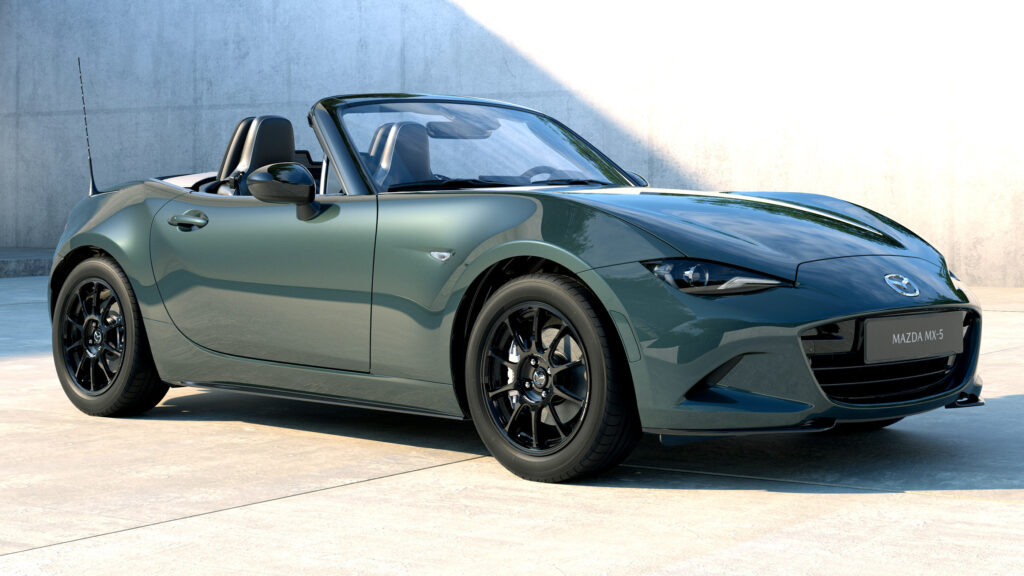


Four horsepower. That’s what Mazda’s engineers extracted from the 1.5-liter Skyactiv-G engine in the 2027 European MX-5, bringing the total to a princely 134 hp. In a world of 600-horsepower electric SUVs, Mazda is still fussing over single-digit power gains and engine acoustics in a roadster whose bones date to 2014.
And honestly, that’s the most Mazda thing imaginable.
The updated ND-generation MX-5 lands in European showrooms this September with a new Zinc Green paint option, a marginally improved powertrain, and a fresh special edition called the Yakudo. The bodywork hasn’t changed. The interior hasn’t changed.
The 8.8-inch infotainment screen introduced in 2024 carries over. What has changed is that Mazda’s engineers refined the exhaust note to better “enhance the agile and direct driving feel” of the car. They want you to hear those four extra horses, every last one of them.
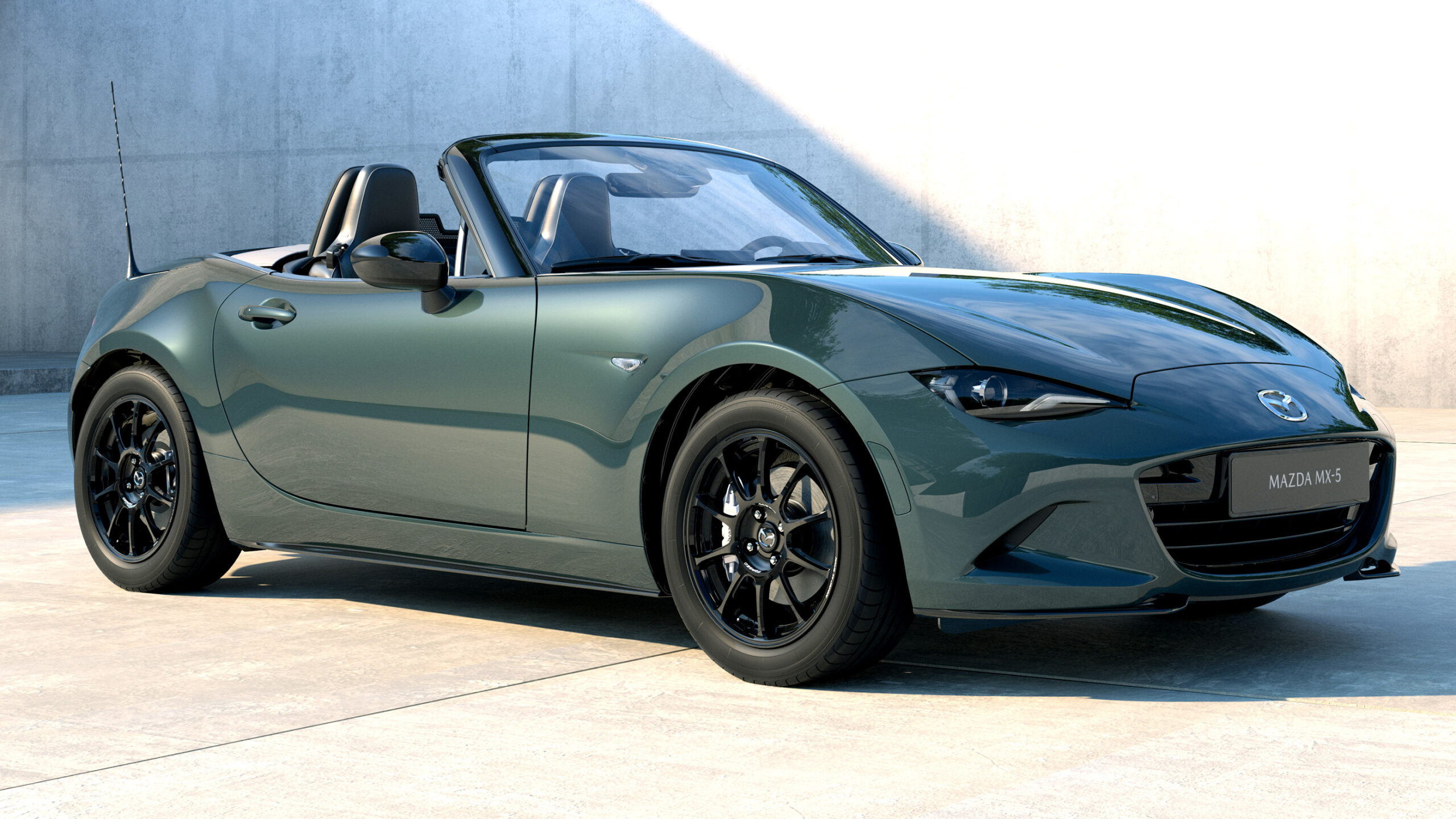
The Yakudo edition, offered only as a soft-top, gets silver exterior accents, matching silver brake calipers, and an Alcantara-trimmed cabin. It joins the existing Kazari and Homura trims. The Homura remains the enthusiast’s pick, with 16-inch black RAYS wheels, red Brembo calipers, Bilstein dampers, and a front strut brace — a setup that closely mirrors the American-market MX-5 Club, though the U.S. car rides on 17-inch wheels.
Europe’s MX-5 lost its 2.0-liter engine option to emissions regulations, leaving only the 1.5-liter four-cylinder. The UK still gets the bigger motor. For the rest of the continent, the bump from 130 hp to 134 hp comes paired with 155 Nm of torque, a drop in CO2 emissions to 139 g/km, and fuel consumption that improves by a whisker to 6.1 liters per 100 km.
These are the kind of numbers that would bore a Mustang buyer to tears but matter deeply to the engineers in Hiroshima who treat every gram and every tenth of a liter as a personal challenge.
Mazda also added a Driver Attention Alert system to the standard safety kit. It’s the kind of regulatory box-checking that keeps the car legal without adding weight or complexity that would compromise the driving experience.
Left-hand-drive production started in May. Right-hand-drive models follow in September. Pricing hasn’t been announced.
The ND generation is now 11 years old, and Mazda plans to keep it running until 2029. That’s a remarkably long life for a sports car in an era of rapid product cycles, though the MX-5 has always played by different rules. Its successor, reportedly designated the NE, will adopt some form of hybrid assistance while attempting to preserve the lightweight formula that has defined the nameplate since 1989.
That’s a difficult needle to thread — batteries are heavy, and the MX-5’s entire identity rests on being light and communicative.
For now, though, the current car soldiers on with its tiny engine, its analog character, and its stubborn refusal to chase horsepower numbers. Four more horses and a better exhaust note won’t move the needle on a spec sheet. But anyone who has driven an MX-5 through a tight back road knows that spec sheets have never been the point.
Mazda keeps polishing this gem because the people who buy it understand exactly what they’re getting. The rest of the market can have its torque vectors and launch modes. The MX-5 remains a car built for people who actually like driving — even if they have to do it with 134 horsepower.

Share this Story