
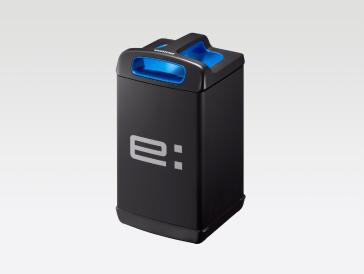


Honda is bringing its swappable battery pack to the American market next month. It’s a quiet but potentially significant move buried inside the company’s display at the Advanced Clean Transportation Expo in Las Vegas this week.
The Honda Mobile Power Pack e:, or MPP, is a portable, swappable lithium-ion battery designed not just for Honda’s own products but for integration into other manufacturers’ electric vehicles and equipment. It’s a business-to-business play, aimed at commercial partners who want to sidestep the usual EV pain points by simply swapping a dead pack for a charged one. Those pain points are familiar: long charging times, limited range, and brutal battery costs.
Honda didn’t invent the swappable battery concept. Gogoro has been running a similar network for scooters in Taiwan for years. But Honda is betting its engineering credibility and global scale can push the idea further, across a wider range of applications, in the world’s largest economy.
The MPP wasn’t the only hardware on display. Honda rolled out both its current and next-generation hydrogen fuel cell modules, and the gap between the two tells the real story of where the company thinks hydrogen is heading.
The current module, co-developed with General Motors, already cut costs by two-thirds and doubled durability over the system that powered the 2019 Clarity Fuel Cell sedan. The next-gen module promises to halve costs again, double durability once more, and triple volumetric power density. If Honda hits those targets, the economics of hydrogen start looking very different, particularly for stationary power.
That’s where the Fuel Cell Power Generator comes in. Honda envisions a scalable stationary system, built from stacked fuel cell modules, capable of delivering 250 kilowatts to 3 megawatts of clean electricity. The target customers aren’t commuters. They’re factories, data centers, and office complexes, the kind of large-scale energy consumers that can’t wait for grid upgrades and can’t tolerate intermittent renewables alone.
Then there’s the Fastport eQuad, the odd duck in the booth. Honda launched Fastport in 2023 as a micromobility logistics subsidiary, and the eQuad is its flagship. It’s a single-rider, pedal-assist delivery vehicle designed to operate in bike lanes, using a pedal-by-wire system where the rider’s input is transmitted electronically rather than mechanically, paired with an electric motor for boost.
Last month, Fastport landed a partnership with Bird and Spin to support field operations on university campuses and in major metro areas. It’s a niche application, but urban last-mile delivery is a problem nobody has cracked cleanly. Honda is throwing hardware at it rather than algorithms.
The thread connecting all three products is Honda’s determination to become an energy company, not just an automaker. Joe Juliano, Honda’s business development lead for sustainability, called the company “a natural collaborator” for zero-emissions energy solutions. That’s corporate-speak, but the underlying strategy is coherent: Honda wants to sell power systems and platforms, not just cars and motorcycles.
Whether the market is ready is another question. Hydrogen infrastructure remains sparse in the U.S. Swappable battery ecosystems require standardization that doesn’t yet exist. And micromobility delivery has burned through investor cash before without finding a sustainable model.
Honda’s 2050 carbon neutrality target gives the company a long runway. The products in Las Vegas this week suggest Honda is no longer content to wait for the EV transition to sort itself out. It’s building parallel bets across batteries, hydrogen, and human-electric hybrids, hoping at least one of them reshapes the energy landscape before the deadline arrives.


Share this Story