
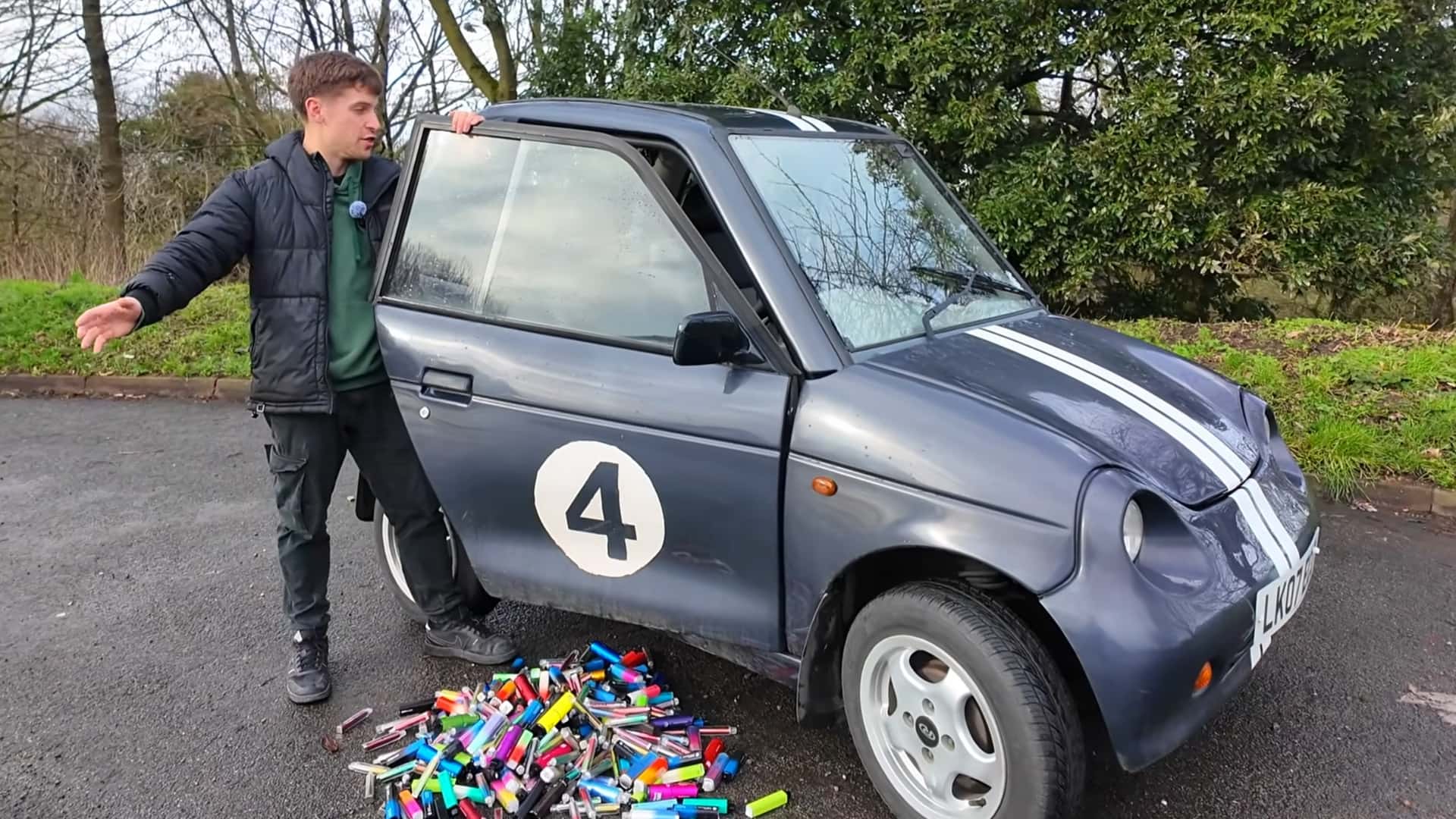


YouTuber Chris Doel ripped apart 500 disposable electronic cigarettes, extracted their lithium-ion cells, and built a battery pack that drives a car. Not a fast car. Not a long-range car. A 2001 Reva G-Wiz, Britain’s infamous electric microcar, now resurrected with the chemical leftovers of a nicotine habit.
The project sounds like a stunt. It is a stunt. But it’s a stunt with a sharp edge.
Millions of single-use vapes hit landfills every year with perfectly functional lithium-ion cells still inside. Doel’s experiment wasn’t about solving the EV range problem. It was about proving those cells have life left in them, and that tossing them is both wasteful and stupid.
He tested each of the 500 cells individually, discarding the dead ones and keeping the healthy. The survivors were fitted into 3D-printed enclosures he calls “modular rows.” Fourteen rows connected in series produced a 50-volt, 2.5-kilowatt-hour battery pack.
For context, a modern EV like a Tesla Model 3 runs on roughly 60 kWh. This pack is a rounding error by comparison.
But the G-Wiz wasn’t a modern EV. It originally ran on a 48-volt lead-acid setup, which makes the vape pack a surprisingly close voltage match. Plug it in, and the little car wakes up.
Doel didn’t cut corners on safety. Every cell got its own fuse. A battery management system prevents overcharging, and temperature sensors monitor the pack for thermal issues.
The finished product sits in an aluminum enclosure that looks more professional than you’d expect from a project born of salvaged nicotine delivery devices.
And here’s the kicker: the pack charges via USB-C. That likely makes this the world’s first USB-C-powered electric vehicle, a distinction nobody was chasing but everyone finds amusing.
Performance tells the real story of what 500 vape cells can and cannot do. The pack maxes out at 120 amps of output. The G-Wiz’s motor can request 300.
Floor the accelerator and the main breaker cuts power before anything dramatic happens. In normal driving, pulling a steady 100 amps, the car reached about 40 mph. The original topped out at 50.
Range came in at 18 miles on a full charge, well short of the original’s 50-mile claim. Nobody is going to commute on recycled vape batteries. That’s not the point.
The point is that an entire waste stream of lithium-ion cells is being buried in the ground because nobody has built the infrastructure or incentive to recover them. Each disposable vape contains a cell rated somewhere between 280 and 400 milliamp-hours. Individually, that’s nothing.
Multiplied by the tens of millions discarded annually, it’s a staggering amount of perfectly usable energy storage heading straight to landfill.
Doel’s project won’t scale. It’s labor-intensive, the cells are inconsistent, and regulatory frameworks for repurposing consumer electronics batteries barely exist. Critics are right about all of that.
But the G-Wiz rolling down a road on garbage batteries makes the waste problem visceral in a way that statistics never do. You can ignore a report about e-waste. You can’t ignore a car driving on 500 things people threw in the trash.
The real question this project raises isn’t whether vape batteries can power EVs. They obviously can’t, not meaningfully. The real question is why an industry that mines lithium from the earth at enormous environmental cost has no serious system for reclaiming the lithium already sitting in our landfills.
A YouTuber with a soldering iron and a 3D printer shouldn’t be the one making that argument. But here we are.

Share this Story