
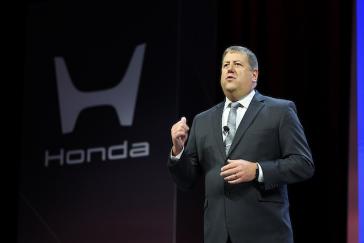


Honda just handed out 56 supplier awards at its annual conference in Columbus, Ohio, and the real story isn’t who won. It’s what the automaker quietly said about where its money is going.
Paul Dentinger, Honda’s senior vice president of purchasing and supply chain, used the kind of language executives choose very carefully. The company, he said, is “maximizing hybrid and gas-powered models.” Not pivoting. Not transitioning. Maximizing.
That single word tells you everything about Honda’s near-term product strategy. While rivals scramble to restructure around battery-electric platforms, Honda is pouring capital into the supplier relationships that keep internal combustion and hybrid lines humming. The numbers back it up: $35 billion in mass production parts purchased from North American suppliers in 2025 alone, feeding 13 plants that built more than 1.52 million vehicles.
Another $1.78 billion went to service parts, the less glamorous but deeply profitable pipeline that keeps 26 million Honda and Acura vehicles on U.S. roads running through dealer service bays. That aftermarket commitment is not an afterthought. It’s annuity income.
The supplier list reads like a map of Honda’s manufacturing DNA. Heavy concentration in Ohio, Kentucky, and Ontario, with a thick corridor running through Mexico’s Guanajuato, Querétaro, and San Luis Potosí states. Names like Astemo, DENSO, F&P Manufacturing, and Yazaki reflect decades-old keiretsu ties that Honda has transplanted onto North American soil.
Nearly 99 percent of Honda and Acura vehicles sold in the U.S. last year were built on this continent. That’s not a talking point. That’s a supply chain fortress.
The award categories reveal priorities. Quality and delivery dominated, with 30 of the 37 mass production winners recognized in that lane. Only five suppliers won for value, Honda’s polite term for cost reduction.
One supplier, UACJ Automotive Whitehall Industries, managed the trifecta of quality, delivery, and value. Gentherm, the thermal management specialist out of Novi, Michigan, took the sole sustainability award. One out of 37.
Honda’s cumulative investment in North American manufacturing now exceeds $25 billion, with $3.1 billion deployed in just the last five years. The company runs 18 plants with 33,000 associates and capacity for 1.6 million cars and nearly 2 million engines annually. Those are not the numbers of a company in retreat from combustion.
Dentinger’s remarks also carried an edge. He called on suppliers to “find new ways to improve cost competitiveness” and “speed up development time” in what he described as a “rapidly changing business environment.” Translation: margins are under pressure, the market is volatile, and Honda expects its partners to absorb some of that pain.
The 700 mass production suppliers and 1,600 service parts suppliers Honda works with in North America represent a cumulative $631 billion in parts purchases since the Marysville Auto Plant opened in 1982. That kind of institutional relationship doesn’t pivot overnight, and Honda clearly isn’t trying to.
Consumer demand for hybrids is surging. Battery costs remain stubborn. Charging infrastructure is uneven. Honda’s response is to lean harder into what sells today while keeping its EV timeline flexible.
The supplier awards aren’t just trophies. They’re signals to Wall Street, to competitors, and to the 56 companies that just got told they’re essential to a strategy that bets the combustion engine still has a long runway.
Honda started building cars in North America 43 years ago. It’s not about to let a narrative written in Silicon Valley rewrite its playbook in Marysville.

Share this Story